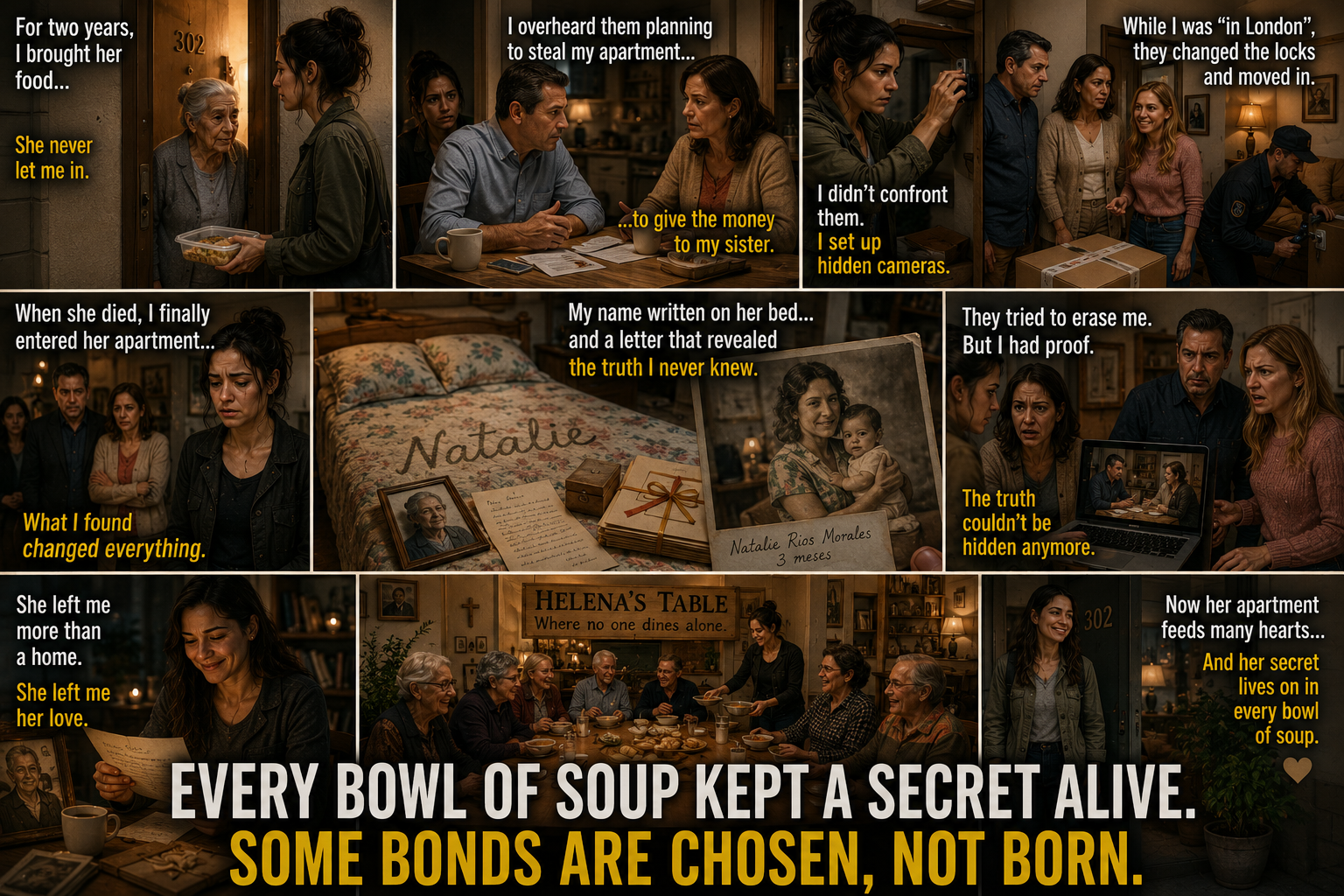
But in the corner of the photo, written in blue ink, was my full name.
It was me.
Not a little girl who looked like me.
Not a coincidence.
Me.
On the back of the photo, it said:
“Natalie Rios Morales. Three months old. Daughter of Raul. My granddaughter.”
The room tilted.
I had to sit on the edge of the bed to keep from falling. The manager asked if I was okay, but his voice reached me from far away, as if he were speaking from inside a bucket.
My granddaughter.
I read those two words once.
Then again.
Then a third time, hoping they would change.
They didn’t.
My name was Natalie Rios. I never used Morales. My mother, Carmen Rios, always told me that my father had left before I was old enough to remember him. She didn’t speak of him with hatred. She spoke with a closed-off sadness, like someone putting a lid on a pot so it wouldn’t boil over.
“Your father didn’t know how to stay,” she would say.
And I believed her.
Because children believe what they need to in order to sleep at night.
I opened the first envelope with trembling hands.
“My dear Natalie:
If you are reading this, I am already dead. Forgive me for not telling you this to your face. I was not a coward toward you. I was old, I was watched, and I was guilty.
I am Helena Morales. Raul Morales, your father, was my son.”
I felt my heart pounding against my ribs.
Raul.
That name rang a bell.
Not from my childhood.
From an old dream, from a word my mother once said while delirious with fever before she died:
“Raul did want to come back.”
I was twenty then and thought she was raving.
I kept reading.
“Your mother Carmen didn’t steal you. She saved you. When you were born, your father wanted to acknowledge you. My other children opposed it because your existence changed the inheritance. I was a foolish woman then. I believed that blood would never be capable of destroying blood.”
The apartment door burst open.
The elegant woman from the funeral walked in as if 302 belonged to her. Behind her came two men, a daughter-in-law with dark sunglasses, and the same scent of expensive perfume I had smelled at the funeral.
“What are you doing in my mother’s room?” the woman asked.
I squeezed the letter.
“She asked me to read this.”
Her gaze dropped to the envelopes tied with the red ribbon.
The color drained from her face.
“Give them to me.”
She didn’t ask.
She ordered.
The manager cleared his throat.
“Mrs. Rebecca, the family asked me to—”
“Shut up, Chuy,” she said. “You only open doors.”
Mr. Chuy lowered his gaze, ashamed.

I stood up.
“I’m not giving you anything.”

One of the men took a step toward me.
“Look, little girl, we don’t know what story you sold the old lady, but that belongs to the family.”
“My name is written on all of them.”
Rebecca let out a dry laugh.
“My mother was senile.”
The word set me on fire.
I thought of every label stuck to my containers. “Broth when I had a cough.” “Birthday pastry.” “Rice pudding. Last one.”
A senile woman doesn’t hoard love with a date attached.
An abandoned woman does.
“If she was senile, why were you coming for white envelopes?” I asked.
Rebecca went still.
The daughter-in-law muttered, “Don’t talk nonsense, Rebe. Let’s go for the important stuff.”
The important stuff.
They looked at the wooden box, the golden key, the photo.
They didn’t look at the gray sweater hanging on the chair.
They didn’t look at her slippers by the bed.
They didn’t look at Mrs. Helena’s life.
Only what they could carry.
Rebecca tried to snatch the letter from me. I stepped back and bumped into the nightstand. The little box fell to the floor and opened.
Inside was a USB drive, a Virgin of Guadalupe medal, and a second photo.
In that photo was my mother, younger, holding me next to a man with light eyes and a tired smile.
On the back:
“Carmen, Raul, and Natalie. Griffith Park. 1990.”
The air left my lungs.
The man was my father.
He had my mouth.
The same small mole by his left eye.
Rebecca saw the photo and lunged for the floor.
“Give it to me!”
Mr. Chuy stopped her.
“That’s enough, ma’am.”
She spun toward him in a fury.
“My mother had no right to keep this!”
I lifted my face.
“Why?”
The room went ice-cold.
Rebecca gritted her teeth.
“Because that story ended thirty years ago.”
“For me, it’s just beginning.”
The other man, perhaps her brother, finally spoke.
“Natalie, you don’t know what you’re stirring up. Our mother was already unwell. She made things up. She said you were her granddaughter because you brought her soup.”
“No,” I said. “She only let me to the door because she was afraid of you.”
Rebecca laughed.
“Of us? Please.”
Then I remembered the USB drive.
I took it before anyone could react and shoved it into my bag.
“Let’s see what’s on it with a lawyer.”
That changed their faces.
Rebecca no longer looked like an offended daughter.
She looked like someone trapped.
“You aren’t leaving here with anything.”
The manager took out his phone.
“I already called Mr. Valdes. Mrs. Helena left instructions.”
Rebecca turned as if she’d been bitten.
“What lawyer?”
Mr. Chuy lifted his chin for the first time.
“The notary. And I also called a patrol car. I’m not losing my job just because you want to empty an apartment before reading a will.”
The silence that followed tasted like fear.
I sat by the bed with the letters on my lap. While we waited, I opened another envelope.
“Raul didn’t abandon Carmen. They killed him slowly with lies. They made him believe I had disowned him for being with a poor girl. They told me Carmen had run off with someone else and that you weren’t his.
By the time I finally knew the truth, it was too late.
Raul died in an accident on Sunset Boulevard. Officially. But a mother knows when death gets a little push.”
I felt nauseous.
I remembered every time I passed by the subway station, by that transit line that roars under the avenue, never knowing that nearby, the history I was missing had been shattered.
I read with a tight throat.
“Carmen fled with you because Rebecca and Ernesto threatened her. They told her that if she tried to claim anything, they would take you away. Your mother preferred to be poor with you than rich without you. That is why I respect her more than anyone of my own blood.”
My tears fell onto the paper.
My mom.
My mom who sold gelatins outside a middle school. My mom who walked with me to the farmers market to buy overripe fruit cheaper at the end of the day. My mom who told me, “We don’t have much, but we don’t owe our souls to anyone.”
She wasn’t an abandoned woman.
She was a woman in hiding.
To save me.
Mr. Valdes arrived half an hour later, with a rumpled suit and a black folder. Two police officers followed. They made no scene. They just stood at the entrance, looking at Helena’s family with a seriousness that finally knocked them off their thrones.
The notary looked at me.
“Are you Natalie Rios?”
I nodded.
“Mrs. Helena asked me to hand this to you only if you entered the apartment voluntarily after her death. If you never entered, everything was to be placed in a trust for an elderly day center.”
Rebecca exploded.
“That’s absurd! I am her daughter!”
The lawyer looked at her over his glasses.
“Which is precisely why you aren’t in the will.”
The daughter-in-law let out a gasp.
Ernesto, the silent brother, slumped into a chair.
Rebecca approached the notary.
“My mother was manipulated.”
“Your mother recorded three videos in my office, underwent a medical evaluation, and signed every document with full capacity.”
The lawyer opened the folder and pulled out a sheet.
“She also documented the withdrawals you demanded. The white envelopes. The threats to put her in a home. The attempts to sell this apartment without her consent.”
Mr. Chuy murmured, “Blessed woman.”
Rebecca looked at me with hatred.
“What do you want? Money? The apartment? A grandmother’s fantasy?”
I looked at her.
Suddenly, I saw in her the face of everyone who had ignored the brown door for years. The neighbors who didn’t ask. The children who only came for envelopes. The entire city walking fast while an old woman counted containers so she wouldn’t forget that someone loved her.
“I want the truth,” I said.
The notary plugged the USB drive into an old laptop Mrs. Helena kept in the living room.
The video started.
Mrs. Helena appeared sitting in her chair by the window. She looked thinner than ever, in her gray sweater with her hands clasped.
“Natalie,” she said on the screen, “if you’re seeing this, I’ve finally managed to open the door for you.”
I had to cover my mouth.
Her voice filled the apartment.
“I recognized you the first day I saw you on the stairs. Not by your face, although you have Raul’s mouth. I recognized you by your full name on a receipt you dropped: Natalie Rios. And because your mother, Carmen, before she went into hiding, sent me one single letter. It said: ‘If one day you find her, don’t take away her peace if you cannot give her love.’”
Mrs. Helena breathed with difficulty.
“I couldn’t give you peace while my children were still prowling around. That’s why I didn’t let you in. The proof was here. If they saw you inside, they would understand who you were. And I still had to finish this.”
On the screen, she lifted one of my containers.
“Every plate you brought me gave me another day. Another day to write. Another day to remember. Another day to put your name where it should have been all along.”
Rebecca slammed the laptop shut.
“Enough!”
The officer took a step forward.
“Ma’am.”
“I’m not listening to any more lies!”
I stood up.
“I am.”
I turned it back on.
Mrs. Helena continued speaking from the grave.
“I am not leaving you this apartment as payment. Love is not paid for. I leave it to you because you are my granddaughter and because this house was already waiting for you before you even knew it. But if you don’t want to live here, do something good with it. Let no one else dine alone if we can prevent it.”
I wept like a child.
Without shame.
Without strength.
The notary placed a hand on my shoulder.
“There are more documents. A pending recognition of paternity, evidence, photographs, letters from your mother. Mrs. Helena knew this wouldn’t be easy, but she left everything in order.”
Rebecca stormed out.
Before crossing the door, she turned to me.
“Don’t think this makes you family.”
I looked at her with wet eyes.
“No. Two years of soup did that.”
She didn’t answer.
The following months were filled with paperwork, lines, copies, signatures, and pains I didn’t know where to store. The justice system moves slowly, with stamps, machine coffee, and windows where a copy is always missing. But it moved.
The will was validated. An investigation was opened for financial abuse against Mrs. Helena. My father’s story was harder: many papers had disappeared, many witnesses had died, many silences had turned to stone. But at least his name returned to the table.
Raul Morales.
My father.
Not the man who didn’t know how to stay.
The man they didn’t let come back.
One afternoon, I went to the cemetery where my mother was. I brought her flowers from the Portales market—simple daisies, because she used to say roses were too pretentious.
“I know, Mom,” I said in front of her grave. “I know you didn’t abandon me to a lie. You hid me from one.”
The wind moved the dry leaves.
I cried, but not as an orphan.
As the daughter of two brave women.
I didn’t move into 302.
I couldn’t.
Mrs. Helena’s apartment was too much her. Her mugs, her curtains, her chair by the window. But I didn’t sell it, either.
I opened the windows.
I washed the tablecloths.
I painted the brown door.
With the help of Mr. Chuy and two neighbors who finally remembered that Mrs. Helena had existed, we turned the place into a small community table for the elderly in the building and the block.
It wasn’t an elegant foundation.
There were no plaques or speeches.
Just a long table, mismatched chairs, spiced coffee, noodle soup on Tuesdays, rice pudding when it rained, and warm bread from the market on Saturdays.
I put a hand-written sign by the door:
“Helena’s Table.”
On the first night, three people arrived.
Mrs. Cecilia from 201, who pretended she didn’t need anyone.
Mr. Ramiro from 105, a stubborn widower.
And a lady from the next street over who said she only came “to look,” but ate two bowls.
I served the soup in silence.
Before sitting down, I placed a small bowl in front of the chair by the window.
Mr. Chuy asked me, “Who is that for?”
I looked at Mrs. Helena’s chair.
“For the one who opened the door for us.”
Over time, the containers she had kept were used again. The one for “broth when I had a cough” served a neighbor with the flu. The “birthday pastry” one held rolls for an eighty-year-old man. The “Rice pudding. Last one” one, I kept on a shelf.
I didn’t touch that one.
Some things deserve to remain as an altar.
One night, while locking up 302, I found another envelope behind the dried-up potted plant by the mat. It had my name and a phrase:
“For when it no longer hurts to enter.”
I opened it carefully.
Inside was one last note.
“My dear girl:
Forgive me for loving you from a crack in the door. It was the only thing I could do at first. But you gave me food without knowing who I was. That is worth more than blood.
Blood explains where we come from. Care decides where we belong.
Thank you for not letting me dine alone.
Your grandmother,
Helena.”
I sat in the hallway and wept with my back against the brown door.
Down below, along the main avenue, the subway passed with its usual thunder. In the building, someone put on an old bolero. On the street, a vendor yelled about Oaxacan tamales as if life hadn’t changed.
But it had changed.
I was no longer just Natalie Rios, the stationery store woman who climbed stairs with soup in a container.
I was Natalie Rios Morales.
Granddaughter of Helena.
Daughter of Carmen.
Daughter of Raul.
And guardian of a table where no one, as long as I could prevent it, would ever eat again while staring at a closed door.
