
When I heard Ray’s voice, I felt the apartment shrink around me. Lucy stood right across from me, pale, her fingers clutching the strap of her purse as if the weight of her world depended on it.
“What did you say?” I asked.
On the other end of the line, a silence heavy with years stretched out. “Don’t sign anything tomorrow, Patricia. Not until you know the whole truth.”
I laughed, but not because it was funny. I laughed the way a woman does when she has already cried far too much. “The truth? Now you want to talk to me about truths, Ray? Three months without answering my texts. Three months without seeing your daughters except on video calls whenever you happened to remember.” “It wasn’t like that.” “Then how was it?”
Lucy lowered her gaze. And that was when I understood the worst part: she already knew. “Patty…” she whispered.
I raised my hand to stop her from speaking. “Ray, if you have something to say, say it now.”

I heard a noise in the background. Like traffic. Like the city swallowing someone up on a wet boulevard. “I’m downstairs.”
I froze. I peeked through the window of my cousin’s apartment, on a third floor with no elevator, clotheslines hanging between buildings, and the scent of chicken soup escaping a neighboring kitchen.
Down on the sidewalk, right next to a food truck that still had steam rising under its yellow lightbulb, stood Ray. Thinner. With several days of beard growth. Holding his phone tightly against his ear. He didn’t look like the confident man who once told me we couldn’t carry other people’s problems. He looked like a man whose home had crumbled inside him.
“Come up,” I said. I hung up.



“How long have you known?” I asked her. Lucy swallowed hard. “For six months.”
Six months. The words cut through me like a slap. “And you didn’t tell me?” “He asked me for time.” “He asked you for time? And you gave it to him?” Her lip trembled. “It wasn’t my secret to tell, Patty.”
I was about to say something cruel to her. Something she didn’t deserve. But there was a knock at the door.
Ray walked in without looking me in the eye. He carried a black legal folder under his arm, and his shirt was wrinkled. The man who used to come home smelling of cologne and the office now smelled of the subway, rain, and exhaustion.
“Hey,” he said. Nobody answered. Lucy stood up. “I’ll go make some coffee.” “No,” I said. “You stay.”
Ray closed the door slowly. For a few seconds, the only sound was the rain beating against the metal awning of the small courtyard. Outside on the street, a vendor passed by shouting, and that everyday normalcy felt like an insult.
“Talk,” I ordered him.
Ray placed the folder on the table. “When we sold the house, I knew we weren’t going to get it back.” “What a brilliant discovery.” He clenched his jaw. “Let me finish, please.”
I crossed my arms. “The buyer was a middleman. A guy from a real estate development firm who was buying up several houses in Oak Park to tear them down and build condos. The real estate attorney told me afterward, once we had already signed. They didn’t care about our house. Only the land.”
I felt a sharp stab in my chest. Our house. The skinny tree on the sidewalk. The walls scribbled on by the girls. The kitchen where Lucy cried with her pregnancy test. All reduced to ‘land.’ “And what does Lucy have to do with this?”



Ray took a deep breath. “I tried to buy it back.” “With what money?” “With the only thing I had left.”
He opened the folder. Inside were bank statements, contracts, receipts, copies of checks. Papers with official stamps. Papers I didn’t understand at first because rage blurred my vision.



Lucy spoke quietly. “He sold his shares in a company.” I looked at him. “What company?”
Ray closed his eyes. “The one in Boston. The one where they offered to bring me in as a partner when Sophie was in treatment.”
I remembered that time the way one remembers a fire: in fragments. The Children’s Hospital. The cold hallways. Tired mothers carrying backpacks full of snacks, extra sweaters, and faith. Sophie in a little pink beanie, asking me if her smile was going to fall out, too. Ray answering calls outside, always outside, his face always tense.
I thought he was hiding from the pain. Maybe he was, too. But not just from that. “That company was your dream,” I said. “Not more than Sophie.”
The sentence disarmed me a little, and that made me angry. “Why didn’t you tell me?” “Because it wasn’t enough. Because every time I scraped some money together, another bill appeared. Medicines, tests, interest, loans. And then… then I made a mistake.”
There it was. I felt it before I even heard it. Lucy pressed her lips together. “What mistake?”
Ray finally looked at me. “I asked my brother for money.”
I stood perfectly still. His brother, Ethan. The same one who didn’t visit the hospital a single time. The same one who sent a text during Sophie’s chemo saying, “God works in mysterious ways.” The same one who always smiled like a car salesman even though he didn’t sell cars.
“No,” I said. Ray lowered his head. “Yes.” I brought a hand to my chest. “Ray…”
“He told me he could help me buy back the house before they demolished it. That he had connections. That he just needed me to sign some power of attorney forms to move the paperwork along quickly. I was desperate.” “What did you sign?”
He didn’t answer. Lucy did. “He signed a conditional assignment. If he didn’t pay within a certain timeframe, Ethan would get the right to purchase the property.”
My stomach churned. “And that’s why you disappeared?” Ray shook his head. “I disappeared because I was a coward. Because when I realized Ethan had used me, I didn’t know how to look you in the face.”
I wanted to scream at him. To tell him that I had watched our daughter vomit blood into a basin without ever stopping her smile for him. That I had signed away our life without breaking down in front of anyone. That I never had the luxury of disappearing.
But then the bedroom door opened. Sophie appeared, barefoot. She was eleven years old now. Her hair had grown out, dark and strong, though you could still see a tiny scar near her neck where a central line left a mark I used to kiss when she slept.
“Dad?”
Ray broke down. Not like before. This time he shattered completely. Sophie walked toward him. She didn’t run. She didn’t fling herself. She just approached with that terrible caution of children who have learned that adults fail, too.
“Why are you crying?” she asked. Ray knelt in front of her. “Because I missed you so much, my sweet girl.” Sophie looked at him seriously. “Then don’t leave so much.”
That was it. Five words. Ray covered his face, and I had to look away because I hated pitying him.
The next day, we went to the attorney’s office. The city woke up washed clean. Out on the main avenue, vendors were opening their awnings, and the subway trains were rushing people through Oak Park. The air smelled of sweet pastries, gasoline, and wet earth—that specific scent of the city after a storm that seems to promise everything can start over, even if it’s a lie.
Lucy sat with me in the backseat of the cab. Her hair was tied up with a purple scrunchie, just like the day she arrived at my house. Her shoes matched this time, but one had a broken lace.
“You never change,” I told her, looking at her foot. She smiled a little. “I match seasonally.” I couldn’t help but laugh. Ray sat in the front, quiet.
The attorney’s office was located downtown, in a building with cold marble and plants that looked more expensive than my entire living room. Ethan was waiting for us there. He wore a blue blazer, a shiny watch, and that smile of a man who believes life is a deal where the person who reads the fine print better always wins.
“Patty,” he said, stepping forward to kiss my cheek. I took a step back. His smile froze. “I see you all are tense. No need. Everything is in order.” “We’ll see about that,” Lucy said.
Ethan looked at her the way one looks at a stain on a shirt. “And you are?” Lucy lifted her chin. “The pregnant teenager your family said was going to ruin a home. Nice to meet you.”
Ray almost smiled. I didn’t. The real estate attorney received us in a room with a long table. There were folders prepared, copies of IDs, receipts, stamps. Everything smelled of ink and threats.
Ethan spoke first. “My brother failed to make the payments. I covered part of the down payment. Legally, the right of first refusal belongs to me. The most sensible thing is for you to sign a waiver today and we avoid any legal battles.” “A waiver?” I asked. “Patricia, it’s not in your best interest to get involved in this. You don’t have the resources to fight.”
That sentence brought back an ancient strength in me. The same one that sustained me in oncology when they told me “we have to wait.” The same one that made me sell my car, my wedding earrings, and my bed if necessary. The same one that made me say “Lucy is staying” when everyone else said no.
“You have no idea how many resources I have,” I said. Ethan let out a tiny chuckle.
Lucy opened her torn backpack. Yes, the exact same one. She still used it even though I had gifted her two new bags. She pulled out a USB drive, a notebook with old stickers, and a green folder.
“Before we continue,” she said, “I want the attorney to look at this.” Ethan frowned. “What is that?” “Your rush.”
Lucy placed the folder in front of the attorney. “When Ray told me what he had signed, I reviewed everything. I’m not a lawyer, but I studied business administration and I work with contracts at the coffee shop where I manage accounts. Something was off: Ethan deposited the down payment from a development company’s account, not from a personal account. And that development company belongs to the exact same person who originally bought the house.”
Ethan lost his color for just a single second. But I saw it. Lucy did, too. “That doesn’t prove anything,” he said. “No. That’s why I went to the City Register’s office with a friend from school. And I requested copies. And then I found out that the power of attorney Ray signed was used to transfer a purchase agreement without notifying Patricia, even though the house was marital property.”
The attorney looked up. Ray looked at me. I felt the floor tilt. “What does that mean?” I asked. Lucy swallowed hard. “It means they couldn’t do any of this without you.”
Ethan slammed his palm on the table. “This brat has no idea what she’s talking about!” The attorney’s face hardened. “Sir, I need you to calm down.” “No, sir, what’s happening is they’re putting on a sentimental theater performance. My brother is useless, my sister-in-law is dramatic, and this girl…”
He didn’t finish. Because Lucy pulled out her phone and played a recording. Ethan’s voice filled the room.
“As long as Patricia doesn’t find out, we move forward. Ray is too deeply buried to review anything. The old house gets sold in three months and we split the profit.”
I felt my blood boil. Ray stood up. “You son of a—” “You sit down!” I screamed.
Ray froze. I was not going to let the truth be muddied with a fistfight. Ethan stared at the phone as if it were a viper. “That’s illegal.”
Lucy looked at him without blinking. “Not more illegal than using your brother’s signature to rob his daughters of the last piece of home they had left.”
The silence fell heavy. The attorney asked to review everything. He made calls. He requested documents. Ethan tried to leave, but Ray planted himself at the door. There were no blows. Just the truth blocking a coward’s way out.
Hours later, we walked out with a different agreement. The fraudulent transaction would be halted. Ethan would have to surrender the purchase right or face a lawsuit that no longer looked like a threat, but a certainty. The development company would agree to sell the house back for the outstanding amount because nobody wanted a legal battle involving recorded calls, misused powers of attorney, and a mother willing to fight to the bitter end.
But we were short on money. We were always short on money. I stood on the sidewalk, in front of a juice stand, clutching the folder against my chest. “I can’t do it,” I said.
Ray approached. “I can cover part of it.” “With what?” “With what’s left from selling my shares. And with my severance package.” I looked at him. “You lost your job?” He nodded. “Two months ago.”
The rage wanted to return, but it arrived exhausted. “Why didn’t you tell me?” “Because I was still learning how not to run away.”
Lucy cleared her throat. “I have another part.” I turned to her. “No.” “Patty…” “No, Lucy. You have a son.” “And I had a home when nobody owed me one.”
I was left speechless. She opened her notebook of stickers. Among drawings of unicorns, crooked calculations, and poorly written motivational phrases, there was a list. Years of savings. Tips. Double shifts. Course payments. Money kept in envelopes with labels: “Matthew school,” “emergencies,” “Patty’s house.”
My eyes filled with tears. “Since when?” “Since you sold the house. I heard you when you cried in the bathroom the night of the move. You said, ‘Forgive me, house.’ As if the house were a person.”
I remembered that night. I thought no one had heard me. “I couldn’t give you back what you did for me,” she said. “But I could protect a little piece of it.”
I hugged her right there on the sidewalk. People passed around us without looking too closely, because in this city, you learn to respect other people’s breakdowns. A street vendor passed by, a delivery guy honked his scooter horn, and the world kept moving, though mine had just completely changed.
Three months later, we returned to Oak Park. The house was wounded. The paint was peeling. The yard had turned into hard dirt. The front door was marked by moisture. The skinny tree on the sidewalk was taller, more stubborn, as if it had decided to wait it out.
My daughters went in first. Valerie touched the wall where we used to measure their heights with a pencil. “I’m still here,” she said, as if talking to an old friend.
Matthew ran out to the yard. “Mom, my toy cars fit here!” Lucy followed him, laughing. Sophie stayed with me at the entrance. “Is it ours again?”
I looked at Ray. He didn’t answer for me. I liked that. “Yes,” I said. “But it’s not the same.” Sophie wrinkled her nose. “Why?” “Because we aren’t the same either.”
That afternoon, there wasn’t enough furniture. We ate grilled cheese sandwiches on paper plates, sitting on the living room floor. Lucy burned two, out of tradition, according to her. My daughters put music on from a phone and danced between boxes.
Ray washed dishes without anyone asking him to. I watched him from the kitchen. I hadn’t forgiven him yet. Forgiveness isn’t a door that flings open all at once. Sometimes it’s just a tiny crack. Sometimes it’s just choosing not to turn the lock.
When Thanksgiving arrived, we set up a beautiful table in the living room. Sophie insisted on lining up autumn leaves from the front door all the way to the table, “so no one gets lost.” Lucy bought festive decorations at the local market and apple pie dusted with sugar. Matthew placed a little red toy car on a shelf “in case anyone wanted a ride.” Valerie set up photos of my dad and of the dog they had colored with markers years ago.
I lit a candle for the woman I was before the hospital. She wasn’t dead, but it was time to say goodbye to her.
Ray arrived at dusk with apple cider. “They were selling it downtown,” he said, unsure. “I don’t know if it’s good.” Lucy took it from him. “It’s good. Around here, everything offered with love finds a place.”
She said it as if she were talking about herself. And maybe she was.
Later, when the girls went upstairs, I found Lucy in the kitchen. She was sitting next to the refrigerator, just like that night years ago. But this time, she wasn’t crying. She held a letter in her hands.
“What is that?” I asked. She handed it to me. It was for me. The handwriting was crooked, filled with cross-outs.
“Patty: If you ever doubt what you did for me, remember this. You didn’t just save a pregnant teenager. You saved Matthew. You saved the woman I was able to become. And without knowing it, you saved the house where one day we were all going to return. Family isn’t always born together. Sometimes it rings the doorbell late, disheveled, and wearing two different shoes.”
I couldn’t finish reading it without crying. “You’re ungrateful,” I told her, wiping my face. Lucy opened her eyes wide. “What?” “You’re making me cry in my own kitchen.”
She laughed. Then she hugged me. And in that hug, I understood something it took me years to learn: I had lost a house to save my daughter, yes. But life, which is sometimes cruel and sometimes has the hands of a distracted girl, had returned it to me full of voices.
Ray didn’t come to the bedroom that night. He stayed on the couch, just like at the beginning, but this time not as a punishment. Out of respect.
Before going to sleep, I went downstairs for a glass of water. The warm ambient lights were still on. The house smelled of cider, chocolate, and pie. In the living room, Lucy was asleep with Matthew resting against her legs. Sophie had stayed right next to them, hugging the teddy bear with the little blue bow. Valerie and my middle daughter were breathing in unison, tangled under a big blanket.
Ray was awake. He looked at me without demanding a thing. I liked that, too. I sat down next to him. I didn’t take his hand. But I didn’t leave either.
Outside in the neighborhood, a distant train passed like a subterranean thunderclap. The city kept moving beneath our feet—enormous, broken, alive.
And I, for the first time in a very long time, stopped counting what I had lost. I began to look at what had stayed………
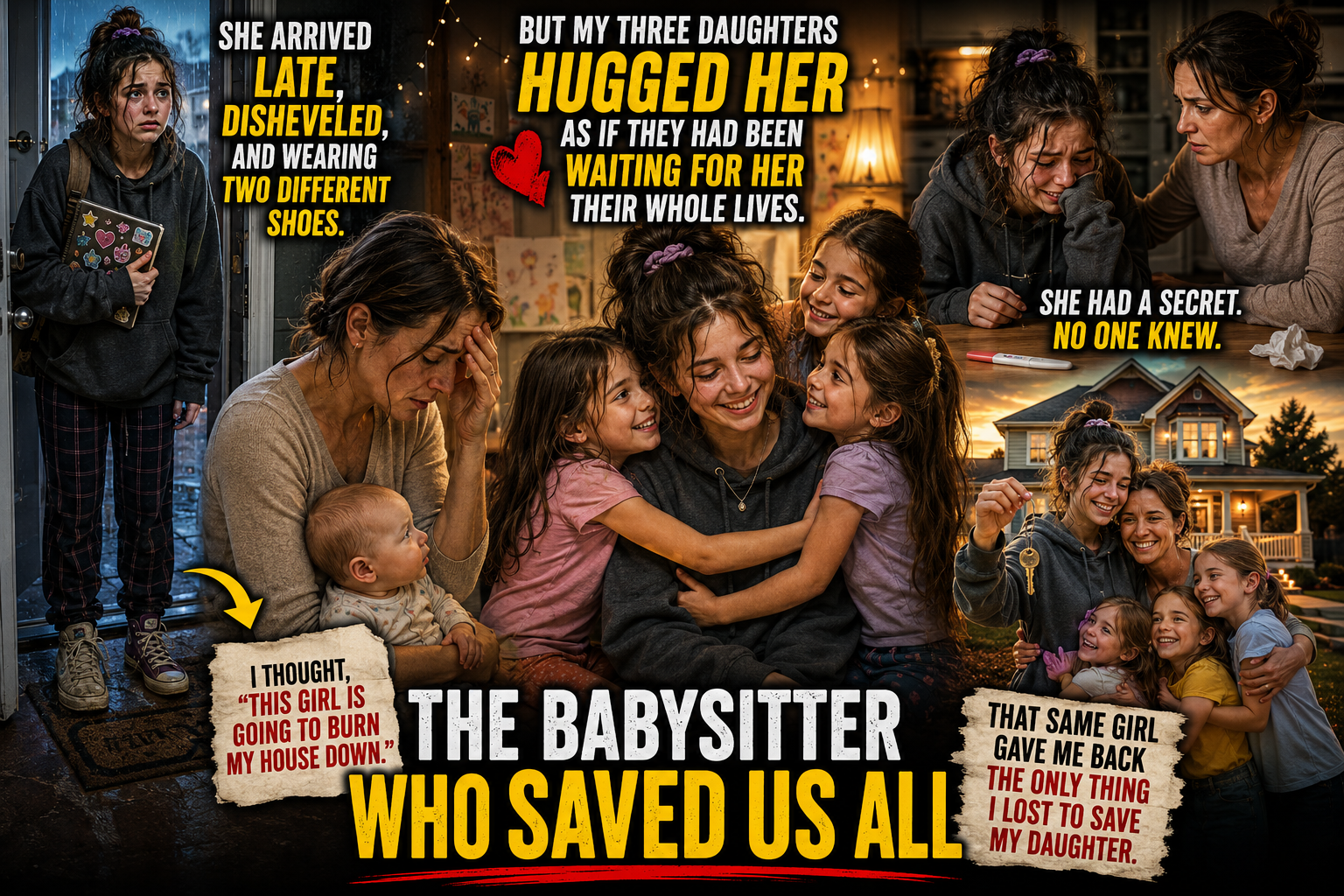
EPISODE1: I hired a 16-year-old babysitter, and on her first day, she arrived late, disheveled, and wearing two different shoes. I thought, “This girl is going to burn my house down.” But my three daughters hugged her as if they had been waiting for her their whole lives…

Part 1 — “The House Breathes Again”
The first morning in the house felt strangely quiet.
Not silent.
Never silent.
There were still footsteps upstairs, cabinet doors slamming too hard, Matthew making engine noises with toy cars across the hallway floor, and Sophie singing badly in the bathroom because she believed nobody could hear her through the pipes.
But the panic was gone.
For the first time in years, the panic was gone.
Patty stood alone in the kitchen wearing old socks against the cold floorboards while pale sunlight slipped through the curtains. The house still smelled faintly like fresh paint and damp wood from repairs, mixed with cinnamon from the cheap candles Valerie insisted made the place “feel emotionally healed.”
Patty smiled at that.
Emotionally healed.
As if healing were something you could buy in glass jars near supermarket checkout lines.
Behind her came the sound of something burning.
Then coughing.
Then Lucy’s voice:
“Oh no. Oh, no no no—Matthew, don’t blow on it! You’re making the fire ambitious!”
Patty closed her eyes.|
There she was.
She walked toward the stove and found Lucy waving a dish towel dramatically at a frying pan while Matthew stood on a chair cheering like he was watching live sports.
“It’s under control,” Lucy announced.
The smoke detector answered immediately.
Patty reached up and shut it off.
Ray entered the kitchen at the exact wrong moment carrying a toolbox. He stared at the smoke hanging near the ceiling.
“We’ve been back three days,” he said carefully. “Three.”
Lucy pointed a spatula at him defensively.
“In my defense, grilled cheese is emotionally complicated.”
Matthew nodded seriously.
“It’s true.”
Patty laughed before she could stop herself.
Real laughter.
It startled everyone.
Even her.

Lucy looked over at her with surprise, then smiled slowly. Not the nervous smile she used to wear years ago when she first arrived pregnant and terrified. This smile was softer now. Safer.
Different.
Patty noticed that difference more and more lately.
Lucy’s hair was tied back neatly.
Her sweater actually matched her shoes.
Her notebook sat open on the counter with organized handwriting and color-coded tabs.
No stickers.
No chaos.
Somehow, that made Patty unexpectedly sad.
“You’re staring,” Lucy said.
Patty blinked.
“I’m wondering when you became an adult.”
Lucy groaned dramatically.
“Please don’t say things like that before breakfast. I still make financial decisions based on whether a menu has pictures.”
Ray hid a smile while opening his toolbox near the sink.


The faucet had been leaking since they moved back in, and he’d spent most of the last week fixing things around the house without being asked:
- loose cabinet handles,
- broken porch lights,
- warped doors,
- cracked shelves.
Quiet repairs.

As if rebuilding the house with his hands was easier than rebuilding the family with words.
Sometimes Patty caught him looking at her like he wanted to say something important.


Usually he didn’t.
And strangely…
she preferred that.
Upstairs came sudden screaming.
Then pounding footsteps.
Then Valerie yelling:
“THAT IS MY SWEATER!”
Followed immediately by Sophie shouting:
“THEN STOP LEAVING IT IN MY ROOM!”
Lucy took a sip of coffee.
“They sound healthy.”
“They sound feral,” Patty answered.
“Healthy can look feral in groups.”
Matthew slid off the chair and raced toward the stairs wearing one sock.
“NO RUNNING!” three adults shouted at once.
He kept running.
Ray sighed deeply.
“Definitely family.”
The words landed softly in the room.
Nobody spoke afterward.
Because not long ago, saying the word family had felt fragile.
Temporary.
Like something life could still take away.
Patty turned back toward the stove. The grilled cheese sandwiches were blackened beyond recognition.
Lucy squinted at them.
“I may have overcommitted.”
“You carbonized bread,” Ray corrected.
Lucy gasped.
“Wow. That sounded personal.”
Patty shook her head, smiling despite herself, and reached for another loaf of bread.
“Move over,” she said.
Lucy obeyed immediately, bumping Patty lightly with her shoulder as they traded places in front of the stove.
It was such a small thing.
So ordinary.
But Patty suddenly remembered another kitchen.
Another night.
Another version of Lucy sitting beside a refrigerator crying with a pregnancy test hidden in her sleeve.
Back then Lucy looked like someone waiting for life to abandon her.
Now she looked like someone life had finally allowed to breathe.
That realization tightened something painfully inside Patty’s chest.
Outside the kitchen window, Oak Park slowly woke beneath pale autumn sunlight. A delivery truck rumbled down the street. Someone walked a barking dog past the skinny tree in front of the house. Wind carried the smell of wet pavement and distant coffee shops through the cracked screen door.
Life moving forward.
Always forward.
Patty suddenly hated that about life.
Lucy placed fresh cheese onto new bread slices beside her.
“You know,” she said casually, “Matthew told his teacher yesterday that Grandpa Ray used to fight kitchen fires professionally.”
Ray looked horrified.
“What?”
Lucy nodded solemnly.
“He also said Sophie survived cancer because she’s ‘too mean to die.’”
From upstairs Sophie screamed:
“I HEARD THAT!”
Matthew screamed back:
“GOOD!”
Patty laughed again.
And this time, everybody joined her.
Part 2 — “The Wall With Pencil Marks”
By afternoon, the house smelled like sawdust, tomato soup, and wet laundry.
Patty stood in the hallway holding a cardboard box labeled:
WINTER CLOTHES / MAYBE KEEP
She had learned over the years that “maybe keep” really meant:
I’m not emotionally prepared to throw this away yet.
The hallway walls still carried faint marks from where furniture once scraped against them during the move-out. Some patches had been painted over badly by the developers before the sale collapsed. Other places still showed water stains shaped like crooked countries.
The house was healing.
Slowly.
Like all wounded things did.
From upstairs came music blasting through Valerie’s bedroom door.
Lucy walked past carrying folded towels balanced dangerously high against her chest.
“Teenager music?” she asked.
Patty listened carefully.
“It sounds like somebody processing emotional damage while yelling.”
Lucy nodded.
“So yes. Teenager music.”
They passed the dining room where Ray knelt beside a broken chair tightening screws carefully. Matthew sat beside him pretending to help with a plastic toy hammer.
“You’re holding it backwards,” Ray told him.
“I’m emotionally supporting the project,” Matthew replied.
Lucy nearly dropped the towels laughing.
Patty watched them quietly.
Months ago, scenes like this would have shattered her heart because they felt impossible.
Now they frightened her for a different reason:
they felt normal.
And Patty no longer trusted normal things to stay.
Lucy disappeared upstairs toward the laundry room while Patty carried the box down the hallway toward the living room.
Then she stopped.
The wall beside the staircase.
The pencil marks were still there.
Tiny uneven lines climbing upward year after year.
VALERIE — AGE 6
SOPHIE — AGE 4
EMMA — AGE 3
Then later:
VALERIE — AGE 10
SOPHIE — AFTER CHEMO
Patty’s chest tightened instantly.
That one nearly destroyed her.
After chemo.
Not even an age.
Just survival.
She touched the faded pencil mark softly with her fingertips.
Behind her came Lucy’s voice.
“You kept them.”
Patty looked back.
Lucy stood halfway down the stairs now, quieter than before, holding only one towel against her chest.
“Of course I kept them.”
Lucy smiled faintly.
“My parents painted over mine.”
The sentence entered the room gently.
Which somehow made it hurt more.
Patty turned fully toward her.
“You had height marks?”
Lucy nodded once.
“In the laundry room.”
A small laugh escaped her.
“My dad said measuring kids on walls was ‘cheap people behavior.’”
Patty stared at her.
Some wounds were so old Lucy told them like jokes now.
That scared Patty sometimes.
How easily people learned to survive cruelty.
Lucy walked down slowly and crouched beside the wall.
“There,” she said suddenly, pointing lower.
“That one was the day Sophie made me watch Frozen four times in a row.”
From upstairs Sophie yelled:
“It was art appreciation!”
Lucy shouted back:
“It was psychological warfare!”
Matthew burst into laughter despite not understanding any part of the conversation.
Ray looked up from the chair, smiling quietly.
Patty watched all of them:
- Lucy kneeling by the wall,
- Matthew laughing,
- Ray fixing something broken,
- the girls screaming upstairs.
And suddenly she realized something strange.
The house no longer looked like the one she fought so hard to recover.
It looked lived in differently now.
As if everyone had left fingerprints on it.
As if the walls themselves had changed shape around their grief.
Lucy stood again.
“We should add Matthew.”
Patty blinked.
“What?”
“The wall,” Lucy said softly.
“He grew almost two inches this year.”
Matthew immediately ran over excitedly.
“I WANNA BE TALL!”
“You already scream at professional volume,” Ray muttered.
Lucy grabbed a pencil from the kitchen drawer while Matthew pressed himself dramatically against the wall like someone posing for an important historical portrait.
“Stand straight,” Lucy instructed.
“I am.”
“You’re leaning emotionally.”
Patty laughed softly again.
Lucy carefully made the mark.
MATTHEW — AGE 5
Then Matthew pointed upward at Sophie’s old chemo mark.
“Why’s Sophie’s name sad?”
The room went still.
Children had a terrifying ability to step directly onto hidden bruises.
Sophie appeared halfway down the stairs holding a sweater.
“It’s not sad.”
Matthew looked confused.
“But everybody got quiet.”
Sophie walked down slowly until she stood beside him at the wall.
“When I got really sick,” she said carefully, “Mom thought I might stop growing.”
Patty felt her throat tighten instantly.
“But I didn’t,” Sophie continued.
“So Mom measured me after the hospital because she was happy.”
Matthew considered this deeply.
Then he nodded.
“Oh.”
And just like that—
he accepted it.
Children were miraculous that way too.
Lucy looked at Sophie with watery eyes.
Sophie noticed immediately.
“Why are YOU crying?”
Lucy wiped under her eyes quickly.
“Because your family gives speeches like tiny philosophers.”
Sophie grinned proudly.
Patty turned toward the wall again.
The pencil marks climbed upward through years of chaos:
- birthdays,
- fevers,
- fights,
- survival,
- forgiveness.
Proof that people had stayed.
Even when life tried very hard to scatter them.
For one brief moment, Patty let herself believe maybe this peace could last.
And somewhere deep inside herself—
that frightened her more than anything.
Part 3 — “Grandpa Ray”
Rain arrived just before dinner.
Not a violent storm.
Just the steady kind that wrapped Oak Park in silver-gray light and made the whole neighborhood smell like wet sidewalks and chimney smoke.
Patty stood at the kitchen sink peeling potatoes while droplets slid slowly down the window above her hands. The skinny tree outside bent softly with the wind, its branches tapping occasionally against the old fence like cautious fingers.
Behind her, the house buzzed with noise.
Valerie arguing with Emma over charger cables.
Sophie practicing a school presentation dramatically in the hallway.
Lucy trying to help Matthew with homework while somehow making multiplication sound like a pirate adventure.
“No,” Lucy insisted from the dining room table, “if seven pirates each steal eight sandwiches, that is not called multiplication. That is called organized crime.”
Matthew frowned at his worksheet.
“School is confusing.”
“It truly is.”
Patty smiled quietly to herself.
Then the kitchen light flickered once.
Ray looked up immediately from beneath the sink where he’d been working on the plumbing all afternoon.
“There it is,” he muttered.
Lucy glanced over.
“What?”
“The wiring problem.”
“Can you fix it?”
Ray slid himself out carefully and stood with a slight groan in his back.
“At this point I think this house survives entirely through stubbornness and electrical threats.”
Patty dried her hands.
“Sounds familiar.”
Their eyes met briefly.
Not romantic.
Not even soft.
But easier than before.
That alone felt enormous.
Ray grabbed his toolbox and headed toward the basement stairs.
Immediately Matthew jumped from his chair.
“I wanna help!”
“No,” Lucy and Patty said together.
Ray paused halfway down the stairs.
“He can hold the flashlight.”
Lucy looked horrified.
“That’s how horror movies begin.”
But Matthew was already sprinting toward the basement proudly carrying a flashlight nearly the size of his arm.
Ray disappeared downstairs after him.
A few seconds later:
“Matthew, don’t shine it directly into my eyes.”
“I’m checking your emotions.”
Patty heard Lucy snort into her coffee.
The rain outside thickened.
The house dimmed softly into evening.
For a while, everything felt strangely peaceful.
Then Sophie wandered into the kitchen holding construction paper and markers.
“Mom?”
“Hm?”
“We need family photos for school tomorrow.”
Patty kept peeling potatoes.
“There are boxes in the hallway closet.”
Sophie hesitated.
“The old ones or the sad ones?”
Patty stopped mid-motion.
Children named emotional history in terrifyingly accurate ways.
Lucy answered carefully from the table:
“Maybe start with the less traumatic albums.”
“Good idea.”
Sophie disappeared again.
Lucy looked toward Patty cautiously.
“You okay?”
Patty nodded automatically.
Lucy didn’t believe her.
That was another thing that changed over the years:
Lucy had learned when adults lied kindly.
Thunder rolled softly somewhere far away.
Then suddenly:
“LUCY!” Matthew shouted from the basement.
Lucy shot upward instantly.
“What happened?!”
“Nothing!” Matthew yelled back.
“BUT GRANDPA RAY SAID A BAD WORD!”
The house went silent for exactly one second.
Then Valerie screamed laughing upstairs.
Emma nearly choked on juice.
Lucy slowly turned toward Patty.
Patty stared back at her.
Neither spoke.
From the basement Ray shouted:
“It slipped!”
Matthew shouted proudly:
“He said the REALLY spicy one!”
Lucy collapsed against the counter laughing so hard she couldn’t breathe.
Patty pressed a hand over her mouth.
Grandpa Ray.
The words echoed strangely through her chest.
Not painful.
Not exactly.
Just unfamiliar.
Like trying on a sweater that almost fit.
A few minutes later Matthew burst back upstairs carrying the flashlight triumphantly.
“Grandpa Ray fixed it!”
He raced through the kitchen making engine noises.
Lucy caught his arm gently.
“Hey.”
“What?”
“Since when is he Grandpa Ray?”
Matthew blinked.
“Since always.”
Lucy opened her mouth.
Closed it again.
Children decided family faster than adults ever could.
Ray emerged from the basement wiping dust from his hands.
Matthew pointed proudly.
“Grandpa Ray saved the electricity.”
Ray froze.
Just slightly.
But Patty saw it.
Everyone did.
For one brief second, Ray looked like a man standing outside in freezing weather who had suddenly been handed warmth without warning.
He looked at Matthew carefully.
“You can just call me Ray if you want.”
Matthew looked horrified.
“That’s disrespectful.”
Lucy turned away instantly to hide laughter.
Ray looked at Patty helplessly.
And unexpectedly—
she felt something inside her soften.
Only a little.
But enough to scare her.
Later that night, after dinner, after homework battles, after showers and arguments over blankets and one dramatic dispute involving Emma accusing Sophie of “stealing her emotional hoodie,” the house finally quieted.
Rain tapped softly against the windows.
Patty walked downstairs for water.
The kitchen lights were off except for the small lamp above the stove.
And there was Ray.
Alone.
Washing dishes.
Not because someone asked.
Not because he wanted credit.
Just washing them quietly in rolled-up sleeves while the rest of the family slept upstairs.
Patty leaned silently against the doorway.
For a moment he didn’t notice her.
And in that moment—
he looked tired.
Not temporary tired.
Life tired.
The kind people carried after surviving too much guilt for too long.
Then he finally sensed her presence and turned slightly.
“You should sleep,” he said softly.
“So should you.”
He nodded once.
Neither moved.
The faucet ran steadily between them.
Then Ray looked toward the staircase to make sure nobody was nearby.
And quietly—
almost fearfully—
he said:
“I liked hearing him call me that.”
Part 4 — “The Blanket”
The rain lasted three days.
Not heavy enough to flood streets.
Not dramatic enough for headlines.
Just endless gray skies pressing softly against Oak Park like the city itself had become tired.
Inside the house, warmth gathered in small places:
- soup simmering on the stove,
- socks drying near heaters,
- steam on bathroom mirrors,
- music leaking beneath bedroom doors.
Patty stood at the dining room table sorting bills while the television murmured quietly in the background. Numbers blurred together after a while:
electricity,
school fees,
insurance,
groceries.
Life was expensive even after surviving disaster.
Especially after surviving disaster.
Across the room Lucy sat with Matthew helping him build a cardboard spaceship from delivery boxes.
“This part is the laser cannon,” Matthew explained seriously.
Lucy squinted at the crooked tape holding it together.
“That part is absolutely structural dishonesty.”
“It’s imagination.”
“It’s a fire hazard.”
Matthew gasped dramatically.
“You sound like Grandpa Ray.”
From the kitchen Ray shouted:
“THANK YOU.”
Lucy looked offended.
“I take it back.”
Patty smiled faintly while organizing receipts.
These moments had started happening naturally now.
Nobody forcing them.
Nobody trying.
The family simply moving around one another like people who had memorized each other’s gravity.
Upstairs, Valerie practiced guitar badly.
Emma yelled at video games.
Sophie had a friend over from school and both girls were currently laughing loud enough to frighten wildlife.
Normal.
The terrifying thing was how badly Patty wanted to trust it.
Lucy suddenly sneezed.
Then again.
Patty looked up immediately.
“You okay?”
“I’m fine,” Lucy answered quickly.
Too quickly.
Patty narrowed her eyes.
“You sound sick.”
Lucy waved dismissively.
“I work at a café. People cough directly into my soul daily.”
Ray entered carrying mugs of hot chocolate.
“She’s been coughing since yesterday.”
Lucy looked betrayed.
“You’re a snitch.”
“I’m old. It’s basically my profession now.”
Matthew pointed proudly at the cardboard spaceship.
“It has emotional support lasers.”
“Excellent,” Ray said.
“We’ll need those.”
Lucy laughed softly—
then immediately pressed a fist against her mouth to hide another cough.
Patty noticed.
So did Ray.
Lucy pretended neither of them did.
That night the temperature dropped sharply.
Wind rattled weakly against the windows while everyone slowly disappeared upstairs one by one.
Patty remained awake longer than usual folding laundry beside the couch while an old movie played unnoticed on low volume.
The house creaked around her.
Old houses always sounded alive at night.
As if memory settled inside the walls after dark.
Near midnight, Patty finally stood and headed upstairs carrying folded towels.
As she passed Lucy’s room, she noticed light beneath the door.
She knocked gently.
No answer.
Patty pushed the door open carefully.
Lucy was asleep sitting upright against the headboard, laptop still open beside her. Papers covered the blanket around her:
financial notes,
school assignments,
café inventory sheets.
One lamp glowed dimly beside the bed.
Matthew slept sideways near her legs clutching a stuffed dinosaur.
Lucy still wore her glasses.
One hand rested protectively over Matthew even in sleep.
Patty stood quietly in the doorway.
Something about the scene hurt unexpectedly.
Lucy looked exhausted.
Not dramatic exhaustion.
The quiet adult kind.
The kind nobody notices because the person keeps functioning anyway.
Patty walked closer carefully and touched Lucy’s forehead lightly.
Warm.
Too warm.
Lucy stirred faintly.
“Mm?”
“You’re sick.”
“I’m alive,” Lucy mumbled sleepily.
“That wasn’t the question.”
Lucy tried to smile without fully waking.
“Coffee shop immunity system.”
Patty sighed softly.
Years ago Lucy slept like someone afraid she might be thrown out overnight.
Even after moving in permanently, she always kept bags partially packed beneath the bed for almost two years.
Patty remembered finding that once.
It broke her heart quietly.
Now the bags were gone.
Now Lucy slept like someone who believed she would still belong there in the morning.
Patty carefully removed the glasses from Lucy’s face and closed the laptop.
A spreadsheet remained frozen on the screen:
monthly expenses,
savings,
future projections.
Patty’s chest tightened slightly.
Lucy planned constantly these days.
Future thinking.
Forward movement.
Adult life.
Again that strange sadness touched her unexpectedly.
She pulled an extra blanket from the chair nearby and gently draped it around Lucy’s shoulders.
Lucy stirred again.
Half asleep, she whispered softly:
“Sorry… I’ll finish the inventory tomorrow…”
Patty swallowed hard.
Even exhausted,
even sick,
Lucy still sounded afraid of disappointing people.
Patty brushed hair carefully away from her forehead.
“There’s nothing to apologize for,” she whispered.
Lucy didn’t answer.
Already asleep again.
Patty stood there longer than necessary watching both of them breathe beneath the soft yellow lamp light.
Matthew.
Lucy.
Safe.
Outside, rain tapped gently against the window.
And suddenly Patty realized something terrifying:
She could no longer imagine this house without them in it.
The thought arrived so suddenly it almost stole her breath.
Because life had already taught her the danger of loving temporary things too much.
Quietly, Patty turned off the lamp and moved toward the door.
But before leaving, she looked back once more.
Lucy shifted slightly beneath the blanket.
And for just one second—
Patty saw not the exhausted woman Lucy was becoming…
but the frightened sixteen-year-old girl who arrived late,
soaked from rain,
wearing two different shoes,
hoping someone would let her stay.
Part 5 — “The Dinner Outside”
By Saturday, the rain finally stopped.
Oak Park emerged slowly from beneath the gray skies like someone opening tired eyes after a long illness. Water still clung to rooftops and gutters, and the sidewalks reflected pale afternoon sunlight in broken silver patches.
The neighborhood smelled like wet leaves and fresh bread from the bakery down the street.
For the first time all week, Patty opened every window in the house.
Cool air drifted through the rooms carrying distant sounds:
dogs barking,
someone mowing a lawn,
children riding bikes over cracked pavement.
Life continuing.
Lucy stood in the kitchen tying her hair back while balancing three grocery bags against one hip.
“Why did we buy enough food to feed a wedding?”
Patty barely looked up from cutting vegetables.
“Because apparently your definition of ‘a few neighbors’ includes half the street.”
Lucy shrugged.
“Community builds emotional resilience.”
“You saw that on social media.”
“I absolutely did.”
Outside in the backyard, Ray and Matthew struggled to unfold an old plastic table that had survived approximately fifteen years and at least four emotional breakdowns.
“This thing is cursed,” Ray muttered.
Matthew pushed proudly against one side.
Immediately the entire table collapsed again.
Lucy leaned out the back door.
“Maybe it’s protesting capitalism.”
Ray stared at her.
“You went to college for business.”
“And now I know the enemy personally.”
Patty laughed under her breath while chopping tomatoes.
The backyard looked different now.
Smaller somehow.
Or maybe Patty herself had changed too much.
The old fence still leaned slightly left. Grass grew unevenly near the porch steps. Sophie had already hung paper lanterns badly across the clothesline, and Valerie kept yelling because they “looked emotionally unstable.”
Emma was attempting to set up speakers for music.
Everything felt messy.
Unorganized.
Alive.
And Patty suddenly realized:
this was the first gathering in the house since before Sophie got sick.
The realization struck her so hard she stopped cutting vegetables mid-motion.
Lucy noticed immediately.
“You okay?”
Patty nodded too fast.
Lucy didn’t push.
She had learned over the years that Patty sometimes needed silence more than comfort.
That evening neighbors slowly began arriving carrying:
- potato salad,
- cheap wine,
- paper plates,
- brownies,
- folding chairs.
Mrs. Delgado from across the street cried the moment she stepped into the yard.
“I knew this house would come back to life,” she declared dramatically while hugging Patty too tightly.
Patty laughed awkwardly.
“It was never dead.”
Mrs. Delgado looked toward the windows glowing warmly behind them.
“No,” she said softly.
“But it was lonely.”
The sentence stayed with Patty all evening.
As the sun lowered, golden light spilled across the backyard.
Music played softly.
Children ran through sprinklers.
Someone burned hamburgers.
Lucy immediately pointed at the smoke.
“See? Finally somebody else ruining food around here.”
Ray raised a spatula defensively.
“The grill attacked first.”
Matthew sprinted across the yard carrying a juice box like an emergency medical supply.
Sophie and her friend painted tiny stars onto paper cups for candles.
Valerie sat on the porch steps pretending not to smile while Emma danced terribly beside the speakers.
And for a while—
Patty simply watched.
Not organizing.
Not surviving.
Not anticipating disaster.
Just watching.
The strange thing about trauma was that peace could feel almost suspicious afterward.
Like happiness was merely life taking a breath before hurting you again.
Lucy suddenly appeared beside her carrying two plastic cups of lemonade.
“You disappeared emotionally,” she said.
Patty accepted the cup slowly.
“Just tired.”
Lucy leaned against the porch railing beside her.
The setting sun painted warm gold across Lucy’s face. Her hair had grown longer recently. More controlled now. Softer. Adult.
Again that ache moved quietly through Patty’s chest.
“You’ve changed a lot,” Patty said without thinking.
Lucy smiled faintly.
“I hope that’s good.”
“It’s strange.”
Lucy laughed softly.
“That sounds less encouraging.”
Patty looked out toward the yard.
Matthew sat on Ray’s shoulders now while both of them argued loudly about whether hot dogs counted as sandwiches.
Sophie was laughing so hard she nearly fell from her chair.
And suddenly Patty realized something painful:
for years she had been so busy trying not to lose people…
she never noticed they were growing.
Moving forward.
Becoming versions of themselves she hadn’t prepared for.
Lucy followed her gaze quietly.
Then she asked:
“Do you ever miss the old days?”
Patty almost answered immediately.
No.
Of course not.
Not the fear.
Not the hospital.
Not the exhaustion.
But then she remembered:
- little girls sleeping in one bed during thunderstorms,
- Lucy singing nonsense songs while cooking,
- Matthew learning to walk across this exact yard,
- chaos packed tightly into small rooms.
And somehow…
yes.
A little.
Patty smiled sadly into her lemonade.
“Sometimes.”
Lucy nodded like she understood perfectly.
Because she did.
As darkness slowly settled over the neighborhood, candles flickered across the backyard tables.
Laughter drifted warmly into the street.
The house glowed behind them through the windows.
Alive again.
Breathing again.
And while everyone around her laughed and talked and ate burned hamburgers beneath hanging lanterns—
Patty felt something terrifying unfold quietly inside her:
happiness.
Real happiness.
The kind that made losing everything feel possible again……
EPISODE2: I hired a 16-year-old babysitter, and on her first day, she arrived late, disheveled, and wearing two different shoes. I thought, “This girl is going to burn my house down.” But my three daughters hugged her as if they had been waiting for her their whole lives…
Part 6 — “The Purple Scrunchie”
Monday mornings always felt slightly violent.
The house woke in fragments:
cabinet doors,
running water,
missing shoes,
half-finished homework crises,
burned toast,
and at least one person yelling “WE’RE GOING TO BE LATE” every seven minutes.
Usually that person was Patty.
But this Monday, she walked downstairs into complete silence.
The kitchen lights glowed softly against pale sunrise.
Coffee already brewed.
Lunches already packed.
Backpacks lined neatly near the front door.
Patty stopped midway down the stairs, confused.
Lucy stood at the counter wearing a dark green sweater and black slacks, calmly slicing strawberries into containers while reading something on her phone.
Everything looked… organized.
Disturbingly organized.
Patty narrowed her eyes.
“Who are you and what have you done with Lucy?”

Lucy looked up innocently.
“I evolved.”
“That’s terrifying.”
Ray entered carrying folded laundry.
Folded.
Correctly folded.
Patty looked between both of them suspiciously.
“Should I be worried about cult activity?”
Ray poured himself coffee calmly.
“She made a schedule.”
“A schedule?”
Lucy pointed proudly toward the refrigerator.
A laminated weekly planner hung there color-coded in neat handwriting:
- school pickups,
- grocery days,
- work shifts,
- study hours,
- dinner prep,
- bill reminders.
Patty stared at it like it might attack.
“You laminated it.”
“I contain multitudes now.”
Matthew wandered sleepily into the kitchen dragging a blanket behind him like emotional luggage.
“Mom says structure builds confidence.”
Patty looked horrified.
“She says things like that now?”
Lucy pointed a strawberry knife toward her.
“I read books.”
“That sounds exhausting.”
Lucy laughed softly.
And that was when Patty noticed it.
The purple scrunchie was gone.
For years Lucy wore that ridiculous faded purple scrunchie nearly every day. Sometimes on her wrist. Sometimes in her hair. Sometimes forgotten around the sink or hanging from cabinet handles.
Now her hair was clipped neatly back with a simple black barrette.
Tiny change.
Tiny stupid detail.
But Patty suddenly felt strangely emotional about it.
Lucy noticed her staring.
“What?”
Patty blinked.
“Nothing.”
“You’re doing the mom stare.”
“I am not.”
“You absolutely are.”


Ray hid a smile behind his coffee mug.
Upstairs Sophie yelled:
“WHO TOOK MY GOOD HOODIE?”
Emma yelled back immediately:
“STOP CALLING EVERYTHING YOU OWN EMOTIONALLY IMPORTANT!”
Lucy sighed peacefully.
“Nature is healing.”
The front door burst open seconds later as Valerie rushed downstairs carrying papers.
“Lucy, can you look at my scholarship essay before school?”
Patty paused.
Not Mom.
Lucy.
Lucy wiped her hands and immediately took the papers.
“Give me thirty seconds.”
Valerie hovered nervously while Lucy skimmed the pages.
Patty watched carefully from the counter.
There was something surreal about it:
Lucy speaking calmly about applications and deadlines while Valerie listened seriously.
Years ago Lucy couldn’t remember where she left her own bus pass.
Now she helped teenagers plan futures.
The realization unsettled Patty again.
Lucy handed the essay back gently.
“You’re overexplaining the middle section.”
Valerie frowned.
“What does that mean?”


“It means you sound smart already. Stop trying to sound impressive too.”
Valerie stared at the paper.


Then slowly nodded.
“Oh.”
Ray looked amused.
“That was surprisingly wise.”
Lucy pointed toward herself proudly.
“I’m like if chaos went to therapy.”
Matthew climbed onto a chair eating dry cereal directly from the box.
“Mom’s smart now.”
Lucy gasped dramatically.
“Now?”
“I mean MORE smart.”
“Save it,” she told him.
Patty smiled quietly while reaching for her coffee.
But beneath the warmth in the room, something else moved softly inside her.
Fear.
Not sharp fear.
Slow fear.
The kind that arrived when life changed gradually enough for you to notice what was disappearing.
Because Lucy looked happy lately.
Not temporary happy.
Not relieved.
Not surviving.
Stable.
As if she finally believed she belonged somewhere beyond this house.
And Patty hated herself a little for how much that frightened her.
Later that afternoon, Patty stopped by Lucy’s café after grocery shopping.
The place buzzed with lunchtime noise:
espresso machines hissing,
cups clattering,
people typing on laptops beneath hanging lights.
Behind the register Lucy moved quickly between customers, confident and focused.
Patty stood quietly near the back watching.
“Morning, Lucy,” one regular customer said warmly.
“Afternoon, Richard,” Lucy corrected automatically while preparing his drink.
“You said the same thing yesterday.”
Richard laughed.
“That’s why you run this place better than the owner.”
Lucy grinned.
“Don’t tell him that. He startles easily.”
People loved her here.
Patty could see it instantly.
Not because Lucy tried hard anymore.
Because she had become someone dependable.
Capable.
Needed.
The thought landed heavily inside Patty’s chest.
Then Lucy glanced up and spotted her.
Her entire face brightened immediately.
“There’s my emotional support adult!”
Patty laughed despite herself.
Lucy came around the counter quickly and hugged her briefly.
Coffee and vanilla clung softly to her sweater.
“You should’ve texted,” Lucy said.
“I would’ve made your drink already.”
Patty looked around the café again.
At the employees asking Lucy questions.
At customers greeting her by name.
At the manager trusting her with inventory sheets and schedules.
And suddenly Patty realized something painful:
This world knew Lucy now.
Not the scared pregnant teenager.
Not the girl needing rescue.
Just Lucy.
And for the first time—
Patty understood that one day,
this house might stop being the center of Lucy’s life.
Part 7 — “The Scholarship Essay”
Tuesday arrived cold enough to make the windows fog from the inside.
Patty stood in the kitchen rubbing circles into the glass above the sink while waiting for coffee to finish brewing. Outside, Oak Park moved beneath pale gray skies:
school buses,
dog walkers,
steam rising from sewer grates.
The city looked tired.
Inside the house, Valerie sat at the dining table surrounded by papers and open laptop tabs, aggressively chewing the end of a pencil.
Lucy entered carrying laundry.
“You look like someone preparing either for college or a criminal trial.”
Valerie didn’t even look up.
“Scholarship applications are psychological warfare.”
Lucy dropped the laundry basket beside her.
“Correct. Show me.”
Patty watched quietly from the kitchen counter.
Again that strange feeling hit her.
Lucy moving through the house confidently now.
Not cautiously.
Not apologetically.
Like she belonged naturally inside adulthood.
Valerie spun the laptop around dramatically.
Lucy began reading.
The room quieted except for typing sounds and the distant hum of the refrigerator.
Then Lucy frowned slightly.
“What?”
“You’re writing what you think scholarship committees want.”
Valerie crossed her arms defensively.
“Well… yeah.”
“No,” Lucy said gently.
“You’re supposed to write what survived you.”
Patty looked up immediately.
Valerie blinked.
“That sounds emotionally illegal.”
Lucy laughed softly.
“I’m serious.”
She pointed toward the screen.
“You keep talking about grades and leadership and future goals. But the strongest part of your essay is right here.”
Valerie leaned closer.
Lucy read aloud quietly:
‘The year my sister got sick, I learned families survive by becoming different versions of themselves.’
The room fell still.
Patty’s hands tightened unconsciously around her coffee mug.
Lucy looked at Valerie carefully.
“That sentence feels real. The rest sounds like a brochure.”
Valerie stared at the screen silently.
Then slowly:
“Oh.”
Patty watched Lucy’s face while she spoke.
Calm.
Patient.
Certain.
Years ago Lucy needed help filling out basic clinic paperwork because stress scrambled her focus so badly.
Now she guided other people through fear like someone holding a flashlight.
The transformation unsettled Patty more every day.
Upstairs came pounding footsteps.
Then Sophie burst into the kitchen wrapped dramatically in a blanket.
“I think school should be illegal during winter.”
Ray entered behind her carrying his toolbox.
“You say that every season.”
“Because education attacks me personally.”
Matthew followed holding cereal.
“Mom says learning is empowerment.”
Sophie pointed accusingly at Lucy.
“She’s ruining us.”
Lucy looked proud.
“My influence spreads.”
Ray poured coffee while glancing at Valerie’s essay.
“How’s it going?”
Valerie sighed heavily.
“Lucy says I write like a corporate hostage.”
“I said you sound emotionally over-rehearsed.”
“THAT’S WORSE.”
Matthew climbed into a chair beside them.
“When I grow up, I’m gonna write about dinosaurs.”
“Honestly,” Lucy said, “that sounds more emotionally authentic already.”
Patty laughed quietly.
The warmth in the room wrapped around her gently:
voices,
movement,
familiar chaos.
But underneath it—
something else kept growing.
That fear again.
Because Lucy no longer looked temporary.
She looked ready.
And people who become ready eventually leave.
Later that evening, Valerie knocked softly on Lucy’s bedroom door.
Patty passed the hallway just in time to overhear:
“Can you read the new version?”
Lucy sat cross-legged on the bed grading café inventory sheets.
“Come in.”
Valerie entered holding printed pages nervously.
Patty should have kept walking.
Instead she stopped silently outside the slightly open door.
Lucy began reading.
Minutes passed quietly.
Then finally she lowered the pages slowly.
“Oh,” she whispered.
Valerie immediately panicked.
“Oh no. Is it bad?”
Lucy looked up with suspiciously shiny eyes.
“No,” she said softly.
“It’s honest.”
Valerie sat carefully at the edge of the bed.
“I wrote the hospital part.”
Lucy nodded once.
“I noticed.”
Valerie stared down at her hands.
“When Sophie got sick… I hated everybody for a while.”
Patty froze outside the door.
Lucy stayed quiet.
Valerie swallowed hard.
“I hated Mom because she looked scared all the time. I hated Dad because he kept leaving the room to cry. I even hated Sophie because everybody loved her in this fragile way and I missed when she was just annoying.”
Patty felt her chest tighten painfully.
Inside the room Lucy spoke gently:
“You were a kid.”
“I know.”
Valerie rubbed her eyes quickly.
“But sometimes I still feel guilty.”
Lucy set the papers aside.
“You know what trauma does to families?”
Valerie shook her head.
“It makes everyone believe they survived wrong.”
Silence.
Then Valerie whispered:
“That’s exactly how it feels.”
Patty closed her eyes outside the doorway.
Because Lucy understood them in ways nobody else ever fully could.
Not because she shared their history.
But because she understood what it meant to survive while carrying guilt afterward.
Inside the room Lucy smiled softly.
“Your essay matters because it’s true,” she told Valerie.
“And true things help people feel less alone.”
Valerie looked down at the pages again.
Then suddenly:
“Did anybody help you like this when you were younger?”
The question landed gently.
Too gently.
Lucy smiled faintly.
“No,” she answered honestly.
“Not really.”
Patty felt tears sting unexpectedly behind her eyes.
Because once again—
the house had accidentally raised someone
who now helped others survive the exact loneliness she once carried herself.
Part 8 — “Grandma”
The first snow arrived early that year.
Not enough to close schools.
Just enough to cover rooftops and sidewalks in thin white powder that made Oak Park look softer than it really was.
Matthew pressed both hands against the front window before sunrise.
“It looks like powdered donuts outside.”
Lucy stood beside him wearing slippers and holding coffee.
“That is not scientifically accurate.”
“It FEELS accurate.”
“That’s fair.”
Behind them, the house slowly woke in sleepy layers.
Patty heard footsteps upstairs.
Cabinets opening.
Sophie arguing with Emma about whose turn it was to shower first.
Normal sounds.
Beautiful sounds.
Patty wrapped a sweater tighter around herself while entering the kitchen.
Matthew turned immediately.
“Grandma Patty!”
The word hit her differently this time.
Not surprising anymore.
Just warm.
Lucy noticed the tiny pause on Patty’s face and smiled quietly into her coffee mug.
“You’re getting emotionally attached to the title,” she teased.
Patty rolled her eyes.
“I’m emotionally attached to caffeine. Everything else is negotiable.”
Matthew gasped dramatically.
“You’re supposed to say me.”
“You’re expensive,” Patty answered.
“WOW.”
Lucy nearly spit out coffee laughing.
Outside, snowflakes drifted lazily beneath pale morning light.
Inside, warmth gathered against the windows.
For a few peaceful minutes, the kitchen felt suspended outside of time.
Then Lucy’s phone buzzed.
She glanced at the screen.
And something changed.
Tiny shift.
Tiny tension.
But Patty saw it immediately.
Lucy silenced the phone too quickly.
“Everything okay?” Patty asked casually.
Lucy nodded instantly.
“Yeah.”
Too fast.
Again.
The same way people answered when they wanted conversations to end before they started.
Patty said nothing.
But the feeling stayed with her.
Later that afternoon, Patty volunteered for Matthew’s kindergarten winter party because apparently she had reached the age where schools automatically assumed she enjoyed glitter-related suffering.
The classroom smelled like crayons, cookies, and damp boots drying near heaters.
Children screamed joyfully in every direction.
Lucy arrived twenty minutes late directly from work still wearing her café apron beneath her coat.
“I ran three blocks because the bus driver emotionally betrayed me.”
Matthew hugged her legs instantly.
“You came!”
“Of course I came.”
Patty watched them together quietly.
Lucy looked tired again lately.
Not weak.
Not unhappy.
Just stretched thin.
Like someone trying very hard to hold too many parts of life together gracefully.
One of the teachers approached holding paper snowflakes.
“Matthew talks about your family constantly,” she told Patty warmly.
Patty smiled politely.
“I apologize in advance.”
The teacher laughed.
“He’s very loved.”
Then she glanced toward Lucy helping children hang decorations.
“And your daughter is wonderful with the kids.”
Patty froze slightly.
Your daughter.
Lucy heard it too.
For one brief second both women looked at each other across the noisy classroom.
Neither corrected her.
Something unexpectedly emotional passed between them.
Then Matthew ran over proudly holding a drawing.
“Look!”
The picture showed:
- a crooked house,
- snow,
- five stick figures,
- and one very large yellow dog despite them not owning a dog anymore.
Lucy crouched beside him.
“Who’s everybody?”
Matthew pointed proudly:
“That’s me.
That’s Mom.
That’s Grandma Patty.
That’s Grandpa Ray.
That’s Sophie.”
Patty smiled softly.
Then Matthew pointed toward the final figure standing beside the house.
“And that’s our Lucy.”
The classroom noise seemed to fade slightly around Patty.
Our Lucy.
Not Mom.
Not babysitter.
Not guest.
Ours.
Lucy’s expression shifted too.
Small.
Brief.
But Patty saw it:
love mixed with something painful.
As if belonging still frightened her a little.
The teacher smiled warmly.
“That’s a beautiful family.”
Lucy looked down at the drawing quietly.
Then after a second she whispered:
“Yeah.”
But there was sadness hidden underneath the word.
That night after dinner, Patty passed Lucy’s room and noticed light again beneath the door.
Inside, Lucy sat at her desk staring at her laptop without moving.
The room was quiet except for Matthew sleeping softly nearby.
Patty knocked lightly.
Lucy looked up immediately and forced a smile.
“Hey.”
Patty leaned against the doorway.
“You’ve been somewhere else all day.”
Lucy looked back toward the laptop screen.
For a moment she didn’t answer.
Then finally:
“Do you ever feel guilty when life starts getting better?”
Patty’s chest tightened instantly.
“Yes,” she answered honestly.
Lucy swallowed hard.
On the laptop screen Patty noticed an email still open.
At the top were bold words:
Chicago Culinary & Hospitality Management Fellowship
Patty stared at the screen.
Then slowly looked back at Lucy.
And suddenly—
deep inside herself—
something cold began to unfold.
Part 9 — “Chicago”
Patty didn’t sleep well that night.
She kept waking to small sounds:
pipes shifting,
wind brushing against gutters,
the refrigerator humming downstairs.
Normal house noises.
But now every sound felt strangely temporary.
Beside her, the other half of the bed remained untouched.
Ray had fallen asleep downstairs again after watching television with Matthew.
Sometimes Patty wondered if he still slept on the couch out of guilt.
Or fear.
Or simply habit.
At three in the morning, she finally gave up trying to sleep and walked downstairs barefoot.
The kitchen glowed softly beneath the stove light.
And there was Lucy.
Of course there was.
She sat at the table wrapped in one of Patty’s old sweaters staring at her laptop while holding untouched tea between both hands.
The Chicago email still filled the screen.
Lucy looked up immediately when Patty entered.
“I didn’t mean to wake you.”
“You didn’t.”
Both women knew that was a lie.
Patty opened the refrigerator slowly just to have something to do with her hands.
Cold air spilled across her skin.
“You should take it,” she said quietly.
Lucy froze.
The sentence hung heavily between them.
“I didn’t ask if I should.”
“No,” Patty answered.
“But you want me to tell you not to.”
Lucy looked down at the tea again.
Outside, snow tapped softly against the kitchen window.
The entire house felt suspended inside silence.
Finally Lucy whispered:
“It’s in Chicago.”
Patty leaned against the counter.
“I can read.”
Lucy almost smiled.
Almost.
“It’s a one-year fellowship,” she continued carefully.
“They partner with restaurants and cafés. If everything goes well afterward, there’s a management placement.”
Patty nodded once.
Big opportunity.
Real opportunity.
The kind people spent years hoping for.
And suddenly Patty hated it.
Not because it was bad.
Because it was good enough to take Lucy away.
The realization made shame burn instantly inside her chest.
Lucy rubbed tiredly at her forehead.
“I already know what you’re thinking.”
Patty crossed her arms carefully.
“That sounds dangerous.”
Lucy finally looked at her fully.
“You think this means I’ll leave.”
The honesty of it knocked the air from Patty’s lungs.
Because yes.
Yes, she did.
And worse—
the fear had already started living inside her before she even knew Chicago existed.
Patty looked toward the dark hallway where family photos lined the wall:
birthdays,
Halloween costumes,
hospital recovery pictures,
summer cookouts,
Matthew covered in spaghetti sauce at age three.
Lucy existed in nearly all of them now.
The house had shaped itself around her slowly without anybody noticing.
Patty swallowed carefully.
“You’d only be gone a year,” she said.
Lucy didn’t answer immediately.
And that silence terrified Patty more than words would have.
Because suddenly she understood:
Chicago wasn’t just a trip.
It was a doorway.
Lucy spoke softly:
“I never thought I’d even qualify for something like this.”
Patty looked back at her.
And there it was again.
That version of Lucy hiding quietly underneath adulthood:
the frightened girl still shocked whenever life offered kindness instead of punishment.
“You worked for it,” Patty said.
Lucy laughed weakly.
“Still feels fake.”
Patty moved closer slowly and sat across from her.
For a while neither spoke.
The kitchen smelled faintly like tea and old wood warmed by heaters.
Finally Patty asked:
“Why haven’t you told the girls?”
Lucy stared down into her cup.
“Because Sophie will panic.”
A beat.
“And because if Matthew gets excited about moving somewhere new, I think it might break my heart a little.”
The honesty hurt.
Patty looked toward Matthew’s backpack hanging near the hallway.
Tiny sneakers beside the radiator.
Evidence of roots.
Lucy suddenly whispered:
“I don’t know how people leave places they love.”
Patty’s chest tightened painfully.
Because she did know.
She knew exactly how.
You left:
- crying in parking lots,
- signing papers with shaking hands,
- carrying boxes while pretending children couldn’t hear your heart breaking.
Sometimes life forced people forward before they felt ready.
And sometimes staying became its own kind of fear.
Lucy closed the laptop abruptly.
“I’m not going.”
Patty blinked.
“What?”
“I already decided.”
The words came too quickly.
Too rehearsed.
Lucy stood and carried the untouched tea toward the sink.
“It’s fine,” she said lightly.
“Chicago’s cold anyway.”
Patty watched her carefully.
Watched the forced casualness.
The tight shoulders.
The fear hidden beneath humor.
And suddenly Patty realized something devastating:
Lucy wasn’t refusing the opportunity because she didn’t want it.
She was refusing it because she loved them.
That realization hurt more than the idea of her leaving.
Upstairs, floorboards creaked softly.
Then sleepy footsteps.
Sophie appeared halfway down the stairs wrapped in a blanket.
“What are you guys doing?”
Lucy instantly smiled too brightly.
“Starting a midnight cult.”
Sophie yawned.
“Cool.”
Then she noticed the tension in the kitchen.
Children always noticed.
Her eyes moved between them slowly.
“What happened?”
Patty answered too fast:
“Nothing.”
Sophie narrowed her eyes suspiciously.
Lucy stepped forward gently.
“Go back to bed, bug.”
Sophie studied Lucy for another second.
Then quietly:
“You’re not leaving, right?”
The room stopped breathing.
Lucy looked at Patty.
Patty looked at Lucy.
And for one terrible moment—
neither woman knew how to answer honestly.
Part 10 — “The Thing About Leaving”
Sophie stayed frozen halfway down the stairs clutching the blanket tightly beneath her chin.
“You’re not leaving, right?”
Lucy opened her mouth.
Closed it again.
Patty felt her own heartbeat suddenly everywhere:
in her throat,
behind her ribs,
inside the silence filling the kitchen.
Children always asked the question adults feared most directly.
Lucy forced a small smile.
“I’m literally standing here.”
“That’s not what I asked.”
The blanket dragged behind Sophie as she walked slowly into the kitchen.
The overhead stove light cast soft shadows across her face, making her look younger suddenly. Fragile in a way Patty hated seeing.
Cancer had stolen something permanent from Sophie:
the ability to trust stability completely.
Lucy crouched carefully in front of her.
“Hey,” she said softly.
“Look at me.”
Sophie did.
Lucy brushed hair gently behind Sophie’s ear.
“I’m not disappearing tonight.”
Tonight.
Patty noticed the word immediately.
So did Sophie.
“You said tonight weird.”
Lucy blinked.
“What?”
“You said it like teachers say ‘for now’ before bad news.”
The accuracy nearly knocked the air from Patty’s lungs.
Lucy laughed weakly.
“You are aggressively observant.”
“That means yes.”
“No,” Lucy answered quickly.
“It means your brain works too hard at three in the morning.”
But Sophie still looked unconvinced.
Patty stepped forward gently.
“Bug, nothing’s happening right now.”
Sophie looked at both women for a long moment.
Then quietly:
“Everybody says that before things happen.”
The sentence landed like broken glass.
Because she was right.
They said it before:
- hospital visits,
- surgeries,
- moving trucks,
- divorce conversations,
- financial disasters.
Adults always softened disaster before delivering it.
Lucy’s eyes filled instantly.
She pulled Sophie into a hug without another word.
Patty looked away toward the window because suddenly she couldn’t breathe correctly.
Outside, snow continued falling softly over Oak Park.
Cold.
Quiet.
Inevitable.
Sophie’s small voice came muffled against Lucy’s shoulder.
“Did I do something wrong?”
Lucy pulled back immediately.
“Oh my God, no.”
“Then why does everybody leave eventually?”
Patty closed her eyes.
There it was.
The real wound.
Not Chicago.
Not distance.
Abandonment.
The invisible inheritance trauma left inside children.
Lucy held Sophie’s face gently between both hands.
“Listen to me very carefully,” she whispered.
“You did absolutely nothing wrong.”
Sophie stared at her with wet eyes.
Lucy swallowed hard before continuing.
“People leave because life keeps moving sometimes. Not because they stop loving you.”
The kitchen went silent again.
Because suddenly Lucy wasn’t just talking to Sophie anymore.
She was talking about herself.
Patty could hear it.
And somehow that made everything hurt worse.
Finally Sophie whispered:
“But what if I don’t want life to move?”
Nobody answered immediately.
Because nobody had ever figured out how to stop it.
After a while Lucy guided Sophie back upstairs slowly, wrapped together beneath the blanket like survivors crossing winter.
Patty remained alone in the kitchen afterward.
Still.
Breathing carefully.
A few minutes later Ray appeared quietly from the living room rubbing sleep from his eyes.
“What happened?”
Patty laughed once without humor.
“Apparently our family communicates exclusively through emotional ambushes now.”
Ray looked toward the staircase.
“Sophie?”
Patty nodded.
Then after a long silence she whispered:
“She knows.”
Ray leaned against the counter beside her.
“The Chicago thing?”
“She overheard enough.”
Snowlight reflected softly through the windows.
Ray stayed quiet for a while before asking:
“What are you afraid of?”
Patty almost answered immediately.
Everything.
Instead she whispered:
“I think the house is changing again.”
Ray looked at her carefully.
And unlike before—
he didn’t rush to fix the feeling.
“That’s what houses do,” he said softly.
“They change shape around whoever’s living inside them.”
Patty looked toward the staircase where Lucy’s footsteps moved faintly overhead.
Then quietly:
“I don’t think I’m ready for this one.”
Ray’s expression softened with painful understanding.
Neither of them said Lucy’s name.
They didn’t need to.
The entire house already felt full of her.
A few minutes later Lucy came back downstairs alone.
Her eyes were red now, though she’d clearly washed her face.
“She fell asleep,” she said quietly.
Patty nodded.
Lucy stood awkwardly near the table.
Then suddenly:
“I’m not going.”
Patty looked up immediately.
The sentence sounded heavier this time.
Final.
Ray noticed too.
He crossed his arms carefully.
“Did you already decide that?”
Lucy shrugged too casually.
“Seems easier.”
Ray stared at her.
Then something surprising happened.
For the first time since the Chicago conversation began—
Ray looked angry.
Not explosive angry.
Sad angry.
The kind that came from recognizing someone making the same mistake you once made yourself.
“Easy for who?” he asked quietly.
Lucy froze.
Patty felt the room tighten instantly.
Ray stepped closer slowly.
“You think sacrificing yourself makes you loyal,” he said.
“But sometimes it just makes other people feel guilty for loving you.”
Lucy looked stunned.
Patty was too.
Because the words didn’t just belong to Lucy.
They belonged to him too.
Years of disappearing emotionally.
Years of carrying burdens alone.
Years of mistaking self-destruction for responsibility.
Lucy whispered:
“I’m not sacrificing myself.”
Ray held her gaze gently.
“Aren’t you?”
Silence.
Then Lucy looked away first.
And Patty realized something terrifying:
Ray was right…..
EPISODE3: I hired a 16-year-old babysitter, and on her first day, she arrived late, disheveled, and wearing two different shoes. I thought, “This girl is going to burn my house down.” But my three daughters hugged her as if they had been waiting for her their whole lives…
Part 11 — “If We Love Her”
The house felt different after that conversation.
Not louder.
Not colder.
Just aware.
Like everyone had begun sensing something invisible moving slowly beneath the surface.
The next morning, nobody mentioned Chicago.
Lucy made breakfast.
Ray fixed the hallway light.
Patty folded laundry.
The girls argued over cereal.
Normal.
Painfully normal.
But underneath every ordinary moment sat the same unspoken truth:
something was changing.
Lucy moved through the kitchen carefully that morning, smiling too easily, talking too much.
Patty recognized the behavior immediately.
Lucy only became overly cheerful when she was emotionally cornered.
“Okay,” Lucy announced dramatically while flipping pancakes, “new family rule: nobody is allowed to become emotionally devastated before 9 a.m.”
Valerie walked in carrying textbooks.
“You say that like we have control over it.”
“That’s quitter talk.”
Matthew climbed onto a chair beside the stove.
“Mom cried in the bathroom yesterday.”
The kitchen froze.
Lucy nearly dropped the spatula.
“MATTHEW.”
“What?” he asked innocently.
“You did.”
Ray immediately looked down into his coffee.
Patty pretended to reorganize napkins just to avoid Lucy’s face.
Children truly were tiny emotional assassins.
Lucy cleared her throat awkwardly.
“Well. That was… private.”
Matthew shrugged.
“You sounded sad.”
Lucy softened instantly at that.
“I was just tired, bug.”
Matthew considered this carefully.


Then:
“When grown-ups say they’re tired, it usually means something bad.”
Nobody spoke.
Because once again—
the child was right.
Later that afternoon, Patty stood in the laundry room staring blankly at the washing machine while socks spun endlessly behind the glass.
She wasn’t really thinking about laundry.
She was thinking about absence.
About how impossible it suddenly felt to imagine this house without Lucy’s voice inside it.
No burned sandwiches.
No chaotic storytelling.
No random singing while cooking.
No Matthew running through hallways.
The thought hollowed something inside her chest.
“You’re spiraling.”
Patty looked up sharply.
Ray stood in the doorway holding a toolbox.
She sighed.
“You sneak emotionally now.”
“You’ve become easier to read.”
Patty leaned against the dryer.
“That sounds insulting.”
“It’s not.”
He stepped inside quietly.
For a moment neither spoke over the low hum of the washing machine.
Then Ray said softly:
“You know she wants to stay because of us.”
Patty crossed her arms instantly.
“She loves us.”
“I know.”
“Then what’s your point?”
Ray set the toolbox down carefully.
“My point is… sometimes love makes people abandon themselves slowly.”
The sentence landed heavily.
Patty looked away immediately.
Because deep down—
she already knew that.
Ray leaned back against the wall.
“When Sophie got sick,” he continued quietly, “I kept telling myself I was sacrificing everything for the family.”
Patty stayed silent.
“But eventually,” he said, “I realized some of it wasn’t sacrifice.”
She looked back at him.
“It was fear.”
The washing machine thumped softly behind them.
Ray rubbed tiredly at his jaw.
“I was terrified if I stopped carrying everything alone, I’d completely fall apart.”
Patty’s throat tightened.
Because she remembered that version of him:



- disappearing into hospital hallways,
- taking phone calls outside,
- sleeping in chairs,
- pretending exhaustion wasn’t swallowing him alive.
Ray exhaled slowly.
“And now Lucy’s doing the same thing.”
Patty whispered:
“She’s not you.”
“No,” he answered softly.
“She’s worse.”


Patty frowned.
Ray looked toward the ceiling where faint footsteps moved overhead.
“She thinks earning love means becoming useful enough that nobody leaves her.”
The words hit Patty like a physical blow.
Because suddenly years of Lucy’s behavior rearranged themselves painfully inside her memory:
- overworking,
- apologizing constantly,
- taking care of everyone first,
- feeling guilty whenever people helped her.
Not gratitude.
Fear.
Fear disguised as usefulness.
Patty sat slowly atop the dryer.
For the first time since Chicago appeared—
she allowed herself to ask the terrifying question honestly:
What if staying hurt Lucy more than leaving?
Tears burned unexpectedly behind her eyes.
“I don’t want her to go,” she whispered.
Ray nodded immediately.
“I know.”
Patty laughed weakly.
“That’s the worst part.”
Her voice cracked slightly.
“I know she should.”
The room fell quiet.
Then Ray moved closer carefully.
Not romantic.
Not fixing.
Just beside her.
“If we love her,” he said softly, “we can’t ask her to stay small so we feel safe.”
That sentence broke something open inside Patty.
Because suddenly she saw it clearly:
the purple scrunchie disappearing,
the organized schedules,
the confidence,
the future slowly unfolding inside Lucy.
She wasn’t losing Lucy.
Lucy was growing.
And somehow—
that hurt even more.
Part 12 — “The Email”
Lucy started avoiding the kitchen.
Not obviously.
Not enough for anyone else to notice.
But Patty noticed everything now.
Lucy suddenly spent more time:
- working late at the café,
- studying in her room,
- taking phone calls outside,
- volunteering for extra shifts.
As if distance could be built quietly in small pieces.
And the house felt it.
Sophie became clingier.
Matthew started asking every afternoon:
“What time is Mom coming home?”
Even Valerie watched Lucy differently now.
Carefully.
Like someone already preparing emotionally for loss.
Three days passed without anyone mentioning Chicago again.
Which somehow made the entire thing worse.
That Thursday evening, the house smelled like garlic bread and laundry detergent.
Patty stirred pasta sauce slowly while snow tapped softly against the windows.
Upstairs:
- Emma blasted music,
- Valerie argued with a printer,
- Sophie practiced science vocabulary dramatically at the dog,
even though the dog had been dead for years.
Normal chaos.
Then Lucy walked in carrying mail.
“Bills,” she announced.
“Advertisements.”
She paused.
“And one terrifying adult envelope.”
Patty glanced over automatically.
The return address made her stomach tighten instantly:
Chicago Culinary & Hospitality Fellowship Program
Lucy saw Patty recognize it.
For one brief second neither woman moved.
Then Matthew raced into the kitchen wearing superhero pajamas despite it only being six o’clock.
“Mom! Grandpa Ray says taxes are a government puzzle!”
Ray shouted from the hallway:
“That is NOT what I said!”
Lucy laughed automatically.
But her hand tightened around the envelope.
Patty noticed.
Of course she did.
Ray entered carrying grocery bags and immediately saw the envelope too.
The room changed quietly.
Not silence exactly.
Just tension entering the air like cold weather beneath a door.
Matthew looked between all the adults suspiciously.
“You guys are doing the weird face again.”
“No we’re not,” Lucy answered too quickly.
“You are.”
Sophie appeared at the kitchen entrance instantly alert.
“What weird face?”
Matthew pointed dramatically.
“The secret emotional one.”
Patty nearly laughed despite herself.
Children really should’ve come with warning labels.
Lucy placed the envelope carefully onto the counter like it might explode.
“I haven’t opened it yet.”
Sophie stared at it.
Then quietly:
“Is that the Chicago thing?”
Nobody answered immediately.
And that answer was enough.
Sophie’s expression changed instantly.
Not crying.
Not anger.
Fear.
Pure childhood fear.
Lucy moved toward her immediately.
“Bug—”
“You said you weren’t leaving.”
The hurt inside Sophie’s voice sliced straight through the kitchen.
Lucy crouched carefully in front of her.
“I said I wasn’t disappearing.”
“That’s not the same thing.”
Patty closed her eyes briefly.
Again.
Too observant.
Lucy swallowed hard.
“No. It’s not.”
The honesty hurt everyone.
Ray quietly set the grocery bags down near the table and stepped back, giving them space.
Sophie crossed her arms tightly.
“Why does everybody always want to leave this house?”
The question stunned the room.
Because suddenly Patty realized:
to Sophie,
the house itself had become survival.
The hospital ended.
The moving ended.
The fear ended.
Here.
Inside these walls.
Lucy looked shattered.
“I don’t want to leave you.”
“Then don’t.”
Simple.
Child logic.
The kind adults lost because life complicated everything.
Lucy looked down helplessly.
And Patty finally understood the impossible position Lucy stood inside:
If she stayed,
she betrayed herself.
If she left,
she felt like she betrayed them.
No wonder she looked exhausted all the time lately.
Valerie appeared silently at the doorway now too, holding unfinished homework.
Nobody in the family truly stayed uninvolved anymore.
Lucy looked around slowly at all of them:
- Sophie trying not to cry,
- Matthew confused,
- Valerie worried,
- Ray painfully quiet,
- Patty standing frozen beside the stove.
Then Lucy whispered:
“I don’t know how to do this without hurting somebody.”
The sentence shattered Patty completely inside.
Because that was motherhood.
That was love.
No perfect choices.
Only different kinds of pain.
The pasta sauce burned slightly behind her on the stove.
Nobody noticed.
Finally Patty stepped forward slowly and turned off the burner.
Then she looked directly at Lucy.
Really looked at her.
At the exhausted eyes.
The guilt.
The fear.
The hope she was trying so hard to hide.
And softly—
almost against her own instincts—
Patty said:
“You should open it.”
Part 13 — “Congratulations”
Nobody moved for a few seconds after Patty said it.
The kitchen seemed to hold its breath.
Lucy stared at her as if she’d misheard.
“You should open it.”
Sophie turned sharply toward Patty.
“What?”
Patty’s own chest hurt saying the words aloud.
But once spoken—
they felt true.
Lucy whispered carefully:
“You don’t have to say that.”
“I know.”
Lucy looked down at the envelope again.
Her fingers trembled slightly.
Matthew climbed onto a chair beside her trying to peek dramatically.
“Is it wizard mail?”
Ray rubbed a hand over his mouth to hide a smile.
“Everything feels less terrifying when you describe it that way.”
“It could still be wizard mail,” Matthew insisted.
Nobody laughed very hard.
The tension remained wrapped tightly around the room.
Finally Lucy slid one finger beneath the envelope seal.
Slowly.
Carefully.
As if opening it might permanently change the shape of the house.
Patty realized with sudden painful clarity:
it already had.
Paper unfolded softly beneath the kitchen light.
Lucy scanned the first lines silently.
Then stopped breathing.
Patty knew immediately.
Ray knew too.
Lucy’s eyes moved faster now across the page.
Her lips parted slightly.
And then—
very quietly—
she laughed once.
The sound broke halfway into a sob.
Matthew looked alarmed.
“Was it bad wizard mail?”
Lucy covered her mouth with one hand.
Patty’s heart twisted painfully inside her chest.
Because she already knew the answer before Lucy spoke.
Finally Lucy whispered:
“Oh my God.”
Sophie stood frozen near the hallway.
Valerie stepped closer slowly.
Ray lowered his eyes.
And Lucy finally looked up from the paper.
Tears filled her eyes completely now.
“I got it.”
Nobody spoke.
Not immediately.
Because joy had entered the room carrying grief beside it.
Matthew blinked.
“You won the Chicago thing?”
Lucy nodded weakly.
Matthew gasped like she’d been accepted into space travel.
“YOU’RE FAMOUS.”
Lucy laughed through tears.
“I’m not famous.”
“You could become famous.”
“That’s somehow worse.”
But Sophie wasn’t smiling.
Patty saw it immediately.
Saw the panic building behind her eyes.
Lucy saw it too.
“Bug—”
“How long?”
The room quieted again.
Lucy swallowed hard.
“One year.”
Sophie’s face crumpled instantly.
“One YEAR?”
The fear inside her voice was unbearable.
Lucy stood quickly.
“Sophie, listen—”
“No.”
Sophie backed away immediately.
“No no no.”
Patty moved instinctively toward her daughter.
“Sweetheart—”
“You all already knew.”
The accusation landed hard.
Because in some ways…
she was right.
Lucy shook her head desperately.
“No, bug, I only found out officially right now.”
“But you were thinking about it.”
Silence.
And again—
that silence answered enough.
Sophie’s eyes filled instantly.
Then she turned and ran upstairs.
The sound of her bedroom door slamming echoed through the house.
Matthew looked frightened now too.
“Is Sophie mad?”
Lucy looked shattered.
Patty’s own heart felt torn directly down the middle:
one half proud,
one half grieving already.
Ray stepped forward quietly.
“Go after her.”
Lucy looked helplessly toward Patty first.
Like she still needed permission.
That nearly destroyed Patty emotionally.
So Patty nodded once.
Lucy disappeared upstairs immediately.
The house fell strangely quiet afterward.
Only the low simmer of forgotten pasta sauce and distant traffic outside remained.
Matthew looked around nervously.
“Did the good thing become a bad thing?”
Nobody answered right away.
Finally Valerie sat beside him carefully.
“No,” she said softly.
“It’s just… sometimes good things change stuff.”
Matthew frowned deeply at this injustice.
“That seems rude.”
Ray laughed quietly under his breath.
Patty leaned against the counter because suddenly her legs felt weak.
Above them, muffled voices moved through the ceiling.
Lucy.
Sophie.
Pain trying to explain itself.
Valerie looked toward the stairs sadly.
“She’s scared Lucy won’t come back.”
Patty closed her eyes briefly.
Because the terrible thing was—
part of her feared that too.
Not physically.
Lucy would visit.
Call.
Write.
But people changed after leaving home.
That’s what life did.
It stretched people outward.
And sometimes they returned different enough that old spaces no longer fit the same way.
The realization hollowed Patty unexpectedly.
Ray watched her carefully.
Then quietly:
“You okay?”
Patty laughed weakly.
“No.”
Honest answer.
Finally.
A few minutes later Lucy returned downstairs alone.
Her eyes were red.
Sophie hadn’t come with her.
Lucy stood near the bottom stair looking completely emotionally exhausted.
“I told her I haven’t accepted yet.”
Patty’s stomach tightened immediately.
“Lucy…”
Lucy looked at her helplessly.
“She was crying.”
“I know.”
“I couldn’t just stand there while she—”
“You cannot make this decision based on who cries hardest,” Patty said softly.
The sentence hurt both of them.
Lucy looked down instantly.
Because deep down—
she knew Patty was right.
Ray stepped quietly toward the sink pretending to organize dishes, giving them privacy without leaving entirely.
Lucy whispered:
“I feel like I’m tearing the family apart.”
Patty moved closer slowly.
Then very gently—
she took the acceptance letter from Lucy’s trembling hands.
At the top of the page, bold letters read:
CONGRATULATIONS.
Patty stared at the word for a long moment.
Such a happy word.
Why did it hurt so much?
Part 14 — “The Quiet After”
That night, nobody finished dinner.
The pasta sat untouched on the stove growing cold while the house drifted into uncomfortable silence.
Not angry silence.
Fragile silence.
The kind families create when everybody is trying not to become the person who breaks first.
Matthew eventually fell asleep sideways on the couch with one sock missing and cookie crumbs on his shirt.
Ray carried him upstairs carefully.
Valerie disappeared into her room claiming homework but clearly crying.
Emma pretended to watch television while scrolling the same three social media posts repeatedly.
And Sophie refused to come downstairs at all.
Lucy sat alone at the kitchen table still holding the acceptance letter.
Not reading it anymore.
Just holding it.
Patty washed dishes slowly beside the sink even though most of them were already clean.
The water ran too long.
Neither woman spoke for several minutes.
Finally Lucy whispered:
“I shouldn’t have opened it.”
Patty kept scrubbing the same plate.
“That’s not true.”
“It made everything worse.”
“No,” Patty answered quietly.
“It just made everything real.”
Lucy looked down again.
The kitchen light cast soft shadows across her face, and suddenly Patty saw both versions of her at once:
- the terrified pregnant teenager,
- and the exhausted woman trying to choose her future without destroying everyone she loved.
The distance between those two people suddenly felt unbearable.
Lucy laughed weakly to herself.
“You know what’s pathetic?”
Patty turned off the water finally.
“What?”
“I used to dream about opportunities like this.”
Lucy rubbed tiredly at her eyes.
“And now I’m scared of them.”
Patty dried her hands slowly.
“That’s normal.”
Lucy shook her head.
“No. It’s not fear of failing.”
A pause.
“It’s fear of becoming someone who leaves.”
The sentence settled heavily between them.
Patty leaned against the counter quietly.
Because now she understood something painful:
Lucy still saw leaving as betrayal.
Not growth.
Not life.
Not adulthood.
Abandonment.
The same abandonment her own parents taught her years ago.
Lucy whispered:
“When people finally love you… how do you walk away from that?”
Patty’s throat tightened instantly.
Because suddenly she understood the cruelest part of all this:
Lucy wasn’t choosing between Chicago and the house.
She was choosing between:
- her future,
- and the fear of losing love.
And nobody should ever have to make that choice.
Upstairs, floorboards creaked softly.
Then footsteps.
Sophie appeared at the kitchen entrance wrapped in her blanket again.
Her eyes were swollen from crying.
Lucy immediately stood.
“Bug—”
“Are you leaving because of me?”
The question shattered the room.
Lucy looked horrified.
“What? No.”
“Because I’ve been sad a lot lately.”
Patty closed her eyes briefly.
Children always blamed themselves first.
Lucy moved toward Sophie instantly and knelt in front of her.
“Listen to me very carefully,” she whispered.
“You are one of the best things that ever happened to me.”
Sophie’s lip trembled.
“Then why do you want to go?”
Lucy looked completely lost for one terrible second.
And Patty realized:
there was no answer gentle enough for a child.
Finally Lucy whispered honestly:
“Because I think… maybe I’m allowed to want things too.”
The kitchen went silent.
Sophie stared at her.
Then quietly:
“You already have us.”
Lucy’s face crumpled immediately.
Patty had to look away.
Because that sentence carried every fear Lucy had ever lived with:
the fear that wanting more meant being ungrateful for love already given.
Lucy pulled Sophie into a tight hug.
“No,” she whispered shakily.
“That’s not what this means.”
But even Patty could hear the uncertainty in her voice.
Sophie cried quietly against Lucy’s shoulder.
And while Patty watched them—
she suddenly understood something devastating:
this house had saved Lucy once.
But now,
without meaning to,
it might also be the thing keeping her afraid to become fully herself….
EPISODE4: I hired a 16-year-old babysitter, and on her first day, she arrived late, disheveled, and wearing two different shoes. I thought, “This girl is going to burn my house down.” But my three daughters hugged her as if they had been waiting for her their whole lives…
Part 15 — “The Mug”
The next few days felt strangely careful.
Nobody argued loudly.
Nobody slammed doors.
Nobody mentioned Chicago unless absolutely necessary.
The entire house moved around the subject like people walking carefully around cracked ice.
And somehow—
that silence hurt more than fighting would have.
Lucy started leaving for work earlier than usual.
Coming home later too.
Not because she wanted distance.
Because she didn’t know where to place herself emotionally anymore.
At breakfast she still laughed.
Still helped with homework.
Still reminded Matthew to brush his teeth properly instead of “artistically.”


But something softer underneath her had become cautious.
Patty felt it every second.
That Thursday night the house finally went quiet around eleven.
Rain tapped lightly against the windows again.
Patty stood alone in the kitchen washing mugs one by one while everyone else slept upstairs.
Or pretended to.
The warm water fogged the sink window softly.
One mug remained beside her elbow.
Lucy’s favorite.
White ceramic.
Tiny chip near the handle.
Coffee stains that never fully disappeared no matter how hard Patty scrubbed.
Patty held it longer than necessary beneath the running water.
And suddenly—
without warning—
her chest tightened painfully.
Because one day this mug might simply stay untouched in the cabinet.
One day Lucy’s laughter might stop echoing through the hallway.
One day Matthew might stop running through the house screaming about dinosaurs and emotional emergencies.
The grief arrived before the goodbye.
And that was the cruel part.
Patty pressed both hands against the edge of the sink and closed her eyes.
She had survived:
- hospitals,
- debt,
- losing the house,
- almost losing Sophie,
- losing herself.
So why did this feel impossible?
A floorboard creaked softly behind her.
Patty didn’t turn immediately.
“Couldn’t sleep either?”
Lucy’s voice sounded tired.
Patty opened her eyes slowly.
“No.”
Lucy entered the kitchen wearing oversized sweatpants and one of Matthew’s ridiculous Christmas socks.
For a moment Patty almost smiled.
Almost.
Lucy noticed the mug in Patty’s hands instantly.
“That thing should’ve died years ago.”
Patty looked down at it quietly.
“You always use this one.”
Lucy shrugged.
“It feels familiar.”
The sentence nearly broke Patty emotionally.
Familiar.
That was the real heart of it all.
Lucy had become woven into the ordinary fabric of the house:

- mugs,
- hallway lights,
- burned sandwiches,
- misplaced keys,
- late-night conversations.
The idea of removing her from those routines suddenly felt unbearable.
Lucy leaned against the counter carefully.


Neither woman spoke for a while.
Rain filled the silence for them.

Finally Patty whispered:
“I’m angry at myself.”
Lucy looked over immediately.
“Why?”
Patty laughed weakly.
“Because part of me keeps hoping something will stop you from going.”
The honesty hung heavily between them.
Lucy looked down instantly.
And that reaction alone filled Patty with shame.
Because there it was.
The guilt again.
Always the guilt.
Patty set the mug down carefully.
“I hate that I even feel that way,” she admitted softly.
“You finally have something that belongs to you completely… and part of me still wants to keep you here.”
Lucy swallowed hard.
“You didn’t trap me here.”
“No,” Patty whispered.
“But maybe we made staying feel safer than growing.”
Lucy’s eyes filled immediately.
“That house saved me.”
Patty shook her head slowly.
“No.”
Her voice cracked slightly.
“You saved yourself. We just gave you somewhere to do it.”
The kitchen fell silent again.
And suddenly Lucy started crying.
Not dramatically.
Quietly.
The exhausted kind of crying people do when they’ve carried emotional weight too long without setting it down.
“I don’t know how to leave without feeling horrible,” she whispered.
Patty crossed the kitchen before even thinking.
She pulled Lucy into her arms immediately.
Lucy folded against her like she had years ago:
smaller somehow,
frightened again.
And Patty realized something heartbreaking:
No matter how grown Lucy became,
a part of her would always remain that sixteen-year-old girl terrified love could disappear overnight.
Lucy cried softly against her shoulder.
“What if everybody changes while I’m gone?”
Patty closed her eyes tightly.
Because they would.
That was the terrible truth about time.
“It’s okay if things change,” Patty whispered shakily.
“That’s what living is.”
Lucy laughed weakly through tears.
“You sound wiser lately.”
“I’m emotionally exhausted lately.”
That finally made Lucy smile a little.
They stayed standing there in the kitchen for a long time while rain touched softly against the windows and the sleeping house breathed quietly around them.
Then eventually Lucy whispered the thing Patty had secretly feared most:
“What if I come back different?”
Patty held her tighter.
Because deep down—
she already knew Lucy would.
Part 16 — “Maybe I’ll Stay Nearby”
The first real argument happened over pancakes.
Which somehow felt appropriate for this family.
Saturday morning sunlight spilled warmly through the kitchen windows while Lucy stood at the stove flipping pancakes with aggressive concentration.
Too aggressive.
Every pancake looked emotionally threatened.
Matthew sat nearby coloring dinosaurs blue because, according to him, “green is predictable.”
Sophie quietly scrolled through her phone at the table.
Valerie studied college websites.
Ray repaired a cabinet hinge badly enough that Patty suspected he mostly wanted an excuse to stay busy.
The house looked normal.
But underneath it—
everybody was waiting for something.
Lucy placed another pancake onto a plate too hard.
Patty finally sighed.
“You’re attacking breakfast.”
Lucy didn’t look up.
“Breakfast attacked first.”
Ray muttered from the cabinet:
“That’s becoming a pattern.”
Nobody laughed much.
The tension remained.
Finally Valerie closed her laptop carefully.
“When do you have to decide?”
Silence.
Lucy stopped moving completely.
Matthew looked between everyone immediately.
“Uh oh.”
Patty felt her stomach tighten.
Lucy answered quietly:
“Two weeks.”
Sophie looked up sharply.
“THAT soon?”
Lucy swallowed.
“Yeah.”
The kitchen suddenly felt smaller.
Too full of breathing.
Too full of fear.
Valerie tried carefully:
“Well… Chicago’s not that far.”
Sophie stared at her like betrayal had entered the bloodline.
“Yes it is.”
“You can literally fly there.”
“That means leaving faster.”
Nobody answered that.
Because honestly—
Sophie wasn’t wrong.
Lucy finally sat down slowly at the table.
For a moment she looked exhausted beyond words.
Then softly:
“Maybe I could stay nearby afterward.”
Patty looked up immediately.
Lucy kept going too quickly now,
like someone trying to build emotional safety before panic spread.
“Like maybe after the fellowship I could apply around here again. Or open something local eventually. Or commute for a while—”
“Lucy.”
Patty’s voice stopped her gently.
Lucy looked over.
And Patty suddenly realized the terrible thing:
Lucy wasn’t talking about career plans.
She was negotiating permission to grow without being abandoned emotionally.
That realization shattered Patty quietly inside.
Patty set down her coffee mug carefully.
“You don’t have to promise us pieces of your future to make us feel better.”
The room went completely still.
Lucy blinked.
Ray slowly stopped working on the cabinet.
Even Sophie looked stunned.
Lucy whispered:
“I’m not doing that.”
Patty held her gaze softly.
“Yes, you are.”
The truth hurt immediately.
Lucy looked down.
Patty moved closer slowly until she sat beside her.
“You don’t owe this house your entire life,” Patty said gently.
“You don’t owe us permanent smallness because we loved you.”
Lucy’s eyes filled instantly.
Matthew looked confused now.
“Why’s everybody sad during pancakes?”
Ray answered quietly from the cabinet:
“Because adulthood is badly designed.”
That finally made Valerie laugh softly.
But Lucy didn’t laugh.
She looked like someone standing at the edge of something enormous and frightening.
Patty reached for her hand carefully.
“You are allowed to become bigger than this house.”
The sentence nearly broke Lucy completely.
Because nobody had ever told her that before.
Not truly.
Lucy whispered shakily:
“But what if bigger means farther away?”
Patty’s throat tightened painfully.
Because yes.
Sometimes it did.
And love could not stop that.
For a long moment nobody spoke.
Then suddenly Sophie pushed back her chair hard enough to make everyone jump.
“I hate this.”
She stormed toward the hallway.
Lucy stood instantly.
“Bug—”
Sophie turned around with tears already running down her face.
“No! Because everybody keeps acting like this is some beautiful emotional thing when it’s not!”
Her voice cracked sharply.
“It just feels like losing somebody again!”
The room shattered open emotionally after that.
Lucy looked devastated.
Matthew looked frightened.
Valerie immediately started crying too despite clearly trying not to.
Patty stood quickly.
“Sophie—”
But Sophie backed away.
“No! Everybody keeps talking about growth and future and opportunities and nobody says the real thing!”
Tears streamed down her face now.
“The real thing is she won’t live here anymore!”
Silence.
Pure painful silence.
Because finally—
someone had spoken the grief out loud.
Lucy covered her mouth with shaking fingers.
Ray looked down at the floor.
Patty felt her own eyes burn instantly.
Sophie whispered brokenly:
“I finally stopped being scared all the time.”
And there it was.
The true wound.
Not Chicago.
Not distance.
Safety.
Lucy represented survival to Sophie.
Stability.
Home after terror.
Losing daily access to her felt like danger returning.
Lucy crossed the kitchen immediately and pulled Sophie into her arms.
Sophie cried against her violently now.
“I don’t want everything to change again.”
Lucy held her tightly while tears rolled silently down her own face too.
“I know,” she whispered shakily.
“I know.”
Part 17 — “You Saved Her Once”
The house stayed emotionally bruised after the pancake fight.
Nobody slammed doors afterward.
Nobody yelled.
Which somehow felt worse.
Sophie barely spoke through the rest of the weekend.
Lucy moved through the house gently now, like someone afraid sudden movements might crack something permanently.
Even Matthew noticed.
At dinner Sunday night he whispered to Ray:
“Did everybody become ghosts?”
Ray nearly choked on water trying not to laugh.
Patty smiled faintly despite herself.
But the sadness remained sitting heavily beneath every room.
That evening, Lucy volunteered to work an extra shift at the café.
Patty knew immediately why.
Distance.
Breathing room.
Escape.
By nine o’clock the house had gone quiet except for television sounds drifting softly from the living room where Emma and Valerie pretended to watch movies while secretly scrolling their phones.
Patty stood alone folding laundry on the couch.
Tiny ordinary things:
- socks,
- towels,
- Sophie’s oversized hoodie,
- Matthew’s dinosaur pajamas.
Evidence of people.
Evidence of home.
The front door opened softly.
Ray entered carrying cold air and grocery bags.
“You bought enough oranges to survive a vitamin apocalypse,” Patty muttered automatically.
“They were on sale.”
He set the bags down in the kitchen.
Patty kept folding.
For a while neither spoke.
Then quietly Ray asked:
“Have you noticed what Lucy’s doing?”
Patty looked up slowly.
“She’s disappearing before it happens.”
The sentence landed painfully because it was true.
Lucy had already started emotionally preparing herself for separation:
- working later,
- staying quieter,
- spending more time alone.
As if she thought loving them less ahead of time might soften the eventual pain.
Patty stared down at the towel in her hands.
“She thinks she’s hurting us.”
Ray leaned against the doorway carefully.
“She thinks existing with needs hurts people.”
Patty closed her eyes briefly.
Again—
that old wound.
The survival guilt.
The fear of taking up space.
Ray rubbed tiredly at the back of his neck.
“You know what scares me most?”
Patty looked at him.
“She still thinks gratitude means shrinking herself.”
The words sat heavily between them.
Patty whispered:
“We taught her that accidentally.”
Ray shook his head immediately.
“No.”
A pause.
“The world taught her that long before us.”
The living room television laughed loudly at some joke nobody upstairs was truly watching.
Patty folded another towel slowly.
Then finally admitted the thing she’d been terrified to say aloud:
“I’m scared she’ll stop needing us.”
Ray looked at her with painful gentleness.
And quietly—
without judgment—
he answered:
“She was never supposed to need us forever.”
That sentence hurt more than Patty expected.
Because deep down,
she knew it was true.
Lucy wasn’t their child.
Not exactly.
Not legally.
Not biologically.
And yet—
somehow emotionally deeper than both.
Patty whispered:
“I don’t know who I am if she leaves.”
Ray moved closer slowly.
The house creaked softly around them.
Then very carefully he said:
“That’s not her responsibility to fix.”
Patty felt tears sting instantly behind her eyes.
Because again—
he was right.
She hated how often he’d become right lately.
Ray sat beside her on the couch quietly.
Not touching.
Just present.
And after a long silence he finally whispered the sentence that completely shattered her emotionally:
“You saved her once.”
A pause.
“Don’t make her feel guilty for surviving you too.”
Patty covered her mouth instantly.
The grief hit hard this time.
Not fear of abandonment.
Not fear of change.
Something worse.
The realization that loving someone deeply sometimes meant accepting they were becoming someone beyond your protection.
Tears slid down her face silently.
Ray looked toward the hallway where Lucy’s coat still hung beside the door.
“She came here because she had nowhere else to go,” he said softly.
“But that was never supposed to become the end of her story.”
Patty cried harder after that.
Because suddenly she understood the difference:
The house saved Lucy.
But the goal was always for Lucy to someday save herself enough to walk beyond it.
Part 18 — “The Realization”
Lucy came home after midnight.
Patty heard the front door open softly while lying awake staring at the ceiling.
The house sounded different at night now.
Every creak.
Every footstep.
As if Patty’s body had become afraid of silence because silence meant time moving forward.
She heard Lucy pause near the hallway.
Probably checking if everyone was asleep.
Then came the familiar sounds:
keys dropped into the ceramic bowl,
shoes kicked off gently,
the refrigerator opening.
Patty closed her eyes.
For one selfish second she almost stayed upstairs.
Pretended sleep.
Pretended distance.
Because every conversation lately felt like standing too close to grief.
But then she heard Lucy coughing quietly downstairs.
And instinct won.
Patty wrapped a sweater around herself and walked slowly toward the kitchen.
Lucy stood barefoot beside the refrigerator drinking orange juice directly from the carton.
She looked startled when Patty entered.
“Oh my God.”
Lucy lowered the carton immediately.
“I became the teenager version of myself again.”
Patty crossed her arms.
“You worked nine hours. I’ll allow criminal behavior.”
Lucy smiled tiredly.
The kitchen glowed softly beneath the stove light again.
Somehow all important conversations in this family happened beside refrigerators.
Rain tapped faintly outside.
Not storm rain.
Spring rain.
The kind that sounded temporary.
Lucy leaned against the counter looking exhausted.
Patty noticed dark circles beneath her eyes now.
“You need sleep.”
Lucy nodded.
“So does literally everyone in this house.”
Patty moved toward the sink slowly.
Neither spoke for a while.
Then quietly Lucy said:
“Sophie barely looked at me before school today.”
Patty’s chest tightened instantly.
“She’s scared.”
“I know.”
Lucy stared down at the orange juice carton.
“But every time she looks at me now, I feel like I’m already leaving.”
The honesty hurt.
Patty swallowed carefully.
“She’ll adjust.”
Lucy laughed weakly.
“That’s what adults say when children are hurting and we don’t know how to fix it.”
Patty almost smiled.
Almost.
Lucy rubbed her forehead tiredly.
“At work today I kept thinking about the first night I stayed here.”
Patty looked up immediately.
Lucy smiled faintly to herself.
“I remember being terrified to fall asleep.”
A small laugh.
“I thought if I slept too deeply somebody might change their mind by morning.”
Patty’s throat tightened painfully.
Lucy looked around the kitchen slowly now:
the old cabinets,
the chipped mugs,
the dim yellow light.
“This house taught me what safety felt like,” she whispered.
Patty looked away instantly because tears burned too fast behind her eyes.
Then Lucy said the thing that finally broke her completely:
“And now I think leaving it feels like betraying that.”
Silence.
Pure heartbreaking silence.
Because suddenly Patty understood everything clearly.
Lucy wasn’t afraid of Chicago.
Lucy was afraid of becoming the kind of person who walks away from love.
Patty moved slowly toward the kitchen table and sat down.
For a long moment she just watched Lucy:
- exhausted,
- guilty,
- frightened,
- hopeful,
- trapped between gratitude and growth.
Then finally—
softly—
Patty asked:
“Do you know what realization I had tonight?”
Lucy looked over carefully.
“What?”
Patty’s hands trembled slightly against the table.
“I think part of me wanted you to stay broken.”
Lucy froze completely.
The words hung horribly between them.
Patty immediately shook her head through tears.
“Not intentionally.”
Her voice cracked sharply.
“Oh God, not because I wanted bad things for you.”
Lucy stared at her silently.
Patty pressed trembling fingers against her eyes.
“I think…”
She swallowed hard.
“I think I became so attached to being the place that saved you… that I never prepared myself for the day you wouldn’t need saving anymore.”
Lucy’s eyes filled instantly.
Patty cried openly now.
“And that’s not love.”
Her voice broke.
“That’s fear.”
Lucy crossed the kitchen immediately.
“No,” she whispered.
But Patty grabbed her hand tightly.
“Yes.”
The truth hurt too much now to soften.
“I kept telling myself I was scared of losing you.”
A shaky breath.
“But really…”
She looked up at Lucy through tears.
“I’m scared of who I become after you leave.”
Lucy started crying too.
Because suddenly the guilt between them stood exposed completely:
- Patty afraid of emptiness,
- Lucy afraid of abandonment,
- both women accidentally tying love to staying.
Lucy knelt beside her chair.
“You gave me a life,” she whispered shakily.
Patty shook her head immediately.
“No.”
Her fingers tightened around Lucy’s hand.
“You built one.”
A pause.
“We just loved you while you did it.”
The kitchen blurred through tears.
And suddenly—
for the first time since Chicago appeared—
something shifted.
Not resolution.
Not acceptance.
Just truth.
And truth,
even painful truth,
could finally breathe…….
EPISODE5: I hired a 16-year-old babysitter, and on her first day, she arrived late, disheveled, and wearing two different shoes. I thought, “This girl is going to burn my house down.” But my three daughters hugged her as if they had been waiting for her their whole lives…
Part 19 — “I Don’t Know How To Leave”
After that night in the kitchen, something inside the house changed.
Not magically.
Nobody suddenly stopped hurting.
But the silence between people became more honest.
And somehow—
honest sadness hurt less than hidden sadness.
The next morning sunlight filled the kitchen softly while coffee brewed and floorboards creaked upstairs.
Lucy stood at the counter making toast.
Real toast this time.
Not burned.
Patty watched from the doorway with unexpected disappointment.
“You’ve become suspiciously competent.”
Lucy glanced over sleepily.
“I contain growth.”
“It’s upsetting.”
Lucy smiled faintly.
Small smile.
Tired smile.
But real.
That mattered.
Patty moved toward the coffee machine quietly.
For the first time in weeks, the air between them didn’t feel tight with avoidance.
Just heavy.Different thing entirely.|
Upstairs Matthew yelled:
“I CAN’T FIND MY LEFT SHOE!”
Ray shouted back:
“CHECK YOUR FEET FIRST!”
Lucy laughed softly into the toaster.
And suddenly Patty felt grief again so sharply it almost stole her breath.
Because one day she would miss these exact sounds.
The realization came constantly now.
Without warning.
Tiny future losses hiding inside ordinary moments.
Lucy placed a mug beside Patty automatically before she even asked.
Coffee.
Two sugars.
Tiny splash of milk.
Years of memorized routines.

Patty looked down at the cup quietly.
Then suddenly:
“When did you learn everyone’s coffee orders?”
Lucy blinked.
“What?”
“You know all of them.”
Patty counted on her fingers.
“Valerie takes cinnamon now. Emma likes too much cream. Ray drinks coffee like emotional punishment.”
“Accurate.”
“And Matthew somehow turned hot chocolate into a personality trait.”
Lucy laughed again.
Then softly:
“I just pay attention.”
The sentence hurt.
Because that was the thing about Lucy:
she always loved people observantly.
Carefully.
As if memorizing them might prevent losing them.
Patty leaned against the counter slowly.
“Do you know what scares me most?”
Lucy looked over immediately.
“That you’ll get somewhere bigger than this house…”
Patty swallowed carefully.
“And realize how small we were.”

Lucy stared at her like the idea physically hurt.
“Patty.”
“No, listen.”
Her voice trembled slightly now.
“You’re smart. You’re capable. You’re becoming this… incredible person.”
She laughed weakly.
“And I’m terrified someday you’ll look back and realize we were just the place you hid before your real life started.”
Lucy looked completely shattered by the thought.
She crossed the kitchen immediately.
“No.”
Patty looked away because tears threatened too fast lately.
Lucy stood directly in front of her now.
“You are my real life.”
The words landed so heavily Patty couldn’t breathe for a second.
Lucy’s eyes filled instantly too.
“You think Chicago changes what this house is to me?”
Her voice cracked softly.
“This house is the reason I know I deserve opportunities at all.”
Patty covered her mouth.


Because suddenly all the fear between them stood naked:
Patty afraid of becoming irrelevant.
Lucy afraid growth would look like betrayal.
Lucy whispered shakily:

“I don’t know how to leave people who saved me.”
There it was.
The sentence both of them had been carrying for weeks.
Patty closed her eyes briefly.
Then finally—
honestly—
she answered:
“And I don’t know how to survive people leaving.”
Silence.
Not empty silence.
Recognition.
Lucy started crying quietly first.
Patty followed seconds later.
Because finally the truth stood between them completely uncovered:
Neither woman was really fighting Chicago.
They were fighting abandonment.
Change.
Time.
The terrifying reality that love could remain real even when daily life no longer looked the same.
Lucy wiped beneath her eyes helplessly.
“I keep thinking if I leave, something bad will happen.”
A shaky breath.
“Like the universe will punish me for wanting more.”
Patty’s heart broke completely hearing that.
Because even now—
after all these years—
Lucy still expected happiness to cost her love.
Patty grabbed both of Lucy’s hands tightly.
“Listen to me carefully.”
Her voice trembled.
“You are not abandoning us by becoming more of yourself.”
Lucy cried harder after that.
And suddenly Patty realized:
this might be the first time in Lucy’s entire life someone had separated love from obligation clearly enough for her to believe it.
Part 20 — “Sometimes I Feel Guilty”
Lucy cried quietly for a long time after that.
Not dramatic crying.
Not collapsing.
Just exhausted tears slipping down her face while Patty held both her hands across the kitchen.
Morning sunlight kept spreading slowly across the counters.
Upstairs the house continued waking:
footsteps,
drawers,
someone dropping something loudly enough to concern the neighbors.
Life kept moving.
Even during heartbreak.
Lucy laughed weakly through tears.
“This family really processes emotional devastation with terrible timing.”
Right on cue, Matthew sprinted into the kitchen wearing two different socks and no pants.
“I FOUND MY SHOE!”
Patty immediately pointed toward the hallway.
“Where are your pants?”
Matthew looked down calmly.
“Oh.”
Then he ran away again.
Lucy burst into real laughter this time.
The sound cracked something open inside Patty’s chest.
Because suddenly she realized:
this was exactly what she feared losing—
the ordinary joy woven into daily chaos.
Lucy wiped beneath her eyes.
“I’m sorry.”
“For what?”
“For becoming the emotional center of every room lately.”
Patty shook her head softly.
“You became family. That’s different.”
Lucy looked down again.
And there it was once more:
that guilt.
Always guilt.
Patty finally asked the question she’d been carrying for weeks.
“What are you really afraid of?”
Lucy opened her mouth automatically.
Closed it again.
Then quietly:
“Sometimes I feel guilty every time my life gets better.”
The sentence settled heavily into the kitchen.
Patty’s chest tightened painfully.
Lucy looked ashamed admitting it.
“As a kid, every good thing disappeared eventually.”
She laughed weakly.
“So now whenever something good happens, part of me waits for punishment.”
Patty listened silently.
Lucy stared down at their joined hands.
“When I moved in here…”
Her voice softened.
“I honestly thought you’d throw me out after a week.”
Patty’s throat tightened instantly.
Lucy smiled sadly to herself.
“Then after Matthew was born, I thought eventually you’d realize I was too much work.”
A pause.
“Then when Sophie got sick, I thought maybe life was correcting itself somehow.”
Patty looked horrified.
“Lucy.”
“I know,” Lucy whispered quickly.
“It sounds awful.”
“No,” Patty said softly.
“It sounds wounded.”
Silence.
Then Lucy admitted the thing she’d clearly never said aloud before:
“I think part of me believes if I become too happy… somebody will take it away.”
The honesty shattered Patty emotionally.
Because suddenly years of Lucy’s behavior finally made complete sense:
- overworking,
- apologizing,
- refusing opportunities,
- staying useful,
- making herself emotionally indispensable.
Not because she lacked ambition.
Because she believed love had conditions.
Patty moved closer slowly.
“Lucy…”
Lucy wiped angrily at her tears now.
“And Chicago feels selfish.”
Her voice cracked.
“Like maybe I’m asking for too much.”
Patty grabbed her face gently before she could look away.
“No.”
Lucy’s eyes filled again immediately.
“You listen to me.”
Patty’s own voice shook now too.
“You survived things that should’ve broken you.”
A tear slipped down her cheek.
“And now you think wanting a future is selfish?”
Lucy cried harder.
Because nobody had ever defended her dreams that fiercely before.
Patty whispered:
“You are allowed to want more than survival.”
The kitchen blurred again through tears.
Lucy looked at Patty like she wanted desperately to believe her.
Then softly—
almost childishly—
she whispered:
“But what if I go… and everybody moves on without me?”
The fear inside the question nearly destroyed Patty.
Because beneath all Lucy’s guilt and fear and hesitation—
there it was.
The real terror.
Not failure.
Not distance.
Being forgotten.
Patty pulled her into a tight hug immediately.
“Oh, sweetheart,” she whispered shakily.
“That could never happen.”
Lucy cried against her shoulder quietly.
And for the first time since Chicago entered their lives—
Patty realized something heartbreaking:
Lucy wasn’t struggling to leave the house.
She was struggling to believe the house would still love her after she did.
Part 21 — “You Have To Go”
After that conversation, the house became gentler.
Not happier.
But gentler.
Like everyone had finally stopped fighting the truth hard enough to bruise themselves against it.
Lucy still hadn’t officially accepted Chicago.
The deadline sat quietly in the background now like a clock nobody wanted to look at directly.
But something inside Patty had shifted.
For the first time—
she stopped trying to imagine ways to keep Lucy emotionally anchored there forever.
And strangely,
that hurt more than resistance ever did.
Sunday afternoon arrived cold and bright.
The girls worked on homework around the dining table while Ray repaired the back porch railing outside. Matthew built an “emergency dinosaur hospital” from couch cushions and tape.
Lucy sat cross-legged on the living room floor sorting paperwork:
financial aid forms,
housing options,
transportation details.
Future.
The sight still made Patty’s chest ache.
She stood in the hallway watching Lucy quietly for a long moment.
Then finally:
“Come with me.”
Lucy looked up immediately.
“What?”
Patty grabbed her coat from the hook.
“Walk.”
Lucy narrowed her eyes suspiciously.
“That sounds emotionally dangerous.”
“It probably is.”
Ten minutes later they walked slowly through Oak Park beneath pale winter sunlight.
The sidewalks still carried patches of old snow near curbs and fences. Wind moved softly through bare tree branches overhead.
For a while neither woman spoke.
They passed:
- the bakery Lucy loved,
- the bus stop where she once got off at the wrong place years ago,
- the small pharmacy where Patty bought Sophie’s medications during chemo.
Memory lived everywhere in this neighborhood.
Lucy shoved cold hands deeper into her pockets.
“I used to think rich people lived in this part of town.”
Patty snorted softly.
“We had three dollars and expired yogurt half the time.”
“Still emotionally glamorous to me.”
Patty smiled faintly.
Then eventually they reached the small park near the elementary school.
Empty swings moved gently in the wind.
Lucy immediately looked nervous.
“Oh no.”
She glanced around dramatically.
“This is where serious conversations happen in movies.”
Patty sat slowly on a cold bench.
Lucy sat beside her carefully.
For a while they just watched dead leaves scrape softly across the pavement.
Then Patty finally spoke.
“When you first came to the house…”
Her voice softened.
“I thought you were temporary.”
Lucy laughed quietly.
“Honestly? So did I.”
Patty looked over at her.
“You know what changed?”
Lucy shook her head.
“You stayed long enough for us to build routines around you.”
Lucy’s expression shifted slightly.
Patty smiled sadly.
“You became part of the ordinary things.”
A pause.
“That’s when people become family.”
Wind moved softly through the empty playground.
Lucy looked down at her hands.
“I’m scared.”
“I know.”
“What if I leave and everything changes?”
Patty laughed weakly.
“Everything changes anyway.”
Then more quietly:
“That’s the part nobody warns you about.”
Lucy’s eyes filled again immediately.
Patty took a slow breath.
Then finally—
with enormous effort—
she said the thing both of them had been avoiding for weeks:
“You have to go.”
Lucy froze completely.
Tears instantly filled her eyes.
Patty’s own vision blurred too.
“You have to go,” she repeated shakily.
“Because if you stay only because you’re afraid of hurting us… eventually this house becomes a cage.”
Lucy shook her head immediately.
“It could never—”
“Yes,” Patty whispered.
“It could.”
Silence.
Lucy cried quietly beside her now.
Patty continued anyway because stopping would make it impossible.
“You were never supposed to stop growing here.”
A tear slid down her face.
“The whole point was for you to someday become someone who could walk beyond this house without apologizing for it.”
Lucy covered her mouth with trembling fingers.
Patty looked toward the playground.
“When Sophie got sick, I kept begging life not to take people from me anymore.”
A shaky breath.
“And somewhere along the way… I started confusing keeping people close with keeping them safe.”
Lucy cried harder after that.
Because finally—
completely—
they both understood:
love was not supposed to become a debt.
Patty turned back toward her slowly.
“You leaving doesn’t erase what we are.”
Lucy whispered brokenly:
“But what if it changes it?”
Patty smiled sadly through tears.
“Oh, sweetheart.”
A small laugh.
“It already changed us.”
The wind carried children’s laughter faintly from somewhere down the block.
Life continuing again.
Always continuing.
Lucy leaned sideways suddenly and buried her face against Patty’s shoulder like she had years ago after nightmares, hospital scares, heartbreaks, exhaustion.
Patty wrapped both arms around her immediately.
And there in the cold winter sunlight,
beside an empty playground,
both women finally grieved honestly:
not because love was ending—
but because life was moving forward anyway……
EPISODE6: I hired a 16-year-old babysitter, and on her first day, she arrived late, disheveled, and wearing two different shoes. I thought, “This girl is going to burn my house down.” But my three daughters hugged her as if they had been waiting for her their whole lives…
Part 22 — “The Boxes”
Three days later, Lucy accepted Chicago.
She did it quietly.
No dramatic speech.
No family meeting.
Just one click at the dining room table while everybody else slept upstairs.
Patty found her afterward sitting motionless in front of the laptop, staring at the confirmation email like it belonged to somebody else.
“Well?” Patty whispered.
Lucy looked up slowly.
And with tears already gathering in her eyes, she nodded once.
That was all.
Patty crossed the room immediately and hugged her tightly before either of them could start second-guessing courage.
Now the goodbye became real.
And the house felt it instantly.
Not in dramatic ways.
In small ways.
Pain always entered homes quietly first.
Lucy started collecting cardboard boxes from the café.
They appeared slowly around the house:
beside the couch,
near the staircase,
stacked against hallway walls.
At first nobody mentioned them.
But everybody noticed.
Matthew used one as a spaceship.
Emma sat inside another claiming “this is where adulthood feels safest.”
Sophie refused to touch any of them.
Patty hated the sound cardboard made now.
That dry scraping noise against hardwood floors suddenly felt unbearable.



One rainy afternoon, Patty walked into the kitchen and found Lucy carefully wrapping mugs in newspaper.
The chipped white mug sat beside her.
Patty stopped instantly.
Lucy noticed her expression.
“I wasn’t stealing it,” she said softly.
Patty tried to joke.
“You emotionally belong to that mug now.”
Lucy smiled weakly.
Then quietly:
“I wasn’t sure if I should take it.”
The sentence hurt far more than it should have.
Patty crossed the kitchen slowly and picked up the mug.
The tiny chip near the handle.
Faint coffee stains.
Years of ordinary mornings.
Then she placed it gently into Lucy’s box herself.
“You should.”
Lucy’s eyes filled immediately.
Patty’s did too.
Because suddenly the reality became unavoidable:
pieces of Lucy would soon stop living in this house.
That evening Valerie sat on Lucy’s bedroom floor helping fold clothes.
Music played softly from Lucy’s phone.
Not sad music.
Which somehow made everything sadder.
Valerie held up an old purple scrunchie she found tangled in a hoodie sleeve.
“Oh my God.”|
Lucy laughed from the closet.
“It survived.”
Valerie stared at it dramatically.
“This belongs in a museum.”
Lucy smiled softly when she saw it.
Then unexpectedly—
her expression shifted.
Tender.
Far away.


“I wore that the first day I came here.”
Valerie looked up immediately.

Lucy sat slowly on the bed holding a stack of folded sweaters.
“I remember standing outside the front door wondering if your mom would change her mind when she saw me.”
A small laugh.
“I looked absolutely untrustworthy.”

“You looked homeless,” Valerie corrected lovingly.
“Fair.”
Valerie twirled the scrunchie around her fingers quietly.
Then after a long pause:
“You know this house is gonna feel weird without you, right?”
Lucy looked down.
“I know.”
Valerie swallowed hard.
“I’m trying really hard to be mature about this.”
Lucy smiled sadly.
“You’re doing pretty well.”
“No I’m not.”
Valerie’s voice cracked slightly.
“I literally cried in chemistry yesterday because somebody mentioned train stations.”
Lucy burst into startled laughter.
“What?”
“I don’t KNOW.”
Valerie rubbed her face.
“My brain attached abandonment trauma to public transportation apparently.”
Lucy laughed harder now through tears.
And somehow both girls ended up crying and laughing at the same time.
The room glowed softly around them:
half-packed boxes,
winter light,
clothes folded into careful stacks.
The quiet beginning of goodbye.
Downstairs, Patty cooked far too much food again.
Ray entered the kitchen and immediately surveyed the counters.
“You made enough pasta for an army.”
“I’m coping.”
“That aggressively?”
“Yes.”
Ray smiled faintly.
Then his expression softened while watching her stir sauce too hard.
“You okay?”
Patty kept her eyes on the stove.
“No.”
Honest answer now.
At least that part had become easier.
Ray leaned against the counter beside her.
The house creaked softly overhead.
Lucy and Valerie laughing upstairs.
Matthew driving toy cars through hallway walls.
Life still happening.
But thinner somehow.
Patty whispered:
“It already feels like she’s leaving.”
Ray nodded quietly.
Because he felt it too.
Part 23 — “Memories”
The boxes slowly took over the house.
Not all at once.
Gradually.
Like quiet proof that time had already made its decision.
One appeared near the staircase.
Then another beside Lucy’s bed.
Then three more in the dining room labeled in careful black marker:
KITCHEN
BOOKS
MATTHEW
MEMORIES
That last one nearly destroyed Patty.
She stood frozen in the hallway staring at the word while afternoon sunlight stretched across the hardwood floor.
Memories.
As if years of love could somehow fit inside cardboard.
Lucy appeared behind her carrying folded towels.
Patty pointed weakly toward the box.
“That label feels emotionally violent.”
Lucy sighed dramatically.
“I knew that one would cause problems.”
Patty crouched slowly beside it.
Inside sat:
- old drawings,
- hospital bracelets,
- birthday cards,
- photographs,
- Sophie’s tiny pink chemo beanie carefully folded near the bottom.
Patty’s throat closed instantly.
Lucy noticed too late.
“Oh no.”
Patty picked up the little hat carefully.
The soft fabric felt impossibly small now.
For one terrible second she was back there again:
hospital lights,
cold waiting rooms,
Sophie asleep against her chest while machines beeped endlessly nearby.
Lucy sat beside her quietly on the floor.
“I almost didn’t keep it,” she whispered.
Patty looked over immediately.
Lucy rubbed nervous circles against her palms.
“But then I thought…”
Her voice softened.
“That was the year this family survived.”
The hallway fell silent.
Patty stared down at the tiny beanie.
Survived.
Such a small word for something that had nearly destroyed all of them.
Lucy gently pulled another item from the box:
an old paper crown made from glitter and tape.
Matthew’s kindergarten “king of dinosaurs” crown.
Patty laughed weakly through tears.
“He wore that for two weeks.”
“He slept in it.”
“He bathed in it.”
Lucy smiled softly.
Then she pulled out a photograph.
Patty immediately groaned.
“Oh no.”
Lucy burst into laughter.
The photo showed:
- Patty exhausted and half-asleep on the couch,
- Ray holding burned grilled cheese triumphantly,
- Sophie wrapped in blankets,
- Valerie making bunny ears behind everyone,
- Lucy in the background accidentally dropping orange juice.
Chaos frozen forever.
“It’s horrible,” Patty declared.
“It’s perfect,” Lucy corrected.
Patty looked at the picture again.
And suddenly her chest hurt so badly she had to look away.
Because Lucy wasn’t wrong.
It was perfect.
Not polished.
Not peaceful.
Real.
The kind of family photograph nobody plans because everybody’s too busy actually living.
Lucy placed the picture carefully into the box again.
Then quietly:
“I’m scared to pack this stuff.”
Patty looked at her.
Lucy stared toward the living room where Matthew and Ray currently argued about whether dinosaurs could legally drive cars.
“I feel like every object I touch suddenly becomes proof I’m leaving.”
The honesty landed painfully.
Patty sat back slowly against the wall.
“Do you know what’s strange?”
Lucy glanced over.
“I used to think losing the house was the worst thing that could happen.”
A weak laugh.
“Now I’m realizing empty rooms can hurt just as much.”
Lucy’s eyes filled immediately.
Then suddenly footsteps thundered downstairs.
Sophie appeared holding a sweater and froze dramatically at the sight of the memory box.
“No.”
Lucy blinked.
“What?”
“No memory boxes.”
Sophie pointed accusingly.
“That’s serial killer behavior.”
Patty burst into startled laughter.
Lucy looked offended.
“I’m moving, not hiding bodies.”
“Same emotional energy.”
Sophie dropped onto the floor beside them heavily.
Then she noticed the chemo beanie in Patty’s hands.
Her expression softened instantly.
“Oh.”
The room quieted.
Sophie reached out carefully and touched the tiny hat with one finger.
“I looked weird bald.”
“You looked adorable,” Lucy corrected immediately.
“I looked like a suspicious potato.”
Patty laughed through tears.
Lucy did too.
And somehow the sadness in the hallway shifted slightly after that.
Still painful.
Still heavy.
But softer now.
Like grief slowly learning how to sit beside love without destroying it.
Then Sophie noticed the label again.
MEMORIES.
Her face changed slightly.
And quietly—
so quietly Patty almost missed it—
she asked:
“Are we gonna stop making new ones?”
Part 24 — “Everybody Leaves Eventually”
The question stayed in the hallway long after Sophie asked it.
“Are we gonna stop making new ones?”
Nobody answered immediately.
Because suddenly the fear inside the house had a shape.
Not just Lucy leaving.
What came after.
Lucy looked at Sophie carefully.
Then softly:
“No.”
Her voice shook slightly.
“That’s not how family works.”
Sophie looked unconvinced.
Patty understood why.
Cancer had taught Sophie something cruel very young:
people promised permanence all the time,
and life ignored them anyway.
Lucy reached out and squeezed Sophie’s hand gently.
“We’ll still have birthdays.”
A small smile.
“Matthew will still emotionally destroy furniture.”
“TRUE,” Matthew shouted from the living room without context.
Ray yelled back:
“STOP JUMPING OFF THE COUCH!”
A loud crash followed.
Then:
“I’M OKAY.”
Nobody even moved anymore.
The house had developed survival instincts.
Lucy laughed softly through tears.
“See? Memories already.”
Sophie smiled a little.
But only a little.
That night snow fell again.
Heavy this time.
Streetlights glowed gold through the windows while the whole neighborhood disappeared beneath soft white silence.
Patty woke around two in the morning thirsty.
The house felt strangely still.
Too still.
Then she noticed:
the front hallway light was on.
Patty walked downstairs slowly.
At first she thought someone forgot to turn it off.
Then she saw Sophie sitting on the floor beside the front door wearing pajamas and winter boots.
Patty’s heart dropped instantly.
“Sophie?”
Sophie jumped slightly.
“What are you doing?”
Sophie looked down guiltily.
And beside her—
Patty saw Lucy’s car keys.
Hidden inside Sophie’s sweatshirt pocket.
The realization hurt so fast Patty had to grip the staircase railing.
“Oh, bug…”
Sophie’s eyes immediately filled with tears.
“I just wanted one more day.”
The sentence shattered Patty completely.
Patty crossed the hallway slowly and sat beside her daughter on the floor.
Snow drifted softly outside the glass door.
The house breathed quietly around them.
Sophie cried silently now.
“I know it’s bad,” she whispered.
“I know it’s selfish.”
“No.”
Patty wrapped an arm gently around her shoulders.
“It’s scared.”
Sophie pressed trembling fingers against her eyes.
“She keeps packing things.”
Her voice cracked sharply.
“And every time I hear tape on a box it feels like somebody’s tearing something out of the house.”
Patty felt tears burn instantly too.
Because honestly—
she understood exactly what Sophie meant.
The sounds of moving:
cardboard,
packing tape,
drawers opening.
Those sounds stayed in your body forever after enough loss.
Sophie whispered:
“I finally started feeling normal again.”
Patty pulled her closer.
“Oh, sweetheart…”
Sophie cried harder now.
“First the hospital happened.”
A shaky breath.
“Then we lost the house.”
Another breath.
“Then Dad left for a while.”
Tears streamed harder.
“And now Lucy’s leaving too.”
There it was.
Not one fear.
Accumulated fear.
Years of instability piled carefully inside a child trying desperately to believe love could stay.
Patty kissed the top of her head gently.
“Lucy leaving for Chicago doesn’t mean she’s leaving the family.”
Sophie laughed bitterly through tears.
“That’s what adults say when somebody leaves.”
The honesty hurt because again—
Sophie wasn’t entirely wrong.
Patty looked toward the snowy street outside.
Then quietly:
“Do you know what I think?”
Sophie wiped beneath her eyes weakly.
“I think this family got so used to surviving disasters…”
Patty swallowed carefully.
“…that now any change feels dangerous.”
Sophie leaned against her silently.
For a while they just sat there together on the hallway floor while snow covered Oak Park outside.
Then Sophie whispered the thing that truly broke Patty’s heart:
“I’m scared she’ll love her new life more than us.”
Patty closed her eyes tightly.
Because hidden beneath every fear in the house—
that was the real one.
Not abandonment.
Replacement.
The terror that someone might move forward and realize they no longer needed where they came from.
Patty gently removed Lucy’s keys from Sophie’s pocket.
Then she placed them back into the ceramic bowl near the door.
The tiny metallic sound echoed softly through the hallway.
Sophie watched silently.
Patty turned back toward her daughter carefully.
“Listen to me.”
Her voice trembled slightly.
“Love is not a competition between places.”
Sophie stared at her.
Patty brushed hair gently away from her face.
“Chicago might become important to Lucy.”
A pause.
“But that doesn’t erase what this house is to her.”
Sophie’s lip trembled again.
“Promise?”
Patty almost answered immediately.
But then she stopped herself.
Because false promises had damaged this family enough already.
So instead—
honestly—
she whispered:
“No.”
A tear slid down her cheek.
“But I trust her anyway.”
The truth sat quietly between them.
Painful.
Real.
And somehow—
stronger than promises.
Part 25 — “The Dinner That Was Too Loud”
The final neighborhood dinner happened on a Friday night.
Nobody officially called it a goodbye party.
That would’ve hurt too much.
So instead Lucy called it:
“a completely normal emotionally stable gathering.”
Which immediately guaranteed emotional instability for everyone involved.
By sunset, the backyard glowed beneath hanging lanterns and borrowed extension cords. Snow had melted earlier that week, leaving the ground damp and cold beneath folding chairs.
Neighbors arrived carrying:
- casseroles,
- pies,
- cheap wine,
- paper plates,
- and the unmistakable energy of people trying too hard to act cheerful.
Patty noticed it immediately.
Everyone was louder tonight.
Laughing harder.
Talking faster.
As if noise itself could delay goodbye.
Lucy moved through the yard hugging neighbors, balancing trays, checking food temperatures, fixing lanterns crooked from the wind.
Still taking care of everyone automatically.
Mrs. Delgado grabbed Patty’s wrist dramatically near the drink table.
“She’s really leaving?”
Patty smiled weakly.
“For a year.”
Mrs. Delgado narrowed her eyes.
“That’s how it starts.”
Patty nearly laughed despite herself.
Because honestly—
part of her feared that too.
Music drifted softly across the backyard while the girls passed around hot chocolate in mismatched mugs.
Matthew sprinted between tables wearing a winter hat shaped like a dinosaur.
Ray worked the grill again despite being objectively terrible at it.
Smoke rose dangerously into the air.
Lucy pointed immediately.
“There it is.”
She placed a hand dramatically over her heart.
“Tradition.”
Ray looked offended.
“My burgers are improving.”
“Legally debatable.”
Patty watched them from the porch steps quietly.
The house glowed warmly behind everyone through the windows.
Alive.
Full.
For one aching moment she wanted desperately to freeze time exactly there.
Then Valerie appeared beside her carrying two paper cups of cider.
“You’re doing the staring thing again.”
Patty accepted the cup slowly.
“What staring thing?”
“The emotionally devastating one.”
Patty snorted softly.
Valerie sat beside her on the steps.
For a while they watched the backyard together:
neighbors laughing,
Emma dancing badly with Sophie,
Matthew trying to feed marshmallows to somebody’s dog,
Lucy yelling at Ray for overcooking literally everything.
Then Valerie whispered:
“It’s weird.”
Patty glanced over.
“She’s leaving.”
Valerie swallowed carefully.
“But somehow she already feels like part of every memory here.”
Patty’s chest tightened painfully.
Because yes.
That was exactly it.
Lucy no longer existed separately from the house.
She existed inside it.
In routines.
In sounds.
In habits.
Like music lingering after it stopped playing.
Later that evening, Lucy ended up cornered near the dessert table by half the neighborhood demanding promises:
- to call,
- to visit,
- to send photos,
- to come back.
Lucy laughed through all of it.
But Patty noticed the exhaustion hiding underneath.
Being loved by many people at once carried its own weight.
Especially when leaving them.
Then suddenly Matthew climbed onto a chair and shouted:
“ATTENTION EVERYBODY.”
The entire backyard turned.
Lucy looked alarmed immediately.
“Oh no.”
Matthew held up a juice box dramatically.
“I HAVE SOMETHING IMPORTANT.”
Ray muttered:
“This family really enjoys public emotional damage.”
Laughter moved through the yard softly.
Matthew pointed proudly toward Lucy.
“My mom got into fancy food school because she’s smart and brave and makes grilled cheese badly.”
The entire backyard burst into laughter.
Lucy covered her face instantly.
Matthew continued loudly:
“And even when she goes to Chicago she still has to visit because all her stuff is here.”
The laughter softened after that.
Became quieter.
More fragile.
Lucy lowered her hands slowly.
Her eyes already glistened beneath the lantern lights.
Mrs. Delgado immediately raised her wine cup.
“To Lucy.”
Other neighbors joined instantly.
“To Lucy.”
Patty felt tears sting unexpectedly.
Lucy looked overwhelmed now.
Loved too visibly.
Ray lifted his cider quietly.
“To the girl who arrived wearing two different shoes and somehow reorganized all our lives.”
Lucy made a broken sound halfway between laughter and crying.
Then everybody raised their drinks.
Even Sophie.
Though her hand trembled slightly.
“To Lucy.”
The backyard glowed softly around them:
winter air,
music,
paper lanterns shifting gently overhead.
And Patty suddenly realized something heartbreaking:
this was no longer just a goodbye dinner.
It was proof.
Proof that one frightened teenage girl had rooted herself so deeply into other people’s lives…
that an entire neighborhood now felt the shape of her leaving…..
EPISODE7: I hired a 16-year-old babysitter, and on her first day, she arrived late, disheveled, and wearing two different shoes. I thought, “This girl is going to burn my house down.” But my three daughters hugged her as if they had been waiting for her their whole lives…
Part 26 — “The Last Night”
Lucy’s final night in the house arrived quietly.
No countdown.
No dramatic announcement.
Just ordinary Tuesday evening light fading slowly through the windows while half-packed boxes waited near the staircase like patient witnesses.
The house felt strangely aware.
As if even the walls understood something was ending.
Patty spent the entire afternoon cooking too much food again.
Lasagna.
Garlic bread.
Soup nobody asked for.
Grief apparently tasted like carbohydrates.
“You know there are only seven of us,” Ray said carefully while entering the kitchen.
Patty didn’t look up from the stove.
“I’m feeding my emotions.”
“That aggressively?”
“Yes.”
Ray wisely stopped talking after that.
Upstairs, music drifted through the hallway while Valerie and Emma helped Lucy finish packing clothes.
Matthew sat inside an empty suitcase pretending to be “portable.”
Sophie followed Lucy from room to room silently like a shadow.
Nobody acknowledged it.
Nobody needed to.
The house itself already felt heavy with goodbye.


Near sunset Lucy came downstairs carrying one final box.
Patty immediately noticed the label:
KITCHEN
Her chest tightened instantly.
Lucy caught the look on her face and sighed dramatically.
“Okay, everybody needs to stop reacting to cardboard like it personally insulted them.”
“It did,” Patty answered honestly.
Lucy laughed softly.
Then she froze near the counter.
“What?”
Patty followed her gaze.
The old grilled cheese pan sat drying beside the sink.
Blackened.
Crooked.
Ruined years ago beyond repair.
Lucy stared at it for a long moment.
“Oh my God.”
She laughed suddenly.
“That thing’s still alive?”
“Barely,” Ray muttered from the dining room.
Lucy walked over slowly and touched the handle gently.
And suddenly Patty saw it happen:
memory moving across Lucy’s face all at once.
Rainy afternoons.
Burned sandwiches.
Tiny girls laughing at the kitchen table.
An entire life contained inside one ruined pan.
Lucy whispered:
“I made so many terrible sandwiches here.”
“You made emotional sandwiches,” Matthew corrected while still trapped inside the suitcase.
“That somehow feels worse.”
Everybody laughed.
Even Sophie.
Though tears already filled her eyes too.
Dinner happened crowded around the dining room table because nobody wanted space between them tonight.
The lasagna burned slightly around the edges.
Nobody cared.
Music played softly from somebody’s phone while candlelight flickered across familiar faces:

- Valerie pretending maturity,
- Emma hiding sadness behind sarcasm,
- Matthew asking thirty-seven questions per minute,
- Ray watching everybody quietly,
- Sophie memorizing Lucy like she feared forgetting details.
And Patty—
Patty kept catching herself thinking:
Remember this.
The sound of laughter.
The shape of the room.
The warmth.

Remember it before it changes.
Halfway through dinner, Lucy stood suddenly.


Everybody looked up.
Lucy raised her glass awkwardly.
“Oh no,” Valerie whispered.
“She’s speeching.”
Lucy pointed at her.
“You survive because I allowed it.”
Then Lucy looked around the table slowly.
And immediately started crying.
“Wow,” she laughed weakly.
“That was fast.”
Patty’s chest cracked open instantly.
Lucy wiped beneath her eyes quickly.
“I just…”
She swallowed hard.
“I don’t know how to explain what this house gave me.”
Silence settled around the table softly.
Lucy looked toward Patty first.
“When I got here, I honestly believed I ruined my life.”
Her voice trembled.
“And then somehow… your family treated me like I still deserved one.”
Patty looked down immediately because tears burned too hard now.
Lucy kept going anyway.
“You taught me things nobody ever taught me before.”
A shaky breath.
“How to stay.
How to trust people.”
A small laugh.
“How to stop burning food intentionally.”
Ray raised a hand.
“Debatable.”
Soft laughter moved through the room.
Then Lucy looked toward the girls.
“You guys made me feel like I belonged somewhere before I even believed it myself.”
Valerie cried openly now.
Emma too.
Sophie looked seconds away from completely breaking apart.
Lucy’s voice softened further.
“And Matthew…”
She smiled through tears.
“You’re the best thing that ever happened to me.”
Matthew blinked rapidly.
“Are we all crying now?”
“Yes,” everybody answered together.
Matthew sighed dramatically.
“Okay.”
Then he started crying too.
That finally destroyed the entire table emotionally.
Later that night after dishes and hugs and emotional damage and too much pie, the house slowly quieted.
One by one lights turned off upstairs.
Doors closed softly.
The familiar rhythm of the family settling into sleep for the last time with Lucy still fully inside the house.
Patty couldn’t sleep.
Of course she couldn’t.
Around midnight she walked downstairs for water.
The kitchen glowed dimly beneath the stove light again.
And there was Lucy.
Sitting beside the refrigerator.
Exactly like years ago.
Patty stopped breathing for a second.
The same spot.
The same yellow light.
The same quiet night.
Only now Lucy looked older.
Stronger.
Still afraid anyway.
Lucy smiled weakly when she saw Patty.
“Well.”
She looked around the kitchen.
“I guess I really do process life beside appliances.”
Patty laughed softly through the ache in her chest.
Then slowly—
carefully—
she sat beside her on the floor.
Neither woman spoke for a while.
The refrigerator hummed quietly beside them.
Finally Lucy whispered:
“I’m still not ready.”
Patty looked at her.
And honestly—
through all the grief and fear and love—
she whispered back:
“Neither am I.”
Part 27 — “The Kitchen Light”
The house barely slept that night.
Not really.
Too many emotions moved through the walls.
Patty lay awake listening to familiar sounds one final time:
- Lucy coughing softly down the hallway,
- Matthew talking in his sleep,
- pipes shifting,
- floorboards creaking beneath old winter air.
Every noise suddenly felt precious.
Temporary.
Sometime after two in the morning, she finally drifted asleep.
Only to wake again before sunrise.
The house was still dark.
For one strange second Patty forgot what day it was.
Then she saw the packed boxes near the staircase.
And grief returned instantly.
Downstairs, the kitchen light was already on.
Patty walked slowly toward it barefoot.
Lucy stood at the stove making grilled cheese sandwiches.
Burning them.
Intentionally terrible.
Smoke curled faintly upward while the ruined old pan hissed angrily beneath butter.
Patty stopped in the doorway.
“You’re committing crimes before dawn now?”
Lucy glanced over sleepily.
“Tradition matters.”
Patty laughed softly despite the tightness in her chest.
The smell hit her immediately:
burned bread,
butter,
coffee.
Home.
Lucy flipped another sandwich badly.
“I wanted one last catastrophic breakfast.”
“You could’ve just made oatmeal.”
“Oatmeal lacks emotional commitment.”
Patty moved beside her quietly.
Outside the windows, dawn slowly turned Oak Park pale blue.
Snow still clung to rooftops and fences.
The world looked suspended between night and morning.
Between staying and leaving.
Lucy slid a plate toward Patty.
The sandwich was almost black.
Patty stared at it.
Then quietly:
“This might actually kill me.”
“That’s love.”
“That’s carbon.”
Lucy laughed softly.
And for one beautiful painful moment—
everything felt normal again.
Like Chicago didn’t exist.
Like boxes didn’t wait upstairs.
Like goodbye wasn’t approaching with every passing minute.
Patty sat at the kitchen table slowly while Lucy made coffee.
The familiar movements nearly destroyed her:
Lucy reaching automatically for the chipped mug,
tapping spoons against cups,
opening cabinets without looking.
The house knew her completely now.
Soon it would have to learn absence instead.
Lucy sat across from Patty holding coffee between both hands.
The kitchen stayed quiet for a while.
Not uncomfortable.
Just full.
Finally Lucy whispered:
“I had a nightmare.”
Patty looked up immediately.
Lucy stared down into her cup.
“I dreamed I came back after a year…”
Her voice softened.
“And nobody needed me anymore.”
Patty’s chest tightened painfully.
Lucy laughed weakly to herself.
“Which is ridiculous.”
A pause.
“But my brain loves emotional violence.”
Patty reached across the table immediately and took her hand.
“Listen to me carefully.”
Lucy looked up.
“You are part of this family in a way distance cannot undo.”
Lucy’s eyes filled instantly.
Patty squeezed her hand gently.
“One year from now, Sophie will still call you crying about something dramatic.”
A small smile.
“Matthew will still emotionally worship dinosaurs.”
Another smile.
“Valerie will still pretend she’s tougher than she is.”
Lucy laughed quietly through tears.
“And me?” she whispered.
Patty looked at her for a long moment.
Then honestly:
“I will still look for you in this kitchen.”
That broke both of them.
Lucy covered her mouth as tears spilled instantly down her face.
Patty cried too now.
Not loudly.
Just quietly,
like people grieving something beautiful.
Lucy whispered shakily:
“What if Chicago changes me?”
Patty smiled sadly through tears.
“Oh, sweetheart.”
A soft breath.
“It’s supposed to.”
Lucy cried harder after that.
Because finally—
fully—
she understood something terrifying and beautiful at the same time:
growth did not mean betrayal.
And love was not measured by staying exactly the same forever.
The old refrigerator hummed softly beside them.
Outside, sunrise slowly touched the neighborhood.
And inside the kitchen light—
two women sat together grieving the life they were about to lose,
while quietly making peace with the life still waiting ahead.
Part 28 — “The Matching Shoes”
Departure morning arrived with rain.
Of course it did.
Soft gray rain tapped steadily against the windows before sunrise while the house moved through its final morning together in exhausted silence.
Nobody had slept much.
Patty could tell immediately.
Valerie’s eyes were swollen.
Emma wore the same hoodie from yesterday.
Ray looked older somehow.
Sophie barely spoke at all.
Even Matthew seemed quieter.
The packed boxes waited beside the front door now.
Real.
Unavoidable.
Lucy moved through the kitchen carefully carrying coffee cups from room to room like someone trying to hold the family together with warm drinks and routine.
But routine had already started breaking apart.
Patty stood near the sink watching her silently.
Trying to memorize everything:
the sound of Lucy’s footsteps,
the way she pushed hair behind her ear,
the tiny hum she made while nervous.
The ordinary details hurt most.
Nobody wanted breakfast.
Lucy made toast anyway.
It burned slightly.
Nobody mentioned it.
Rain blurred Oak Park beyond the windows while headlights slid across wet streets outside.
The city looked cold.
Temporary.
Exactly how Patty felt inside.
Around eight o’clock, Ray began loading boxes into the car.
Every trip to the driveway felt like losing another piece of the house.
KITCHEN.
BOOKS.
MATTHEW.
MEMORIES.
That last one nearly broke Patty again.
Sophie sat curled tightly on the couch hugging a blanket while pretending to scroll her phone.
Not fooling anyone.
Lucy approached carefully holding two mugs of hot chocolate.
She handed one silently to Sophie and sat beside her.
For a long time neither spoke.
Then finally Sophie whispered:
“I’m trying really hard not to make this worse.”
Lucy’s face crumpled instantly.
“Oh, bug…”
Sophie stared down at the mug.
“I know you should go.”
Her voice trembled sharply.
“I just really hate that you have to.”
The honesty hurt everyone in the room.
Lucy wrapped an arm around her immediately.
“I hate it too.”
Sophie laughed weakly through tears.
“You’re supposed to say something mature and hopeful.”
“I’m emotionally underqualified this morning.”
That finally made Sophie smile a little.
A tiny one.
But real.
Upstairs, Valerie helped Matthew zip his coat.
“Do you think Chicago has dinosaurs?” he asked seriously.
“Probably not walking around downtown.”
“That seems like bad city planning.”
Lucy overheard from the hallway and burst into soft laughter.
Patty watched her from the staircase.
And suddenly—
for one impossible selfish second—
she wanted to stop everything.
Tell Lucy not to go.
Tell Chicago no.
Lock every door in the house against change itself.
The urge hit so hard it frightened her.
Because love could become selfish so easily when wrapped tightly enough around fear.
Lucy looked up and caught Patty staring.
Their eyes met.
And somehow Lucy understood immediately.
She crossed the hallway slowly and took Patty’s hand gently.
Neither woman spoke.
They didn’t need to.
At nine fifteen, the car was finally packed.
Rain still fell softly outside.
The house had grown painfully quiet now.
As if everyone subconsciously stopped making noise because noise meant the morning kept moving forward.
Matthew waited near the door wearing his backpack too tightly.
Ray stood beside the porch silently.
Valerie cried openly now.
Emma hid tears badly.
Sophie refused to let go of Lucy’s hand.
Patty felt like her chest had become glass.
Lucy moved through the room hugging everyone one by one.
Long hugs.
Careful hugs.
The kind people use when trying to memorize each other physically.
Then finally—
Lucy stood in front of Patty.
Neither moved immediately.
The rain filled the silence for them.
Lucy’s eyes were already red again.
Patty looked down accidentally—
and froze.
Lucy’s shoes.
Matching.
Simple black boots.
Clean.
Adult.
Not the frightened sixteen-year-old girl who once stood soaked on the porch wearing two different shoes and apologizing for existing.
Lucy noticed where Patty was looking.
A small sad smile touched her face.
“Well,” she whispered shakily,
“guess I finally figured life out.”
Patty felt tears spill instantly.
She shook her head softly.
“No.”
Lucy looked at her.
And Patty whispered the truth that hurt most of all:
“You finally figured yourself out.”
Lucy broke completely after that.
So did Patty.
They held each other tightly in the middle of the hallway while the entire family cried quietly around them.
Not because love was ending.
Because love had become big enough to survive distance.
And somehow—
that hurt even more.
A few minutes later, Lucy walked toward the front door carrying her coat and keys.
Then suddenly she stopped.
Turned around.
Looked at the house one last time.
The hallway.
The staircase.
The kitchen light still glowing softly behind everyone.
Home.
Patty saw the exact moment Lucy realized she would carry this place inside her forever.
Lucy whispered:
“I’ll call tonight.”
Matthew immediately pointed dramatically.
“You BETTER.”
Soft laughter broke through tears.
Lucy smiled shakily.
Then finally—
she stepped outside into the rain……..
EPISODE8: I hired a 16-year-old babysitter, and on her first day, she arrived late, disheveled, and wearing two different shoes. I thought, “This girl is going to burn my house down.” But my three daughters hugged her as if they had been waiting for her their whole lives…
Part 29 — “The Quiet House”
The house became quiet in the wrong way after Lucy left.
Not peaceful quiet.
Missing quiet.
The kind where every room feels slightly too large.
Patty stood in the hallway long after the car disappeared down the rain-soaked street.
Nobody moved at first.
The front door still hung partially open behind them, letting cold air drift softly into the house.
Matthew finally broke the silence.
“I hate airports emotionally.”
Ray rubbed a hand over his face.
“She drove, buddy.”
“Still.”
The sadness inside his tiny voice nearly destroyed Patty.
Sophie quietly walked upstairs without speaking.
Not angry.
Just emptied out.
Valerie followed a few minutes later carrying two untouched mugs of hot chocolate.
Emma disappeared into her room claiming she “needed alone time before becoming psychologically dramatic.”
Nobody stopped her.
Everybody understood.

Patty eventually closed the front door.
The click echoed through the hallway far louder than it should have.
And suddenly—
the house felt different immediately.
Not because Lucy took furniture.
Not because boxes disappeared.
Because her absence had shape.
Patty could feel it everywhere:
- no keys dropping into the ceramic bowl,
- no voice singing badly in the kitchen,
- no Matthew-and-Lucy conversations before breakfast.
The ordinary spaces hurt most.
Rain continued through the afternoon.
The family drifted separately through the house like survivors after a storm.

Ray repaired things that didn’t need repairing.
Valerie reorganized bookshelves aggressively.
Emma took three separate showers for no emotional reason.
Sophie locked herself in her room.
Matthew wandered sadly between rooms carrying a toy dinosaur.



Finally he climbed beside Patty on the couch.
“When does a year stop being huge?”
Patty wrapped an arm around him carefully.
“I don’t know.”
Matthew stared toward the hallway.
“It already feels weird.”
Patty swallowed hard.
“Yes.”
He looked up at her quietly.
“Do you think Mom’s crying too?”
The question shattered something inside Patty.
Because yes.
Without a doubt.
Somewhere between Oak Park and Chicago, Lucy was probably gripping the steering wheel trying not to cry every time she thought about the house behind her.
Patty kissed the top of Matthew’s head gently.
“Yes,” she whispered honestly.
“I think she probably is.”
That evening nobody wanted dinner.
Patty cooked soup anyway because grief apparently still required nourishment.
The kitchen felt unbearably empty while she chopped vegetables alone.
Halfway through cutting carrots, she instinctively turned to say something to Lucy.
And froze.
Nobody stood there.
The silence afterward nearly knocked the breath from her lungs.
Patty gripped the counter hard.
Then suddenly—
unexpectedly—
she started crying.
Not dramatic crying.
The exhausted kind.
The kind that came after holding yourself together too long.
Ray entered quietly a few minutes later and immediately stopped.
He saw:
- the untouched carrots,
- Patty crying silently beside the stove,
- the unbearable emptiness hanging through the kitchen.
Without a word, he crossed the room slowly and wrapped both arms around her from behind.
Patty leaned back against him shakily.
“I keep expecting her to walk in,” she whispered brokenly.
Ray rested his chin gently against her hair.
“I know.”
The soup simmered softly on the stove.
Outside, rain touched the windows.
And for the first time since Lucy arrived years ago—
the house no longer sounded complete.
Around nine o’clock, Patty’s phone rang.
Everybody looked up instantly.
Lucy.
Matthew nearly tackled the couch trying to reach the phone first.
“PUT HER ON SPEAKER.”
Patty answered with trembling fingers.
Lucy’s voice filled the living room softly.
“Hey.”
And immediately—
the entire house breathed again.
Just a little.
Matthew shouted:
“DOES CHICAGO HAVE DINOSAURS?”
Lucy laughed weakly through obvious tears.
“I haven’t checked yet.”
Sophie appeared silently halfway down the staircase.
Valerie stopped pretending to read.
Emma emerged from the hallway instantly.
Everybody gathered unconsciously toward the sound of Lucy’s voice.
Like plants leaning toward light.
Patty closed her eyes briefly listening to her.
Still Lucy.
Still theirs.
Even from hundreds of miles away.
Then softly—
carefully—
Patty asked:
“How’s the city?”
There was a pause.
And Lucy answered in a voice thick with homesickness and wonder at the same time:
“Big.”
Then after another pause:
“But not bigger than the house.”
Part 30 — “The Things That Stayed”
The first week without Lucy felt endless.
Not dramatic.
Just stretched strangely thin.
The house still functioned:
- alarms rang,
- dishes piled up,
- homework got ignored,
- Ray burned toast badly enough to concern civilization.
Life continued.
But something essential no longer moved through the rooms.
And everybody felt it differently.
Sophie started sleeping with her bedroom door open again.
Matthew carried the phone everywhere waiting for Lucy’s nightly calls.
Valerie rewrote her scholarship essay three separate times because, according to her:
“My emotions became academically unstable.”
Emma pretended nothing was wrong while suddenly spending all her time downstairs instead of alone in her room.
And Patty—
Patty kept hearing Lucy everywhere.
The creak of floorboards.
Coffee brewing.
A laugh from another room that wasn’t there when she looked up.
Grief was cruel that way.
It made memory sound alive.
Chicago slowly entered the house through phone calls and photos.
Lucy sent pictures constantly:
- tiny apartments,
- crowded trains,
- enormous buildings,
- Matthew grinning beside giant city sculptures,
- coffee disasters at the fellowship café.
Every image hurt and healed at the same time.
One evening Matthew proudly announced:
“Mom learned how to pronounce quinoa correctly.”
Lucy looked offended through the video call.
“I was betrayed by silent vowels.”
Ray nearly choked laughing.
For a few precious minutes—
the distance shrank.
But nights remained hardest.
Especially for Patty.
Because nighttime removed distractions.
And in silence,
absence became loud again.
One Thursday after everyone slept, Patty wandered downstairs for water.
The kitchen glowed softly beneath the stove light.
Out of habit she reached automatically toward the cabinet—
and froze.
Lucy’s chipped white mug still sat there.
Forgotten.
Patty stared at it for a long moment.
Then slowly picked it up.
The tiny crack near the handle.
Faint coffee stains.
Years of ordinary mornings pressed invisibly into ceramic.
Patty held it carefully against her chest.
And suddenly—
without warning—
she remembered another kitchen years ago:
rain outside,
a frightened pregnant teenager crying beside the refrigerator,
apologizing for taking up space in the world.
Patty sat slowly at the table.
The quiet wrapped softly around her.
Then she laughed once through tears because she realized something strange:
Lucy had left.
And somehow—
she was still everywhere.
In the family’s habits.
In their language.
In the way they loved each other now.
The house itself had changed shape around her permanently.
Patty looked around the kitchen slowly.
The old refrigerator.
The burned pan hanging crooked beside the stove.
The pencil marks climbing the hallway wall.
Proof.
Not of loss.
Of staying.
Maybe that was the thing nobody explained properly about love:
Some people leave physically long before they leave emotionally.
And some people—
the rare ones—
never fully leave at all.
Patty smiled weakly through tears and touched the blackened handle of the grilled cheese pan hanging nearby.
Then softly—
to the quiet house,
to memory,
to herself—
she whispered:
“You really did change everything, didn’t you?”
Upstairs, the floor creaked faintly.
Life still moving through the house.
Still growing.
Still becoming.
Patty stood slowly and placed Lucy’s mug carefully back into the cabinet.
Not hidden away.
Not packed into memory boxes.
Exactly where it belonged.
Because some people stop living in your house…
but never stop living inside your life.
Part 31 — “The Smell of Burned Bread”
Spring arrived slowly after Lucy left.
Snow disappeared first.
Then heavier coats.
Then finally the gray skies lifted enough for Oak Park to breathe green again.
Life kept moving.
That was the strange thing Patty hated and admired about life at the same time:
it never stopped long enough for heartbreak to catch up.
Three months passed.
Lucy called constantly.
Sometimes too late.
Sometimes crying from exhaustion.
Sometimes laughing so hard Matthew couldn’t finish sentences properly.
Chicago changed her.
Patty could hear it.
Not in bad ways.
In stronger ways.
Lucy spoke faster now.
More confidently.
Like someone learning she belonged in rooms she once thought were reserved for other people.
And every time Patty noticed it—
her heart broke and healed simultaneously.
One Saturday morning, Patty woke before everyone else.
The house rested quietly beneath soft sunrise light.
Ray still slept upstairs.
Sophie had a friend staying over.
Matthew wouldn’t visit until next weekend.
For the first time in years—
the house felt truly still.
Patty wandered downstairs wearing old socks against cold floorboards.
The kitchen smelled faintly like coffee grounds and wood polish.
Habit moved her before thought did.
She reached for bread.
Butter.
Cheese.
Then stopped.
A slow smile touched her face.
“Oh no,” she whispered to herself.
She was making grilled cheese.
Lucy’s terrible tradition had infected the family permanently.
Patty laughed softly while heating the old ruined pan.
The butter hissed gently.
Morning sunlight spilled slowly through the window above the sink.
And suddenly—
the smell hit her.
Burned bread.
Instantly,
violently,
memory crashed through her chest.
Lucy laughing beside the stove.
Matthew yelling about emotional support dinosaurs.
Sophie rolling her eyes.
Ray pretending not to smile.
The kitchen looked exactly the same.
But the absence inside it suddenly became enormous.
Patty gripped the counter hard.
And unexpectedly—
she started crying again.
Not because Lucy left.
Because time had moved anyway.
Because the girls were growing older.
Because the house no longer needed saving.
Because survival had quietly become ordinary life.
The grief surprised her.
Not sharp anymore.
Softer.
Deeper.
The kind that lived beside gratitude.
Patty laughed weakly through tears while smoke curled upward from the sandwich.
Then suddenly a sleepy voice behind her said:
“You’re burning it wrong.”
Patty turned sharply.
Ray stood in the doorway wearing sweatpants and glasses, hair completely uneven from sleep.
Patty wiped her face quickly.
“You weren’t supposed to witness this emotionally.”
Ray smiled softly.
Then he crossed the kitchen slowly and stood beside her at the stove.
The sandwich was absolutely ruined.
Lucy would’ve been proud.
Ray looked at the smoke.
“She really left damage everywhere.”
Patty laughed again.
Real laughter this time.
The kind that hurt less now.
Ray glanced at her carefully.
“You okay?”
Patty looked around the kitchen slowly:
the old cabinets,
the pencil marks still climbing the hallway,
the chipped mug inside the cabinet,
the burned pan hanging nearby.
Proof everywhere.
Proof that people could leave
and still remain part of a place.
Finally Patty nodded softly.
“Yes.”
And surprisingly—
this time,
it was true.
Part 32 — “Chicago Lucy”
Chicago exhausted Lucy immediately.
The city moved too fast.
Too many trains.
Too many people.
Too many strangers walking like they already knew exactly where they belonged.
For the first two weeks, Lucy got lost constantly.
One morning she accidentally boarded the wrong train and ended up forty minutes away from the fellowship kitchen carrying three pounds of onions and an emotional breakdown.
Another day she cried in a grocery store because there were too many cereal options.
Matthew called it:
“advanced adulthood.”
Lucy called it:
“urban psychological warfare.”
Her apartment was tiny.
Not cozy tiny.
Aggressively tiny.
The radiator hissed like it held grudges.
The upstairs neighbor practiced trumpet badly at midnight.
And the shower only produced two temperatures:
- lava,
- betrayal.
Still—
it was hers.
That realization frightened Lucy more than she expected.
Some nights she stood in the middle of the apartment after Matthew fell asleep just staring at the walls quietly.
Nobody could take this away suddenly.
Nobody could throw her out overnight.
Safety still felt unreal sometimes.
The fellowship itself was harder than anything Lucy imagined.
Professional kitchens moved like battlefields.
Everybody yelled.
Everybody rushed.
Everybody somehow knew how to dice onions at terrifying speed.
During her second week, Lucy accidentally dropped an entire tray of plated desserts in front of two executive chefs and a food critic.
Chocolate exploded everywhere.
One chef closed his eyes slowly like a man reconsidering his career.
Lucy immediately whispered:
“This feels symbolic.”
Nobody laughed.
Later she locked herself in the employee bathroom and cried silently against paper towel dispensers for twenty minutes.
Then—
without even thinking—
she called Patty.
Patty answered on the second ring.
“Lucy?”
That alone nearly made Lucy cry harder.
The familiar sound of Patty’s voice moved straight through all the exhaustion and loneliness and fear.
Lucy pressed shaking fingers against her forehead.
“I dropped twelve desserts in front of rich people.”
Silence.
Then Patty asked carefully:
“Like… emotionally?”
Lucy laughed weakly through tears.
“Actual desserts.”
“Oh.”
A pause.
“That’s fixable.”
Lucy slid down the bathroom wall onto the floor.
“I think everybody here secretly knows I’m pretending to belong.”
Patty didn’t answer immediately.
Then softly:
“Lucy.”
The gentleness in Patty’s voice nearly destroyed her.
“You know what the difference is between you now and the girl who arrived at my house?”
Lucy wiped angrily beneath her eyes.
“What?”
“You used to panic after mistakes because you thought mistakes meant people would stop loving you.”
Lucy stared at the tiled bathroom floor silently.
Patty continued softly:
“Now you panic because you care about succeeding.”
The words hit hard.
Because suddenly Lucy realized:
Patty was right.
This fear felt different.
Not survival fear.
Future fear.
Hope fear.
And somehow that meant she had already changed more than she understood.
That night Lucy video-called the house while eating instant noodles at midnight.
The screen filled immediately with chaos:
- Matthew showing dinosaur stickers too close to the camera,
- Sophie yelling about homework,
- Valerie arguing with Emma about chargers,
- Ray burning something in the background.
Home.
Lucy smiled so hard it hurt.
Patty noticed immediately.
“What?”
Lucy shook her head softly.
“Nothing.”
Her voice caught slightly.
“I just forgot how loud you all are.”
Matthew gasped dramatically.
“YOU MISS US.”
Lucy laughed.
“Unfortunately.”
Then Sophie leaned closer to the camera suspiciously.
“Did you cry today?”
Lucy froze.
Patty burst out laughing instantly.
“Sophie, maybe don’t interrogate people emotionally.”
“She definitely cried.”
Lucy sighed deeply.
“You’re all exhausting.”
Sophie grinned proudly.
And suddenly—
through the noise,
through the distance,
through the homesickness—
Lucy realized something beautiful:
The house had not disappeared without her.
It kept living.
And somehow—
so did she…….
EPISODE9 (ENDING): I hired a 16-year-old babysitter, and on her first day, she arrived late, disheveled, and wearing two different shoes. I thought, “This girl is going to burn my house down.” But my three daughters hugged her as if they had been waiting for her their whole lives…
Part 33 — “The House Keeps Living”
By May, the house stopped feeling wounded.
Not healed completely.
Just alive again.
There was a difference.
The grief Lucy left behind no longer sat heavily in every room.
Instead it settled quietly into routines:


- nightly phone calls,
- photos from Chicago taped onto the refrigerator,
- Matthew counting days until visits on a calendar shaped like dinosaurs,
- Sophie pretending not to wait near the phone every evening.
Love had stretched.
But it hadn’t broken.
Chicago changed Lucy in small visible ways.
Patty noticed them immediately during video calls:
- Lucy stood straighter now,
- spoke with more confidence,
- interrupted people less apologetically,
- laughed louder.
One evening Lucy casually mentioned arguing with a restaurant manager about inventory costs.
Ray nearly dropped his coffee.
“You argued with authority voluntarily?”
Lucy looked offended through the screen.
“I’ve evolved.”
Valerie pointed dramatically.
“She’s becoming unstoppable.”
Lucy sighed.
“Unfortunately true.”
Patty watched quietly from the kitchen while everyone crowded around the laptop.
And deep inside herself—
she felt something unexpected:
pride without fear attached to it.
That was new.


Meanwhile, the house kept changing too.
Sophie started sleeping with her bedroom door closed again.
Small detail.
Huge victory.
Matthew learned how to ride a bike and immediately crashed into Mrs. Delgado’s recycling bins.
Ray planted tomatoes in the backyard despite having absolutely no gardening talent whatsoever.
And Patty—
Patty slowly stopped waiting for grief to ambush her every time the house became quiet.
Not because she missed Lucy less.
Because missing someone had finally stopped feeling dangerous.
One rainy afternoon, Patty stood in the hallway repainting the wall near the staircase.
The pencil marks still climbed upward:
birthdays,
growth spurts,
survival.
Lucy’s handwriting appeared among them now too.
MESSY BUT ALIVE — LUCY, AGE 17
Patty smiled softly at it.
That same afternoon Sophie wandered downstairs holding a science project and looking deeply offended by existence.
“I hate volcanoes.”
“That feels emotionally unrelated to school.”
“It’s not.”
Patty laughed softly.
Then Sophie noticed the wall.
Her eyes landed on Lucy’s old writing.
For a moment she stayed quiet.
Then softly:
“Do you think she’s happy?”


The question carried no panic this time.
Just curiosity.
Hope.
Patty set the paintbrush down carefully.
“I think she’s becoming herself.”
Sophie leaned against the hallway wall beside her.
“That sounds scary.”
Patty smiled sadly.
“It is.”
Rain tapped gently against the windows.


The house smelled like paint and coffee and growing spring air drifting through open screens.
Then Sophie surprised her.
“I still miss her all the time.”
A pause.
“But now it doesn’t feel like something terrible is happening.”
Patty looked at her daughter quietly.
And suddenly she realized:
this was healing.
Not forgetting.
Not replacing.
Learning how to carry love without fearing its absence every second.
Patty wrapped an arm around Sophie’s shoulders gently.
“You know what I think?”
“What?”
“I think this family got really good at surviving.”
A small smile.
“But now we’re learning how to live too.”
Sophie considered this deeply.
Then:
“That sounds harder.”
Patty laughed softly.
“It is.”
That night Lucy called from Chicago wearing an apron dusted in flour and looking exhausted.
“I burned garlic bread in front of investors today.”
Matthew gasped proudly.
“She remembers us.”
Lucy burst into laughter.
And suddenly the whole house laughed too.
Not because the joke was especially funny.
Because for the first time since she left—
the laughter no longer sounded broken.
Part 34 — “The Visit”
Lucy came home in October.
Eight months after leaving.
The entire house transformed before she even arrived.
Patty cleaned things that were already clean.
Ray bought too many groceries.
Matthew changed outfits three times because:
“Chicago people are fashionable.”
Sophie pretended not to care while checking Lucy’s train status every eleven minutes.
Valerie baked cookies badly.
Emma burned candles everywhere like the house was preparing for spiritual contact.
Nobody slept much the night before.
Rain started around noon.
Soft autumn rain.
The same kind that had fallen the night Lucy first arrived years ago.
Patty noticed immediately.
Of course it would rain today.
Somehow important things in this family always arrived with weather attached.
By five o’clock everybody hovered near windows pretending not to.
Matthew finally shouted:
“SHE’S TAKING TOO LONG.”
Ray checked the time calmly.
“The train’s literally on schedule.”
“That feels emotionally inconsiderate.”
Then headlights swept briefly across the wet street outside.
The house froze.
Every single person stopped moving at once.
Patty’s heart slammed hard against her ribs.
The car door opened.
And there she was.
Lucy stepped out into the rain wearing a long dark coat and carrying too many bags while arguing with her umbrella.
Older now.
Different somehow.
Still Lucy anyway.
Matthew screamed loud enough to concern neighboring states.
“MOOOOOOOM.”
He launched himself through the front door before anyone could stop him.
Lucy barely had time to drop her suitcase before Matthew collided into her at full speed.
Lucy laughed instantly.
That same laugh.
The sound hit Patty’s chest so hard she almost cried immediately.
Matthew wrapped himself around her dramatically.
“You were gone for one hundred years.”
“It was eight months.”
“Same thing.”
Lucy buried her face briefly against his hair.
Then she looked up.
Toward the house.
Toward the porch.
Toward them.
And Patty saw it happen instantly:
that tiny moment of recognition when somebody realizes a place still belongs to them.
Lucy’s eyes filled immediately.
Patty’s did too.
Ray hugged her first.
Quick.
Tight.
Emotional enough that he immediately pretended to cough afterward.
Valerie cried openly.
Emma tried not to and failed.
Sophie held Lucy so tightly it looked painful.
And through all of it—
Patty waited.
Because suddenly she couldn’t move.
Lucy finally turned toward her slowly.
Rain touched softly against the porch roof around them.
For one second neither woman spoke.
Then Lucy whispered shakily:
“Hey.”
Patty laughed once through tears.
“Hey yourself.”
And suddenly Lucy crossed the porch fast and folded into her arms exactly the way she used to after hard days years ago.
Patty held her tightly.
And instantly—
impossibly—
the house felt complete again.
Later that evening, after hugs and noise and Matthew showing Lucy seventeen unrelated dinosaur facts, the house settled into warm chaos.
Lucy moved through the kitchen automatically:
opening cabinets without looking,
stealing bites of food,
complaining about Ray’s cooking.
Like muscle memory.
Patty watched quietly from the stove.
And suddenly she realized something beautiful:
Lucy had changed.
Absolutely changed.
More confident.
More certain.
More herself.
But the house still recognized her completely.
That fear Patty carried for months—
the fear Lucy would return too different to fit here anymore—
finally loosened its grip.
Because home hadn’t disappeared.
It had simply grown big enough to include distance too.
Late that night, after everyone else slept, Lucy wandered quietly through the hallway alone.
Patty noticed from the kitchen doorway but said nothing.
Lucy stopped beside the pencil marks on the wall.
MESSY BUT ALIVE — LUCY, AGE 17
Her fingers touched the writing gently.
Then she smiled softly to herself.
Patty finally stepped forward.
“You still are,” she said quietly.
Lucy looked back.
“What?”
“Messy.”
Patty smiled.
“But alive.”
Lucy laughed softly.
Then suddenly her eyes filled again.
“I missed this house so much.”
Patty looked around slowly:
the warm hallway lights,
the old wood floors,
voices murmuring faintly upstairs.
And softly—
with complete certainty now—
she answered:
“It missed you too.”
Part 35 — “Two Different Shoes”
Lucy stayed four days.
Four loud,
beautiful,
painfully fast days.
The house filled immediately around her again:
- burned toast,
- midnight conversations,
- Matthew climbing into her bed at six in the morning,
- Sophie following her room to room pretending she wasn’t.
Patty caught herself relaxing for the first time in months.
Not because Lucy was home.
Because she finally understood something important:
Lucy leaving had not destroyed the family.
The family survived it.
Adapted.
Expanded around it.
Love stretched farther than Patty once believed possible.
And somehow—
that realization made loving Lucy easier instead of harder.
The final morning arrived too quickly.
Again.
Suitcases waited near the front door.
Coffee brewed softly in the kitchen.
Rain touched the windows.
Of course it rained.
Lucy stood at the counter packing leftover cookies into containers while Valerie argued that airport snacks were “financially predatory.”
Ray loaded bags into the car.
Matthew sat dramatically on the floor.
“I reject transportation.”
“Nobody asked,” Emma informed him lovingly.
Sophie stayed unusually quiet.
But not shattered this time.
Sad.
Yes.
Still safe anyway.
That difference mattered.
Patty stood near the stove watching Lucy move through the kitchen one last time before Chicago.
And suddenly she realized something almost unbelievable:
The fear was gone.
Not the missing.
Not the love.
The fear.
Because now Patty knew:
Lucy could leave this house
and still belong to it completely.
Eventually Lucy grabbed her coat and suitcase.
The familiar ache returned immediately anyway.
Because understanding something emotionally didn’t stop goodbye from hurting.
Lucy hugged everyone carefully:
Matthew first because he demanded it,
then Emma,
then Valerie,
then Sophie longest of all.
Finally—
Patty.
Lucy held her tightly in the middle of the hallway.
“I’ll come back for Christmas,” she whispered.
Patty smiled softly against her hair.
“I know.”
And this time—
she truly did.
Lucy pulled away slowly,
wiping beneath her eyes.
Then she grabbed her suitcase and headed toward the front door.
Halfway there—
Patty suddenly froze.
Looked down.
Then burst into startled laughter through tears.
Everybody turned immediately.
“What?” Lucy blinked.
Patty pointed weakly toward her feet.
Lucy looked down.
Silence.
Then horror.
One black boot.
One dark brown boot.
Completely different shoes.
The entire house exploded laughing.
Lucy covered her face instantly.
“Oh my God.”
Matthew fell sideways onto the floor screaming with laughter.
Sophie cried while laughing too.
“That is ACTUALLY insane.”
Ray nearly dropped the car keys.
Valerie pointed dramatically.
“FULL CIRCLE CHARACTER DEVELOPMENT.”
Lucy groaned into her hands.
“I HATE THIS FAMILY.”
Patty laughed so hard tears streamed freely down her face now.
Because suddenly—
all at once—
she saw both versions of Lucy again:
- the terrified pregnant teenager arriving in rain wearing mismatched shoes,
- and the grown woman leaving for her own future…
still slightly messy,
still overwhelmed,
still loved completely anyway.
Lucy shook her head helplessly while everyone laughed around her.
And Patty realized something beautiful:
Lucy had changed enormously.
But the deepest parts of her remained wonderfully the same.
Lucy finally laughed too,
breathless and teary-eyed.
“Well,” she sighed,
“guess some things survive personal growth.”
Patty walked over slowly.
Then gently—
with tears still shining in her eyes—
she fixed Lucy’s coat collar like she had done a thousand times before.
And softly,
with all the love this house had ever learned how to hold—
she whispered:
“Some people spend their whole lives searching for home.”
The house fell quiet around her.
Rain tapped softly outside.
Lucy’s eyes filled instantly.
Patty smiled through tears.
“You accidentally rang our doorbell one rainy afternoon…”
A small shaky breath.
“wearing two different shoes.”
Lucy broke completely then.
So did everyone else.
And while laughter and crying tangled together in the warm hallway light—
Patty understood the final truth at last:
Lucy had never just been someone they rescued.
She had become part of the house itself.
Part of their language.
Their memories.
Their love.
And no amount of distance would ever fully undo that.
Because some people leave your home—
and somehow still remain inside it forever.
