On prime-time American television during the late 1960s, millions of families tuned in to CBS to laugh at Hogan’s Heroes, a sitcom set in the fictional German prisoner-of-war camp Stalag 13. The show presented a absurdity-fueled World War II: bumbling German officers were outwitted by clever Allied prisoners, secret tunnels snaked beneath barracks, and high-ranking Third Reich officials were routinely portrayed as foolish, greedy, and utterly incompetent.
To the casual viewer, it was lighthearted escapism—a farce turning the darkest chapter of the 20th century into slapstick comedy. Yet behind the laughter, the monocles, and the military uniforms lay one of the most astonishing paradoxes in television history. The very actors wearing the Wehrmacht and Nazi uniforms—playing the bumbling fools of the Third Reich—were Jewish refugees and Holocaust survivors. Several of them carried the physical and emotional marks of fascist brutality, including real scars inflicted by SS officers, which they wore openly on camera while making the regime a global laughingstock.
The Reality Behind the Uniforms
To understand the profound weight of this television phenomenon, one must look at the central cast who portrayed the show’s German antagonists and Allied captives:
-
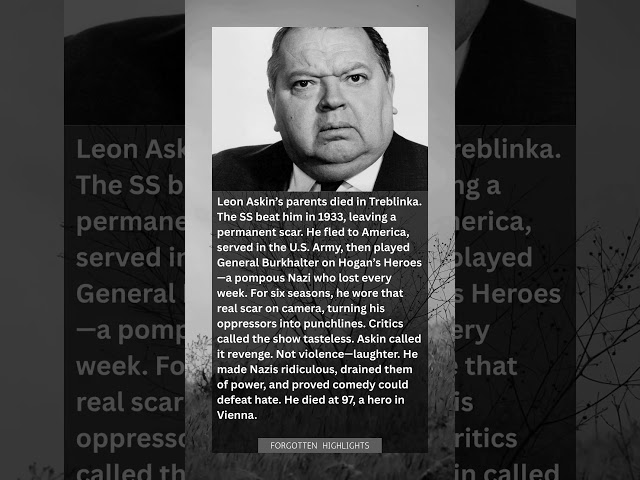
Leon Askin (General Albert Burkhalter): Born Leo Aschkenasy in Vienna, Askin was a Jewish actor and director. During the rise of National Socialism, he was arrested, beaten, and tortured by Nazi thugs and SS officers, leaving him with visible scars. He managed to flee Europe in 1940, arriving in the United States, but his parents were murdered in the Treblinka extermination camp. When he took on the role of General Burkhalter—the blustering, domineering general in Hogan’s Heroes—he brought his real scars to the set.
-
John Banner (Sergeant Hans Schultz): Born Johann Banner to Jewish parents in Austria, Banner fled to the United States following the 1938 Anschluss. While he enlisted in the U.S. Army Air Forces to fight the Axis powers, many members of his family who remained behind in Vienna were murdered in concentration camps. On screen, Banner became famous for portraying Sergeant Schultz, the lovable, candy-obsessed guard whose famous catchphrase was “I know nothing!”
-
Werner Klemperer (Colonel Wilhelm Klink): Klemperer, who played the cowardly, vain camp commandant, was the son of the famed Jewish conductor Otto Klemperer. His family fled Germany in 1933 shortly after Hitler took power. Klemperer later served in the U.S. Army during World War II.
-
Robert Clary (Corporal Louis LeBeau): Playing the French corporal, Clary was a French Jew who actually survived the Holocaust. He was deported to Buchenwald and spent three years in concentration camps; 12 members of his immediate family were murdered in the gas chambers.
+-------------------+-----------------------------+------------------------------------+
| Actor             | Role in Hogan's Heroes     | Real-World Background              |
+-------------------+-----------------------------+------------------------------------+
| Leon Askin        | General Albert Burkhalter   | Austrian Jew; beaten by SS; fled   |
| John Banner       | Sergeant Hans Schultz       | Austrian Jew; lost family in camps |
| Werner Klemperer  | Colonel Wilhelm Klink       | German Jew; fled Nazi regime 1933  |
| Robert Clary      | Corporal Louis LeBeau       | French Jew; survivor of Buchenwald |
+-------------------+-----------------------------+------------------------------------+
Turning Trauma into Satire
When Hogan’s Heroes was pitched in the mid-1960s, it faced intense skepticism. The Holocaust and the horrors of World War II were recent history; only two decades had passed since the liberation of the camps. Critics questioned whether a comedy set in a German POW camp was tasteless or offensive.
However, the Jewish actors who took the roles saw the project through a completely different lens. For them, portraying Nazis as incompetent buffoons was not a dismissal of history, but an act of ultimate psychological triumph and revenge.
“If they ever write an episode where Colonel Klink wins, I will walk off the set.” — Werner Klemperer
Werner Klemperer agreed to play Colonel Klink under one strict condition: Klink could never be portrayed as successful, heroic, or victorious. He insisted that the character must always be a foolish puppet who was systematically outwitted in every single episode. Klemperer understood that stripping fascism of its terrifying aura through relentless ridicule was a potent weapon.
For actors like Leon Askin, wearing the uniform of the very regime that had beaten him and murdered his parents was an extraordinary subversion. Askin stood before millions of television viewers wearing the insignia of a General, playing the character not as a terrifying oppressor, but as a pompous, henpecked idiot terrified of his own superiors and constantly duped by prisoners. The facial scars from his real-life encounters with fascist violence were visible in close-ups—a silent witness to real history while the narrative systematically dismantled the myth of Nazi superiority.
The Power of “I Know Nothing!”
John Banner’s portrayal of Sergeant Schultz became an iconic piece of American pop culture. Schultz was a man who wanted nothing to do with war, ideologues, or military discipline; he wanted to eat strudel, drink beer, and avoid trouble at all costs.
When asked how a Jewish man whose family was destroyed by the Nazis could play a German soldier so sympathetically, Banner explained his perspective clearly:
“Schultz is not a Nazi. I see Schultz as the representative of some kind of goodness in any generation.”
By humanizing the lower-ranking guard while reducing the high-ranking leadership (Klink, Burkhalter, and Hochstetter) to impotent fools, the show drew a sharp line between fanatical ideology and human survival. The show’s ultimate irony was that the very men Hitler sought to destroy were the ones dictating how the Third Reich would be remembered on international television: as a ridiculous, doomed farce.
A Living Legacy of Catharsis
The story behind Hogan’s Heroes and its cast remains one of the most compelling examples of reclaiming power through art. Where totalitarianism demanded fear, awe, and obedience, these actors answered with satire, mockery, and laughter.
When viewers watch those old episodes today, knowing the tragic personal histories of the actors changes the experience entirely:
-
Reclaiming the Narrative: Those who were hunted and persecuted returned as the storytellers, turning their former persecutors into punchlines.
-
Physical Subversion: Real scars received during acts of hate were transformed on screen into symbols of survival and ultimate victory.
-
Cultural Catharsis: By transforming a terrifying enemy into a bumbling joke, the show helped a postwar generation process collective trauma through comedy.
The man who wore his real SS scars on TV playing a bumbling officer wasn’t just performing a script; he was declaring victory over the monsters who had tried to erase him. Through six seasons and 168 episodes, these Jewish actors stood under the Hollywood lights, wearing the symbols of their oppressors, and ensuring that history’s cruelest villains were remembered not as conquerors, but as fools.
