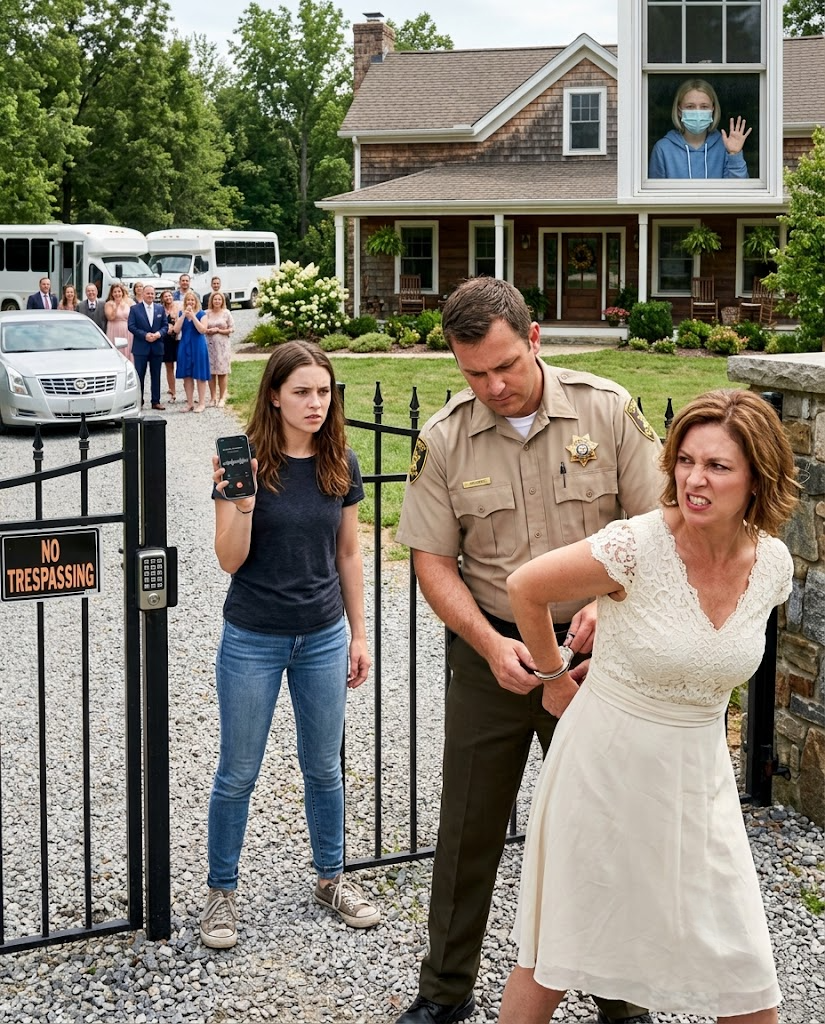
I tapped the voicemail while my mother still had one hand wrapped around the iron gate.
For a second, all anyone heard was the faint hiss of the recording and the sound of gravel shifting under forty pairs of formal shoes.
Then my mother’s voice came through my phone.

She had left the message the night before, after I stopped answering her calls.
Her tone on the recording was not confused, emotional, or worried about Lily.
It was controlled.
She said I could change whatever locks I wanted, but Saturday was happening because the guests had already been invited, the vendors had already been paid, and she was not going to let me humiliate her over what she called my daughter’s “temporary medical situation.”
Then came the part that mattered.
She said that if I refused to open the property, she would come anyway, get inside, and put Lily upstairs where she belonged until the party was over.
The recording ended.
Nobody behind the gate said anything immediately.
My mother’s fingers loosened around the iron bars.
Dad stared at my phone as if the device itself had betrayed them.
Sheriff Daniel Brooks looked from me to Mom.
“Did you leave that message?” he asked.
Mom’s face tightened.
She did not deny it.
Instead, she pointed toward me and said, “She’s twisting a private family conversation into something it wasn’t.”
That answer changed the scene more than any denial could have.
Sheriff Brooks had already heard me tell my parents not to enter the property.
He had already seen the posted notice.
He had already watched Mom ignore his warning, reach through the gate, and repeatedly try an access code after being told she had no permission to enter.
Now he had heard her own recorded voice explaining that she intended to come onto the property despite my refusal.
He asked her again to step away from the gate.
Mom stepped closer instead.
“Emily,” she snapped, “open this gate right now before you destroy this family.”
Behind me, I heard the faint click of the upstairs window latch.
My stomach dropped.
I turned toward the house.
Lily was still standing behind the glass in her mask and oversized hoodie, but she had cracked the window less than an inch because she was trying to hear what was happening.
That tiny opening scared me more than my mother’s shouting.
Eleven days earlier, I had carried my daughter through our front door after her bone-marrow transplant with a list of precautions that had transformed our home into something between a farmhouse and a controlled recovery space.
Shoes stayed away from her room.
Surfaces were disinfected constantly.
Visitors were restricted.
Food preparation had changed.
The air purifier ran day and night.
I had spent the previous week thinking about germs the way other people think about smoke during a house fire: invisible did not mean harmless.
Forty guests below Lily’s window had never been an inconvenience.
They had been a risk I was unwilling to take.
I hurried back onto the porch and motioned for Lily to close the window.
She understood immediately.
The sash came down.
Only after I saw it shut did I turn back toward the gate.
Mom was arguing with Sheriff Brooks now.
She kept insisting that she had used the farmhouse for family events before, as though previous invitations had somehow become permanent ownership rights.
Dad joined in, saying they had stored belongings in the barn and guest rooms for years.
That was true.
It was also exactly why I had spent Friday moving every item that belonged to them into the storage unit.
For seven years, I had tolerated the language.
“Our farmhouse.”
“Our place in the country.”
“The family property.”
At first I corrected them.
Then I stopped because correcting them at Thanksgiving or over the phone always turned into an exhausting argument about respect, gratitude, and how much my grandmother had supposedly wanted everyone to enjoy the house.
But my grandmother had sold the property to me.
I had paid the appraised value.
My name was on the ownership documents.
I paid the taxes, insurance, repairs, and renovation costs.
When the plumbing failed two winters after I bought it, my parents did not split the bill.
When the barn roof needed work, nobody referred to it as “our roof.”
When the driveway washed out after weeks of rain, Dad did not call and ask what his share would be.
The farmhouse became communal only after the hard parts were finished.
Until Lily came home sick, that entitlement had mostly cost me patience.
Now it threatened something I could not compromise on.
Sheriff Brooks asked Mom for the third time to move away from the gate.
She finally did, but only long enough to turn toward the guests.
“This is a misunderstanding,” she announced.
The caterers had stopped unloading.
The quartet members stood beside their instrument cases.
Several guests looked uncomfortable enough that they were already moving back toward the buses.
One older couple quietly returned to their car without saying goodbye.
Mom saw them leave.
That was when her anger changed direction.
She no longer sounded like a woman trying to get into a party venue.
She sounded like someone watching control slip away in public.
“You did this on purpose,” she said to me.
“Yes,” I answered.
Her eyes widened slightly.
I walked down the driveway until I was still well inside the property but close enough that I did not have to raise my voice.
“I changed the locks on purpose. I changed the gate code on purpose. I moved your things on purpose. I asked the sheriff to be here on purpose.”
Dad shook his head.
“For an anniversary party?”
“No,” I said. “For Lily.”
That distinction should have been obvious.
The fact that I still had to say it told me everything.
Mom glanced toward the upstairs window again.
“She can stay in one room for a few hours.”
I felt the last small part of me that had been hoping she might finally understand disappear.
This had never been about her failing to understand the medical risk.
I had explained it twice.
She simply believed her event mattered more.
For days, I had been treating the conflict as if I needed better wording, better evidence, or some perfect explanation that would make my parents suddenly behave like grandparents of a medically fragile child.
Standing there, I realized that was the wrong problem.
They understood the boundary.
They just did not accept that I had the authority to enforce it against them.
Mom reached for the gate again.
Sheriff Brooks moved between her and the keypad.
“Mrs. Carter, you have been instructed not to enter this property,” he said.
She tried to step around him.
He blocked her path.
Dad caught her elbow and told her to stop.
She jerked away from him.
Then she said she was going inside whether I liked it or not.
The same intention that had sounded arrogant on the voicemail was now happening in front of a law-enforcement officer who had personally warned her to stay out.
Sheriff Brooks told her to place her hands behind her back.
Mom stared at him.
For the first time that morning, she seemed genuinely unable to understand what was happening.
“You cannot be serious.”
He repeated the instruction.
She looked at Dad.
Then at the guests.
Then at me.
I did not move toward the gate.
I did not argue.
I did not tell the sheriff what to do.
I had already made my decision when I changed the locks.
Everything happening now came from hers.
Mom refused to put her hands behind her back.
Sheriff Brooks took her wrist, turned her carefully away from the gate, and handcuffed her.
A few guests gasped.
Most did not.
By then, they had heard enough to understand that this was no longer a daughter throwing her parents out of a family celebration.
My father seemed to understand it too.
He stopped arguing about ownership.
Instead, he looked up at Lily’s window.
The curtain had moved slightly, but she was no longer visible.
“Is she really that vulnerable?” he asked quietly.
I stared at him.
I could have screamed.
I could have reminded him that I had already explained the transplant precautions twice.
I could have told him about the nights I checked Lily’s temperature because I was terrified of missing the first sign of infection.
Instead, I said, “Yes.”
His shoulders lowered.
That one word landed harder than the arguments had.
Dad walked toward the Cadillac without another protest.
Mom, meanwhile, was still insisting that I had planned the entire situation to embarrass her.
In one sense, she was right about the planning.
I had planned carefully.
I had called ahead because I did not want forty people arriving at my home and turning a medical recovery into a shouting match at the front door.
I had documented that my parents no longer had permission to use the property.
I had moved their belongings because I did not want them later claiming they needed to enter the house to retrieve something.
I had changed the locks because people who believe a boundary is optional often treat an old key as permission.
What I had not planned was the handcuffs.
That required Mom to ignore every opportunity she was given to stop.
The caterer eventually asked me what to do with the food.
I told him I had not hired him and could not authorize changes to my parents’ contract.
The florist returned her arrangements to the van.
The quartet packed their cases back into the vehicle they had arrived in.
The charter buses began loading guests again.
Nobody applauded me.
Nobody needed to.
It did not feel victorious.
It felt expensive, humiliating, and sad.
But the driveway was getting quieter.
That mattered.
When the last bus pulled away, gravel popped under its tires and then settled.
The property became still enough that I could hear the air purifier again when I stepped inside.
That sound had been background noise for eleven days.
That morning it sounded like the only thing in the house doing exactly what it was supposed to do.
I washed my hands, changed my outer shirt, and went upstairs.
Lily was sitting cross-legged on her bed with her sleeves still pulled over her hands.
Her mask covered most of her face, but I could see fear in her eyes.
“Is Grandma mad at me?” she asked.
The question nearly broke me.
Not because I did not know how to answer it.
Because a twelve-year-old recovering from a bone-marrow transplant had watched a grown woman create chaos outside her home and somehow concluded that she might be responsible.
I sat in the chair beside the bed instead of climbing onto it because we were still following the cleaning routine her doctors had given us.
“This was not your decision,” I told her. “And none of this happened because you did something wrong.”
She looked toward the window.
“She wanted the party really bad.”
“Yes.”
“More than she wanted to see me?”
I hated that question even more.
I could not repair my mother’s priorities with a comforting sentence.
So I did not try.
“I think Grandma wanted things her way,” I said. “And my job is to keep you safe even when somebody gets angry about it.”
Lily considered that.
Then she nodded once.
Downstairs, my phone started ringing.
Dad.
I let it ring twice before answering.
His voice sounded different without Mom beside him.
He did not ask me to apologize.
He did not demand the gate code.
He said he had been told where Mom was being taken for processing and that he was going to deal with that.
Then he asked where their belongings were.
I gave him the storage information.
He was silent for several seconds.
“You really moved everything.”
“Yes.”
Even then, I could hear the old family assumption underneath his surprise.
They had believed my boundary was temporary anger.
They thought I would cool down, open the gate, carry the boxes back inside, and restore the arrangement that had always benefited them.
I had done versions of that before.
That was my part in how we got here.
I had confused keeping peace with solving problems.
There is a difference between being generous with access and surrendering control of your own home.
This time, I was not moving the boxes back.
Dad asked whether I intended to keep them off the property permanently.
“I intend to keep Lily’s recovery protected,” I said. “After that, we can talk about what kind of relationship is possible.”
He did not like the answer.
But he finally understood that access would no longer be assumed.
Over the following days, the practical consequences were much quieter than Saturday morning.
The gate remained locked.
The old code stayed disabled.
My parents’ belongings stayed in storage.
There were no relatives dropping by because they happened to be nearby.
There were no surprise deliveries arranged by Mom as an excuse to come onto the property.
For the first time since Lily came home, I stopped glancing toward the driveway every time tires sounded on the road.
Dad sent messages instead of arriving.
Most were short.
Some were defensive.
A few tried to explain that Mom had been under enormous pressure because the anniversary celebration had been planned for months.
I did not argue with that.
Planning something for months does not create a right to endanger someone else.
Eventually, he sent one message that did matter.
He said he had replayed the voicemail in his head and realized something he had not wanted to admit at the gate.
Mom had not been asking permission.
She had been informing me that she intended to override my decision.
It was the first time he described the problem accurately.
That did not fix everything between us.
It did make a future conversation possible.
Mom’s messages were different.
She focused on embarrassment, the guests, the lost deposits, the handcuffs, and the damage she believed I had done to her reputation.
She barely mentioned Lily.
That hurt, but it also removed the last excuse I had been making for her.
I did not need to keep wondering whether I had explained the medical risk badly.
The issue was not communication.
It was priority.
I saved the voicemail, but I stopped replaying it.
At first it had felt like evidence I needed to defend myself.
Later, I realized I no longer needed my mother’s own voice to remind me why I had said no.
The clearest evidence was upstairs doing schoolwork in a hoodie while an air purifier hummed beside her bed.
Weeks passed.
Lily’s recovery remained the center of our household, but the atmosphere slowly changed.
The disinfectant smell became less sharp.
Her energy returned in small pieces.
Some mornings she came downstairs and sat at the kitchen table instead of eating in her room.
On good days she complained about homework, which was such an ordinary twelve-year-old thing that I sometimes had to turn away so she would not see how relieved it made me.
The farmhouse also began feeling like ours again in a way renovations had never accomplished.
Not because my parents were gone.
Because I had finally stopped treating ownership as something I needed their emotional permission to exercise.
The front porch was still the same porch.
The barn still leaned slightly at one corner despite the repairs.
The gravel still collected in the same annoying places after heavy rain.
But I no longer heard “our farmhouse” in my head whenever I made a decision about it.
It was the home where my daughter was recovering.
That was enough.
Dad eventually asked if he could visit Lily when her medical restrictions allowed it.
He asked.
That single change mattered more to me than an apology rehearsed under pressure would have.
I told him we would follow the medical guidance and decide when the time came.
He said okay.
He did not drive over anyway.
Mom was not included in that first conversation about a future visit.
I was not trying to punish her.
I simply no longer believed that family title alone guaranteed access to my child or my home.
Trust had become something connected to behavior.
One afternoon, Lily came downstairs while I was replacing the batteries in the gate keypad.
She stood a few feet away and watched me snap the cover back into place.
“Are you changing the code again?” she asked.
“No. Just the batteries.”
She nodded and looked toward the road.
For months, that keypad had been an ordinary convenience.
Then it became the object my mother attacked because she believed a code should still open a door I had already closed.
Now it was ordinary again.
That felt important.
Lily asked whether she could choose the next code someday.
I smiled.
“When you’re feeling better.”
She thought for a second.
“Nothing Grandma can guess.”
“Definitely nothing Grandma can guess.”
Then she went back inside, leaving me beside the gate with a screwdriver in one hand and a fresh battery package in the other.
There was no crowd.
No Cadillac.
No sheriff.
No argument about who owned what.
Just a locked gate doing the simple job I had once been made to feel guilty for asking it to do: opening only when the person who lived there decided it should.