At 1:17 in the morning, my phone lit up.
I had just gotten out of the shower. My hair was still wet, the ends dripping onto the old t-shirt I wore to sleep.
A red notification dot appeared on Instagram. It was a post from Adrian Shaw. My boyfriend. Or so I thought until that minute.
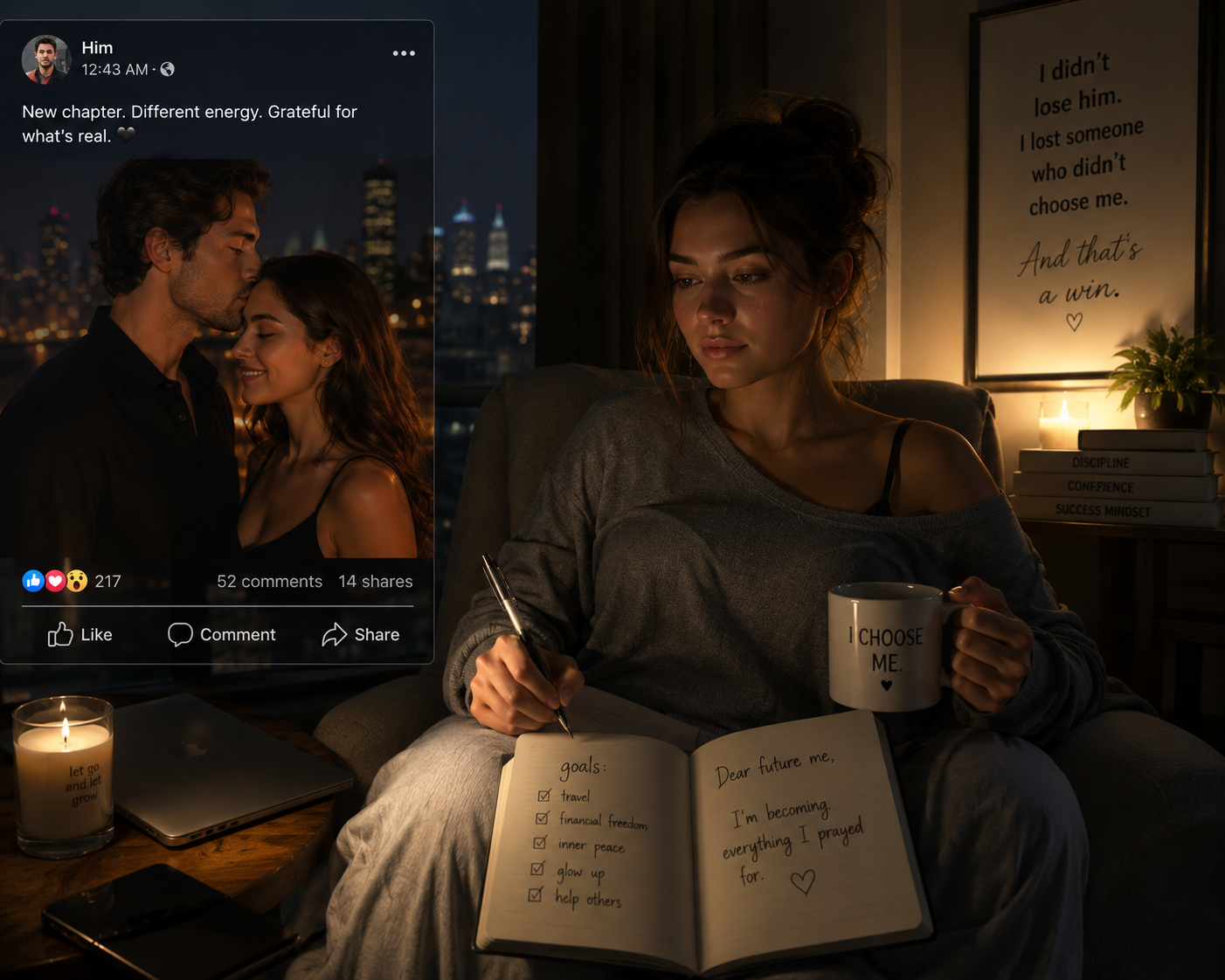
The photo took a second to load. In it, a woman was lying on his bare chest. He had pale skin, a firm torso, his hand resting on her cheek. The girl was wearing a top that was way too revealing, her neck was covered in red marks, and Adrian’s lips were pressed against her ear.
The caption was short. “For the rest of my life, as long as you’re here, I’m complete.”
I stared at the screen. I didn’t blink.
I knew the woman. Sophia Cross. His grad school classmate. The same one we had argued about dozens of times. The same one he always defended with a tired tone: “Don’t be insecure, Paula. She’s just a friend.”
The same one who, at a get-together a month ago, laughed and accepted it when someone yelled: “Kiss her! You guys look like a couple anyway!”
Adrian didn’t push her away. I got up and left.
Since that night, we started a cold war. A whole month. He didn’t call me. I didn’t call him either. I thought we were still fighting. He was already starting a new life.
I scrolled down to the comments. His friend Mark wrote: “Aren’t you afraid Paula’s going to cause drama again?”
Adrian replied: “When does she not come back begging on her own?”
Someone else asked: “How long have you guys not been talking?”
He answered: “Almost a month. I bet the day after tomorrow, on my birthday, she’ll panic and come back crying.”
I read the sentence again. Come back begging on her own.
That’s how he talked about me. About me. The woman who for three years had called him in the middle of the night when we argued. The one who apologized even when she didn’t know what she had done wrong. The one who, during our last breakup, called him twenty-seven times and sent him forty-three text messages.
I opened our chat history. The last message from that time was still there: “I messed up. Please, don’t ignore me.”
Three hours later, he had replied with a single word: “Yeah.”
Back then, I thought that “yeah” meant forgiveness. Now I understood it meant: I knew you’d come back.
I looked at the photo again. That hand now touching Sophia’s face had touched mine. Those lips had kissed my neck. That tongue had traced my skin while he promised me I was his only home. And now all of that belonged to another woman.
I didn’t cry. I took screenshots. Then I started deleting.
First, I left Adrian’s family group chat, the one where his mother, just a month ago, had told me: “You guys should get married already.”
Then I left his friends’ group chat. Then I deleted his Instagram and his number. I didn’t block him. I just deleted him. The way you delete an emergency contact that is no longer going to save you.
After that, I deleted my Twitter, TikTok, and Reddit accounts, the ones I had used for seven years. Finally, I changed my phone number. Only my family and my boss would have the new one.
When I finished, it was two in the morning. My hair was already dry. I went to bed. I closed my eyes. I didn’t cry.
The next morning, I asked for the day off. Not out of pain. For logistics.
I went to the company and handed in my resignation. My boss looked at me in surprise. “What happened?” “I want to move to another city.” “Which one?” “I don’t know yet.” “But your project…” “I left all the handover documents ready. They’re in your email.”
He looked at me for a few seconds and didn’t ask anything else.
I went back to the apartment. It was rented by Adrian. He paid the rent, I paid for food, electricity, water, and internet. For three years, I thought that was living together. That day I understood it was just living inside a room that could stop being mine the moment he wanted it to.
I packed everything. Two suitcases. One backpack. That was all I had after three years.
When the landlady came for the keys, she was surprised. “Aren’t you waiting for Mr. Shaw?” “No.” “Did you guys have a fight?” “We broke up.” She didn’t ask anything else.
I chose the new city at random. I opened the map. I put my finger on a spot. I bought a ticket for a four-hour Amtrak train ride.
I slept during the trip. The conductor woke me up when we arrived. I walked out of the station with my two suitcases, not knowing where I was going to sleep. The sky was blue. So clear it seemed to be mocking me.
My new phone vibrated. It was a former coworker, Sarah. “Paula, did you really leave?” “Yes.” “Adrian called the office. He asked why your phone isn’t working.” “What did you tell him?” “That you resigned. He asked where you went. I told him I didn’t know.”
I looked up at the sky. “Thank you.” “Are you okay?”
I smiled. For the first time in a long time, the answer wasn’t a lie. “I’ve never been better.”
That afternoon I rented an old apartment, no elevator, on the sixth floor. One bedroom, a small living room, white walls, wide windows.
As I was carrying up the last suitcase, it got stuck on the landing. Then a male voice called out from above: “Do you need help?”
I looked up. A man in a gray t-shirt was walking down with a trash bag in his hand. “No, thank you.”
He was already coming down. He grabbed my suitcase with one hand and carried it up as if it weighed nothing. “What floor?” “Sixth. 601.” “What a coincidence. I live in 602.”
He left the suitcase in front of my door. “I’m Matthew Gray.” “Paula Lane.” “Lane, like the street?” “Lane, like Lois Lane.”
He nodded. He didn’t ask where I came from. He didn’t ask why I was moving in alone. He just said: “Welcome, neighbor.”
That night I slept on the floor on a yoga mat, with no bed, no hot water, and stray cats crying under the window. But, for the first time in years, no one was waiting for me to come crawling back. And that was already a home.
The first sunrise in my new apartment arrived without asking for permission.
The light came through the bare window and fell directly on my face. I had no curtains. No bed. No table. No glasses. I had slept on a yoga mat, using a jacket as a blanket and a backpack as a pillow.
My back hurt. My neck was stiff. The floor smelled of dust, old paint, and stale humidity.
Even so, when I opened my eyes, the first thing I felt wasn’t sadness. It was silence. A simple silence. Clean.
Without the sound of Adrian checking his phone next to me. Without the anxiety of checking if he was online. Without waiting for a message from him to pop up. Without wondering if that day he would punish me with indifference or reward me with a kind phrase.
I stayed still, looking at the white ceiling. There was nothing in that apartment. And that was exactly what made it mine.
I got up slowly, folded the mat, and checked my phone. No message from Adrian. Of course. He didn’t have my new number. He didn’t have my accounts. He didn’t have my groups. He didn’t have my addresses.
For the first time in three years, if he wanted to find me, he would have to make an effort. And for the first time in three years, I wasn’t planning on helping him.
I went down to the street to buy breakfast. The building was old, the kind with concrete stairs, rusted mailboxes, and cables hanging like black roots along the walls. At the entrance, there was a small convenience store that sold milk, bread, eggs, cheap umbrellas, and transit cards.
The owner, a woman in her fifties with a perm and a raspy voice, looked me up and down. “New in the building?” “Yes.” “What floor?” “Sixth.” “Ah, poor thing.”
She smiled, as if that were a welcome.
I bought bread, yogurt, and bottled water. When I returned, I walked up slowly. By the fourth floor, my legs were burning. By the fifth, I thought maybe I had made a mistake choosing a walk-up apartment.
On the sixth, the door to 602 opened. Matthew walked out with wet hair, a black t-shirt, and a toolbox in his hand. “Good morning, neighbor.” “Good morning.”
He looked at the bag I was carrying. “Do you have gas yet?” “I don’t know.” “Hot water?” “Not that either.” “Electricity?” “There’s a bulb hanging, but no lamps.”
He nodded with an almost technical seriousness. “So you have a cave with windows.”
I couldn’t help but smile. “More or less.” “If you need someone to check the gas valve, let me know. Sometimes these old systems act up.” “Thank you.”
I went into my apartment and closed the door. For a few minutes, I leaned against it. Matthew’s kindness didn’t excite me. It scared me a little.
After Adrian, any kind gesture seemed to hide a future debt. Adrian was also kind at first. Very kind. Too kind. He would bring me food when I worked late. He would wait for me at the bus stop. He would touch my hair and say: “Paula, when you’re tired you look like a wet cat.”
I would laugh. I thought I had found someone who truly saw me. But over time, that gaze turned into a cage.
First, he knew what food I liked. Then, he decided what food I should order. First, he waited for me after work. Then, he asked why I was taking so long. First, he told me he missed me. Then, he got mad if I went out with friends.
At first, when we fought, he would get desperate. Later, he got used to me coming back. And in the end, he turned me into a bet with his friends. “She comes back begging on her own.”
I took my phone out of my backpack and opened the gallery. The screenshots were still there. The photo of Adrian with Sophia. The comments. The reply.
I swiped my finger across the screen. I didn’t delete them. Not yet. The screenshots weren’t meant to torture me. They were evidence. Not for a trial. For my memory.
Because I knew bad days would come. Days when I would remember Adrian laughing with me in bed. Days when a song, a smell, or a phrase would make me think maybe I overreacted. And then I would need to see his own words. Not the ones he whispered in my ear. The ones he said when I wasn’t there.
That day I bought a cheap bed, a folding table, a pot, two plates, a lamp, and curtains. I carried it all however I could. Part of it arrived by delivery. The rest I carried myself.
The bed came in pieces. The manual looked like it was written by someone who hated humanity. I spent three hours trying to put it together. I hurt my fingers. I put a screw where it didn’t belong. I had to take half the frame apart.
At eight at night, sitting on the floor among boards and tools, I started to laugh. Not a happy laugh. An absurd laugh. Because for years I thought I couldn’t live without Adrian. And there I was, defeated by a pressed wood bed. Not by love. By screws.
There was a knock on the door. I stayed still. “It’s Matthew,” he said from outside. “I don’t want to bother you, but I heard a really loud crash. Are you okay?”
I looked at the board that had fallen on my foot. “Yes.” “Are you sure?” “More or less.”
I opened the door. He looked at the disaster behind me. He didn’t smile mockingly. He just lifted the toolbox he had in his hand. “Do you want me not to ask and just help?”
I liked that phrase. Don’t ask. Just help. “Yes,” I said.
He came in, crouched next to the pieces, reviewed the manual for ten seconds, and said: “This is wrong starting from step two.” “Thanks for the humility.” “I didn’t mean you. The manual is bad.”
He worked in silence. I handed him screws. He adjusted pieces. In less than forty minutes, the bed was ready.
“Don’t jump on it,” he warned. “I don’t trust this brand.” “I wasn’t planning on celebrating like that.” “Good.”
He stood up, gathered his tools, and walked toward the door. “Thank you,” I said. “You’re welcome.” “Do you want water? It’s the only thing I have.” “No need. Tomorrow they’re shutting off the water in the building from nine to three. Buy a bucket or some jugs.” “How do you know?” “They announced it in the neighborhood group chat.” “I’m not in the group.” “Do you want me to add you?”
I hesitated. A neighborhood group meant more people. More noise. More ties. More chances of someone asking where I came from.
Matthew seemed to understand my pause. “No need right now. I’ll let you know if there’s anything important.” “Thank you.” He left.
That night I slept in my new bed, with poorly hung curtains and the smell of cheap wood. I slept badly. I dreamed of Adrian’s photo. In the dream, he was in a white room, holding Sophia’s face. But when she lifted her head, it was me.
I woke up sweating. It was 3:18. My hand reached for the phone automatically. For years, when I woke up like that, I would text Adrian. “Are you awake?” If he was in a good mood, he would reply: “Another nightmare?” If he was annoyed, he’d leave me on read.
That early morning I unlocked my phone. There was no Adrian. There was no conversation. There was no place to beg. I felt empty. And then, strangely, free.
On the third day, they shut off the water. I went down to buy two large bottles. On the stairs, I ran into Matthew with a small cart loaded with water jugs. “I told you,” he commented. “Yes. I should have listened to you.” He looked at my two bottles. “That won’t even last you half a day.” “I live alone.” “People who live alone wash up too.”
I didn’t know whether to laugh. He pointed to a jug on the cart. “Take one.” “No.” “I’m not giving it to you. You can pay me back later.” That difference made me accept. “Thank you.” “You’re welcome.”
We walked up together. On the fifth-floor landing, an older neighbor opened her door and called out to him: “Matthew, can you check my sink when you have time?” “I’ll be there in ten minutes, Mrs. Eleanor.” “You’re an angel.”
He seemed uncomfortable. “It’s nothing.”
When we reached the sixth floor, I asked him: “Are you an electrician?” “No.” “A plumber?” “Nope.” “Then why does everyone ask you to fix things?” “Because I learned how to fix things.” “What do you do?” “I work at a logistics company. At night, sometimes I do repairs for neighbors.” “Do you sleep?” “Sometimes.”
He said it with such seriousness that it almost made me laugh again.
That afternoon, while I was organizing my clothes in the new closet, I received a call from my former coworker, Sarah. “Paula, he came by.” I didn’t ask who. “To the company?” “Yes. He was furious. He asked where you went. He said he needed to talk to you.”
I sat on the floor. “What did you tell him?” “That I didn’t know.” “Did he believe you?” “No. But there was nothing he could do either. Then he asked the boss. The boss said he respected the privacy of a former employee.”
I felt gratitude toward a boss with whom I had barely exchanged more than reports for years. “Thank you for letting me know.” “Paula…” “Tell me.” “He’s posting things.” I didn’t say anything. “Not directly about you. But he posted a story with Sophia. Something like ‘finally calm after the storm’.”
Calm after the storm. I was the storm. Sophia, the calm.
It hurt. Not like the first photo. The first blow breaks you. The following ones find the edges already cracked.
“Don’t look at it,” Sarah said. “I’m telling you so you’re prepared, not so you go look at it.” “I’m not going to look.” “Good.” I hung up.
I didn’t go look. But my body did react. I felt cold in my hands. A knot in my throat. An absurd urge to reclaim something. Not Adrian exactly. But my version of the story.
I wanted someone to tell him: She wasn’t the storm. You provoked her.
I wanted him to know I wasn’t crying. I wanted Sophia to understand that she hadn’t won a trophy, but a man who would one day turn her pain into a joke too.
But I didn’t do anything. That was the first act of real resistance. Not responding. Not explaining. Not correcting his narrative. Because for three years I had spent too much of my life trying to make Adrian understand my feelings. This time, his understanding was no longer my problem.
Adrian’s birthday arrived two days later. The date was etched in my memory. For years I had organized everything. Cake. Gift. Dinner. A long midnight text. Photos. A letter.
The year before, I bought him a watch that cost more than half my salary. He looked at it and said: “You shouldn’t have spent so much.” But he wore it to every important meeting.
That day I woke up before six. My first thought was: Today is his birthday. The second: I don’t care. The third, more honest: I do care, but I’m not going to do anything.
I got up, made instant coffee, and sat at the folding table by the window. Outside, the new city was starting to move. Motorcycles. Breakfast vendors. A woman sweeping the sidewalk. A child crying because he didn’t want to go to school. Life went on. I had to as well.
At eight, my old number, now canceled, would surely be receiving calls that would never go through. At nine, maybe Adrian would have checked Instagram. At ten, he would notice I hadn’t posted anything. By noon, he would probably say in front of Sophia: “She’s holding out. She’ll call.” By night, maybe he would start to doubt.
That idea gave me a small satisfaction. Not enough to heal. But enough to get up.
That day I looked for a job. I sent out resumes. I answered ads. I updated my portfolio. I was an editorial designer, with experience in cultural content and project management. It wasn’t an easy profession to start from scratch in another city, but it wasn’t impossible either.
At five, I got an interview for a small publishing house. At seven, another for an online course company. At eight, I went down to buy rice and vegetables.
When I returned, Matthew was sitting on the stairs of the sixth floor, fixing a lamp. “Hi, neighbor.” “Hi.” “Do you have water now?” “Yes.” “Stable bed?” “For now.” “Big progress.”
I pulled a bag of oranges out of my grocery bag. “I owe you for the water jug.” “No need.” “You said I should pay you back.” “I said that so you would accept it.”
I looked at him. “That was manipulation.” “Yes, but low risk.”
For the first time in days, I laughed without feeling like I was betraying myself. I gave him three oranges. “Partial payment.” He accepted them. “Thank you.”
I went into my apartment and closed the door. I stood leaning against the other side for a moment. It wasn’t love. Or interest. Or illusion. Just the relief of a human interaction without punishment.
With Adrian, even jokes had an edge. If I said something clumsy, he corrected me. If I laughed loudly, he told me I was exaggerating. If I got upset, he shut down for days.
Matthew made jokes that demanded nothing afterward. That, in my new life, was a rarity.
A week passed. Then two. I started getting to know the city. I found a cheap bakery. A laundromat. A park where people ran at sunset. A public library with tables by the window.
I also started getting to know myself in Adrian’s absence. I discovered that I didn’t hate eating alone. That I could sleep with the window open. That I liked walking without a destination. That I didn’t have to explain every expense. That I could buy a ridiculous yellow mug and use it without hearing: “What a childish taste.”
The interview with the publishing house went well. The salary was lower than my previous job, but enough. The director, a forty-year-old woman named Irene, reviewed my portfolio and said: “You have a good eye for visual rhythm. Can you start on Monday?” “Yes.” “The team is small. Sometimes there’s chaos.” “I’m used to it.” “Everyone says that until they see our chaos.” “Believe me, I’ve seen chaos.” She didn’t ask. She hired me.
On the first day, I arrived half an hour early. I bought coffee for the team. I sat at my new desk. The chair was uncomfortable. The computer was old. The software took a long time to open.
But nobody knew who Adrian was. Nobody asked if we were still together. Nobody looked at me as “Shaw’s intense girlfriend.” I was Paula Lane. New designer. Period.
Three weeks into my disappearance, Sarah called again. “Paula, don’t freak out.” I froze. “What happened?” “Adrian is seriously looking for you. He went to your old apartment. The landlady told him you turned in the keys. He went to the office again. He also messaged several people asking if anyone knew your new number.”
I took a deep breath. “Is he with Sophia?” “I don’t know. But… he deleted the post.”
That’s when I closed my eyes. My heart did something stupid. Not joy. Not hope. An old, automatic movement. Like a dog hearing the keys of someone who once fed it.
“Why?” “I guess because he started to realize.” “No.” “No?” “He realized I didn’t come back. Not what he did.”
Sarah stayed silent. “You’re right.” “If he asks, you don’t know anything.” “Of course.” I hung up.
That night I dreamed about him. Not about the photo. About an old afternoon. It was raining. I was sick. Adrian arrived with hot soup and a scarf. He dried my hair with a towel, clumsy but tender. “If I’m not here, what do you do with yourself?” he told me then. I replied: “Wait for you.”
In the dream, I woke up crying. In real life too. I sat up in bed, hugging my knees. That’s when I understood something cruel: Love doesn’t disappear just because a person humiliated you. Dignity can decide to leave before the heart understands. And that’s okay. You don’t have to wait to stop loving to save yourself.
The next morning I went to work with puffy eyes. Irene looked at me and left a cup of tea on my desk. “I won’t ask.” “Thank you.” “I’ll just say something. The things that hurt at night are better worked through during the day.” “Is that editorial advice or life advice?” “Both.”
I kept working.
Time started to move differently. One month. Two. Three. Adrian stopped searching through acquaintances, or so it seemed. I didn’t look for news. At first, it was discipline. Then it became a habit.
I heard something about Sophia by accident. An old friend posted a picture from a dinner where she and Adrian were. He was smiling, but not the same as before. Sophia looked beautiful, of course. White dress, red lips, hand on his arm. I closed the app. My hands didn’t shake. That was progress.
In my building, my life filled with small routines. On Wednesdays, Matthew helped Mrs. Eleanor with impossible things: a stuck window, a leak, a light bulb. On Fridays, the store owner saved sweet bread for me. On Saturdays, I went to the farmer’s market.
Sometimes Matthew coincided with me on the stairs and we ended up walking down together. We didn’t talk about deep things. We talked about pipes, the weather, vegetable prices, stray cats, and neighbors who left trash out past hours.
One afternoon, returning from the market, it started raining heavily. I was carrying bags in both hands. Matthew appeared out of nowhere with a black umbrella. “You’re going to get soaked.” “I already am.” “Then you’ll get less soaked.”
He covered me without touching me. We walked slowly. The rain hit the umbrella. I felt a pang of memory: Adrian in the rain, years ago, waiting for me. But this time it didn’t hurt as much. Maybe because Matthew didn’t say: “You can’t do this without me.” He just held the umbrella.
When we reached the building, he handed me a bag that had slipped. “Your tomatoes survived.” “Thank you.” “They are strong tomatoes.” “Like me.” I said it without thinking. He looked at me for a second. “Yes.” He didn’t add anything else. That “yes” stayed with me all night.
In the fourth month, Adrian found me. I don’t know how. Maybe through someone from the previous company. Maybe through a social security trail. Maybe because people with enough obsession and wounded pride end up finding doors.
It was a Saturday afternoon. I was walking down in comfortable clothes to buy laundry detergent when I saw him in front of the building. Dark suit. Impeccable hair. Thinner. He was holding a bouquet of white flowers.
For a second, my body reacted before my mind. My stomach tightened. My throat closed. My feet wanted to step back.
He saw me. His eyes changed. “Paula.”
His voice. Four months of silence and a single word was enough to open a locked room inside me.
I didn’t step down the last stair. I stayed where I was. “What are you doing here?”
He took a step forward. “I looked for you everywhere.” “I didn’t ask that.”
He squeezed the bouquet. “I needed to see you.” “I didn’t.”
The sentence hurt him. I saw it. Before, seeing pain on his face would have made me run to fix it. This time I watched him like someone watching the rain behind a glass window.
“Paula, I’m sorry.”
Four months ago, those words would have been an open door. Now they were just late words with expensive flowers. “For what?” He frowned. “What?” “You say you’re sorry. For what exactly?” He opened his mouth. He closed it. “For hurting you.” “More specific.” “For… posting that.” “That?” “The photo.” “And what else?”
His jaw tensed. “For talking badly about you in the comments.” “What did you say?” He looked down. “Paula…” “Say it.” “I said you always came back.”
I felt the phrase in my chest, but it didn’t pierce me the same way. “And did you believe it?” He didn’t answer. “You did believe it.” “I was angry.” “No. You were sure.”
He looked up. His eyes were red. “Because you always came back before.”
There it was. The truth. Not disguised. Not softened. He didn’t respect me because my love seemed guaranteed. Because I taught him, with every return, that he could break me a little more and still find me waiting.
“You’re right,” I said. Adrian looked confused. “What?” “I used to come back.” I said every word slowly. “Not anymore.”
His hand trembled. “Sophia and I broke up.” Her name appeared between us like a familiar shadow. “I don’t care.” “It wasn’t what I thought it was.” I almost smiled. “What a surprise.” “Paula, I was confused. She admired me, she understood me. With you, everything was a fight.” “Because I was the girlfriend. She was the break.” “That’s not fair.” “No. It wasn’t fair to me.”
He squeezed the bouquet. “I love you.”
The phrase arrived. The old key. The one that used to unlock everything. I waited. Nothing happened. It hurt, yes. But it didn’t unlock.
“You don’t know how to love without feeling like an owner,” I said. His face hardened. “That’s not true.” “No? You posted another woman to punish me. You let your friends make fun of me. You bet I would come back begging. And now you’re here because I didn’t.” “I came because I miss you.” “You miss that I chose you even when you humiliated me.” “Paula.” “No.”
My own voice surprised me. Clear. Without a tremor.
“You didn’t come to apologize when you posted the photo. You didn’t come the next day. You didn’t come when I deleted my accounts. You came when you realized that this time there was no way back.”
Adrian stood in silence.
Behind me, on the stairs, I heard a door open. Matthew was walking down with a trash bag. He stopped when he saw us. Adrian looked at him. The shadow of jealousy was immediate. “Who is he?”
There it was. He still thought he had the right to ask.
Matthew, with perfect calm, said: “A neighbor.” Adrian looked him up and down. “I didn’t ask you.” Matthew didn’t change his expression.
I stepped down the last stair and stood between them, not to protect Matthew, but to set the boundary. “Don’t talk to him like that.”
Adrian let out a bitter laugh. “Of course. I get it now.” “No, you don’t get anything.” “Is that why you disappeared? Because of him?”
The accusation filled me with a mix of exhaustion and disgust. “I disappeared for myself.” “I don’t believe you.” “I don’t need you to believe me.”
He tried to step closer. Matthew took a step, not aggressive, just present. Adrian noticed.
“Paula, let’s talk alone.” “No.” “Three years don’t end like this.” “You’re right. They ended at 1:17 in the morning, when you posted another woman and laughed at me.”
His face turned pale. I pulled up the screenshots on my phone. Not for him. For me. I opened them and showed him his reply. “When does she not come back begging on her own?” “That night, I believed you.”
His eyes filled with tears. “I didn’t…” “Yes.” I put the phone away. “And I listened to you. I stopped coming back.”
I walked up the stairs. Adrian called out to me. “Paula, please.” I didn’t stop. Matthew didn’t say anything either. He just waited downstairs until Adrian left.
That night, I found the bouquet of flowers in the building’s dumpster. I didn’t throw it away. Maybe he did. Maybe the wind. Maybe the store owner. It didn’t matter. The past can also end in a dumpster without a ceremony.
After that visit, Adrian started sending letters. He couldn’t call me. He didn’t have my number. He couldn’t add me on social media. So he used physical mail.
The first one arrived at the publishing house. I don’t know how he got the address. Irene left it on my desk. “I didn’t open it, obviously.”
I looked at the envelope. My name written in his handwriting. My stomach flipped. “Do you want me to throw it away?” I thought about it. “No. I’ll read it.”
I opened it in the bathroom.
“Paula, I don’t know how to talk to you right now. I realize that I built our relationship on your fear of losing me. That makes me feel ashamed. Sophia wasn’t love. It was vanity. I liked seeing myself in her eyes because she didn’t know the worst parts of me. You did, and that made me feel judged. I know I don’t deserve another chance, but I can’t accept that our story ends like this.”
I read the last sentence several times. I can’t accept. Even in an apology, he was still talking about what he could accept. I put the letter away. I didn’t reply.
The second arrived a week later. More desperate. The third, more humble. The fourth, longer. In all of them, there was something resembling regret. In none of them was there a sentence that made me want to go back. Not because they were poorly written. Adrian wrote well. He always knew how to use words. That was part of the problem. I no longer wanted words that arrived after the actions.
The last letter arrived two months later. It just said: “Today I understood that asking you to come back is still just thinking about myself. I hope you’re happy someday, even if it confirms you don’t need me anymore.”
That one did make me cry. Not out of love. Out of mourning. Because maybe that was the first time Adrian loved me without trying to drag me back. Or maybe it was just the best-written letter. It didn’t matter. I didn’t reply to that one either.
The first year in the new city was hard. I’m not going to lie. Freedom doesn’t pay the bills. Dignity doesn’t assemble furniture on its own. Starting from scratch is not a movie scene with inspiring music. It’s filling out forms, carrying heavy bags, getting sick with no one to bring you medicine, learning bus routes, going to the wrong supermarket, missing a voice that hurt you, and hating yourself for missing it.
There were nights when I was on the verge of looking up his name online. There were mornings I woke up wanting to return to the old apartment, not because I wanted Adrian, but because I missed knowing where everything was. The unknown is exhausting.
But little by little, the city started to recognize me. The baker saved sesame buns for me. My neighbor Mrs. Eleanor asked me to read her bank messages. Irene started trusting me with big projects. My designs improved. My body did too. I ate on time. I slept better. I started wearing dresses again that Adrian used to say “drew too much attention.” I cut my hair above my shoulders. The first day I showed up at the publishing house with the new cut, Irene said: “Now you look like a protagonist.” I didn’t know how much I needed to hear that.
Matthew and I became friends. Not quickly. Not with fireworks. With small things. A fixed lamp. A bowl of soup when I had a fever. A picked-up package. A stray cat that we both started feeding and that decided to name himself, by Mrs. Eleanor’s decree, “General.”
Matthew never asked me directly about Adrian. One day, while feeding the cat, I said: “My ex came by months ago.” “I know.” “You didn’t ask?” “It wasn’t my story to demand.” I looked at General, who was eating with arrogance. “He thought I left because of you.” Matthew let out a short laugh. “That says more about him than us.” “Yes.” “Did it bother you?” “It exhausted me.” “That’s different.” “Yes.”
There was silence. Then he added: “I’m not good with other people’s drama.” “Me neither. And yet I lived in one for three years.” “So you’re an expert.” “Retired.” He smiled. “Good.”
Another year passed before Matthew asked me out to dinner as something more than neighbors. It was a fall night. We had taken General to the vet because he was limping. Turned out he had just fought and lost to another cat. When we got back, Matthew said: “Do you want to have dinner with me?” “We have dinner together sometimes.” “No. I mean… have dinner with me. No cat, no pipes, no lamps.”
I looked at him. My heart didn’t race. There was no vertigo. There wasn’t that intense anxiety I confused with passion when I was with Adrian. There was calm. That scared me.
“I’m not sure if I’m ready.” “That’s okay.”
He didn’t ask when. He didn’t play the victim. He didn’t pull away offended. He just said: “When you know, tell me. If the answer is no, we’ll just keep feeding General.”
That night I thought a lot. With Adrian, love had been a rollercoaster: peaks of tenderness, drops of anxiety, intense reconciliations, cruel silences. With Matthew, everything was more like a well-set table. Not thrilling in the old sense. But stable. And after years of falling, stability can also cause vertigo.
A week later, I knocked on his door. When he opened it, I said: “Yes.” He blinked. “Yes to what?” “To dinner. No cat.” He smiled. “Great.”
We went to a small restaurant near the river. We ate fish, vegetables, and rice. We talked about our families, work, music, the time he shocked himself fixing a lamp because he thought he turned off the breaker but hadn’t. He didn’t touch me without permission. He didn’t try to define me. He didn’t say he would save me.
On the way back, we walked under yellow trees. At the door of the building, he asked me: “Can I hold your hand?” That question almost made me cry. Not out of romance. Out of respect. “Yes.”
His hand was warm. Large. Calloused. He didn’t squeeze it tightly. He didn’t hold me as if he feared I would escape. He just walked with me.
Months later, Adrian wrote to me again. This time by email. I don’t know how he got my new work address, but the message was short. “Paula, I’m leaving the country for a while. Therapy, work, I don’t know. I wanted to tell you that I’m not going to look for you anymore. It took me too long to understand that your silence wasn’t a punishment, it was an answer. I’m sorry I forced it to be so final. Take care.”
I read the email. Matthew was in my kitchen, trying to convince General not to climb on the table. I didn’t tell him right away. Not because it was a secret. Because it was no longer urgent.
I finished chopping tomatoes. I washed the knife. I poured water. And then I understood that Adrian had become something I didn’t think was possible: News. Not an open wound. News.
That night, after dinner, I told Matthew: “Adrian wrote.” He left the plates in the sink. “Are you okay?” “Yes.” “Do you want to talk about it?” “Not really.” “Okay.”
I sat in the chair. “I think he’s finally gone.” Matthew looked at me. “And you?” I thought about it. “I left a long time ago.”
He nodded. He didn’t say “good riddance.” He didn’t insult Adrian. He didn’t demand space. He just sat across from me. “Then let’s toast.” “With water?” “General didn’t let us buy wine.” The cat meowed from the floor, as if defending his decision. We toasted with water. To leaving. To staying. To not coming back.
Three years after that early morning, I returned to my old city for work. The publishing house sent me to a book fair. I was no longer the new designer. I was the visual coordinator for an entire line of publications. I had a team, projects, professional bags under my eyes, and a much nicer suitcase than the two I had fled with.
On the second day of the fair, I saw him. Adrian. He was at a university booth, talking to someone. His hair was a bit shorter. His face calmer. Sophia wasn’t there. No one was by his side.
He saw me too. For a second, the world did that cruel thing where it shrinks. Then I took a breath. And the world returned to its normal size.
Adrian walked toward me. “Paula.” “Adrian.” We stood face to face. No music. No rain. No drama.
“You look good,” he said. “I am.” His eyes softened. “I’m glad.” And, for the first time, I believed him. Not because it mattered. But because he wasn’t trying to use the sentence as a bridge.
“You?” I asked. “Better. Not perfect.” “No one is.” He smiled faintly. “Yeah.”
There was a pause. “I read some things you designed,” he said. “They are very good.” “Thank you.” “You were always good.” I didn’t answer. Before, I would have waited years for that sentence. Now it arrived like a book I no longer needed to read.
Adrian took a deep breath. “I’m not going to apologize again. I already did it too late and too many times. Just… thank you for not coming back.” I looked at him. I didn’t expect that one. “Thank you?” “If you had come back, I would have stayed the same. Maybe worse. Your absence forced me to see myself without an audience.” I felt a soft sadness. Not painful. Human. “It was really hard not to come back,” I said. He closed his eyes for a second. “I know that now.” “No. You don’t know.” He opened his eyes. He nodded. “You’re right.”
That answer, simple and defenseless, showed me that maybe something had indeed changed. Not enough for me. But something. “Take care, Adrian.” “You too, Paula.”
We parted ways. I didn’t look back right away. When I did, he was still there, watching me walk away. But this time I didn’t feel a tether. Just distance.
When I got back to the hotel, I called Matthew. “I saw him.” “Him?” “Yes.” “How are you?” I looked at the city out the window. The city where I had loved, begged, waited, disappeared. “Good.” “Good for real or ‘don’t ask’ good?” I smiled. “Good for real.” “I’m glad.” “Matthew.” “Yes?” “Thank you for never asking me why I arrived with two suitcases.” There was silence. “I figured you’d tell me someday if you wanted to.” “I think I can now.” “Then I’m listening.”
That night I told him everything. Not just everything that happened. He already knew that in parts. I told him how it felt. I told him about the twenty-seven calls. The forty-three messages. The word “yeah.” The photo. The phrase “she comes back on her own.” The train. The first night on the floor. The poorly assembled bed. The water jug. The umbrella.
He listened without interrupting. At the end he said: “I’m glad you made it to 601.” “Me too.” “And to 602.” I laughed. “That was convenient.” “Very convenient. For me.”
The following year, Matthew and I moved in together. Not to 601 or 602. To an apartment with an elevator, a balcony, and enough space for General, who accepted the move with feline disdain. We both signed the lease. We split expenses. We bought furniture together.
The first night, sitting on the floor among boxes, Matthew handed me a key. “Your copy.” I took it. “Aren’t you going to say ‘our home’?” “I could, but it sounds cheesy.” “A little.” “Besides, a home isn’t the key. It’s what we do after we open the door.” I looked at him. Sometimes, life gives you back phrases you didn’t know you needed.
We didn’t get married right away. There was no rush. I learned to distrust stories that run to close wounds with rings. First we lived. We argued about the trash. About the cat. About schedules. About the right way to hang a towel. But we argued differently. No disappearing. No silent treatments. No posting other people on social media. No turning love into a bet.
One day, Matthew messed up and spoke to me in a harsh tone. I froze. Not because of what he said. Because of what my body remembered. He noticed immediately. “I’m sorry. That came out wrong.” “Yes.” “I’m going to rephrase that.” And he did. Just like that. So simple, yet so difficult for others. That’s when I understood that a healthy relationship isn’t one where no one fails. It’s one where a mistake isn’t turned into a weapon.
Five years after that 1:17 am, I found the screenshots in an old cloud backup. The photo. The comments. “When does she not come back begging on her own?”
I stared at them. Matthew was in the living room, putting together a new bookshelf. “Everything okay?” he asked. “Yes.” “What are you looking at?” “An old ghost.”
He came to my side. He didn’t invade the screen. He just waited. I showed him. He read in silence. Then he said: “What a jerk.” It was so blunt that I laughed. “Yeah.” “Do you want to delete it?”
I looked at the screen. For years I kept them as proof. As an antidote. As a reminder not to go back. But I no longer needed to look at them to believe myself. I no longer needed evidence of my pain to justify my decision.
I tapped select. Delete. The phone asked if I wanted to permanently delete. I accepted. The screen was clear. I felt something small. Not an explosion. Not a cinematic closure. Just a deeper breath.
“Done,” I said. Matthew went back to the bookshelf. “Good.” “Do you need help?” “Yes. But if the manual is wrong, I’m blaming the manufacturer.” “As always.” “Tradition matters.”
I got up and went to help him. As I held up a board, I thought about the Paula who one night got out of the shower and saw a photo capable of breaking her life. I wanted to hug her. Tell her that not crying didn’t mean not feeling. That running away wasn’t cowardice. That two suitcases were enough to start over. That the sixth floor with no elevator would be hard, but it would also teach her how to climb. That a neighbor with a trash bag wasn’t a salvation, but a kind presence on the path she chose herself. That Adrian would one day be just a name. That the phrase “she comes back on her own” would stop being a prophecy and become the first lie she disobeyed.
Life didn’t compensate me by giving back exactly what I lost. It doesn’t work that way. It gave me other things. A new city. A job that belongs to me. An arrogant cat. A table that wobbles a bit. A man who asks before holding my hand. And, above all, it gave me back to myself.
Sometimes, when someone asks me why I left without saying anything, I answer: “Because I had already spent too much time talking to someone who didn’t want to listen to me.” And when they ask if I ever wanted to go back, I tell the truth: “Yes.” Many times. But I didn’t go back. That is the important part. I didn’t go back. Not for his birthday. Not when he deleted the post. Not when he came with flowers. Not when he wrote letters. Not when he said he loved me. Not when my heart still hurt.
Because a woman doesn’t need to stop loving to choose her dignity. She only needs, just once, not to answer. Once, to close the door. Once, to get on the train. Once, to arrive in an unknown city with two suitcases and a broken heart. And discover, over time, that she wasn’t lost. She was finding her way out.
The rest of the life Adrian promised with another woman doesn’t belong to me. Let him live it however he wants. The rest of my life started that early morning, when I saw his photo, saved the screenshots, erased my name from his world, and understood that the scene he expected—me coming back to beg him—was never going to happen again.
Never. Not in this life. Not in any other where I remember how much it costs to find your way back to yourself.