PART 9: THE NIGHT MY HUSBAND REALLY DIED
“I was wearing Michael’s coat that night.”
Jennifer’s confession hung in the hospital room.
Ava stared at her mother.
The detective stopped typing.
I could hear my own heartbeat.
“Why were you at Richard’s office?” I asked.
Jennifer looked toward the guarded doorway.
“Paul called me.”
“Thirteen years ago?”
“Yes.”
“What did he say?”
“He said Dad had suffered chest pain and needed his insurance information. He told me to bring the blue folder from our house.”
“Why didn’t he call me?”
“He said Dad didn’t want to frighten you.”
The same excuse Richard had used when he hid his problems with Michael.
The same excuse my children had used when discussing my house.
Everyone claimed they were protecting me whenever they wanted to keep me ignorant.
“Where did you get Michael’s coat?”
“He left it at our house after dinner the week before. It was snowing, and I grabbed the first coat near the door.”
“What happened when you reached the office?”
Jennifer closed her eyes.
“The outside door was unlocked. The hallway lights were off. I found Dad on the floor beside his desk.”
“Was he alive?”
“Yes.”
The word nearly broke me.
Richard had been alive when she arrived.
“What did he say?”
“He looked at Paul and whispered, ‘You switched them.’”
“Switched what?”
“I didn’t understand then. Now I know he meant his heart pills.”
“Where was Evelyn?”
“I didn’t see her.”
“Dr. Lane?”
“He arrived later.”
“What did Paul do?”
“He took the blue folder from me and told me to call his phone instead of 911.”
“Why?”
“He said an ambulance was already coming.”
“Was it?”
“No.”
“How long did you wait?”
Jennifer began crying.
“Nine minutes.”
I stood.
“Richard was lying on the floor, and you waited nine minutes?”
“Paul said Dad had taken his emergency medicine.”
“Did you check?”
“I was scared.”
“So was Richard.”
“I know.”
“No, Jennifer. You know now. That night, you chose not to know.”
She covered her face.
“Dad grabbed my wrist. He told me to call you.”
Every part of me became still.
“He asked for me?”
“Yes.”
“And did you call?”
“No.”
“Why?”
“Paul said hearing your voice would make his heart work harder.”
A sound escaped me that did not feel human.
For thirteen years, I had believed Richard died without calling my name.
But he had called for me.
My daughter had been standing beside him.
And she had chosen to listen to Paul.
“When did you finally call the ambulance?”
“When Dad stopped responding.”
“Was Paul still there?”
“He left before they arrived.”
“And Dr. Lane?”
“He was the emergency physician who met us at the hospital. He told me Dad’s death was natural.”
“Did you tell him what Richard said about the pills?”
“Yes.”
“What did Dr. Lane say?”
“He said people become confused during cardiac events.”
“And you believed him.”
“I wanted to.”
That was the truth beneath every terrible decision Jennifer had made.
She believed whatever allowed her to avoid losing something.
Her husband.
Her home.
Her inheritance.
Her image of herself as a good daughter.
“What did Paul say afterward?”
“He said the security camera had recorded me entering the office in Michael’s coat. He said if I mentioned the pills or the nine-minute delay, the police would think Michael and I had killed Dad.”
“Why would they think Michael did it?”
“Because Dad had argued with him about money that afternoon.”
“Did Michael know you were going to the office?”
“I don’t know.”
The detective leaned forward.
“Why didn’t you disclose this during the original investigation?”
“There wasn’t an investigation. Dr. Lane ruled it a natural death.”
“You still lied to your mother.”
Jennifer looked at me.
“Yes.”
“And when Paul began planning to take my house, you joined him because he already controlled you.”
She nodded.
“He reminded me of that night. He said if I refused, he would give the photograph to the police.”
“You risked my life to protect yourself from questions about Richard’s death.”
“I’m sorry.”
I turned toward the window.
Snow was beginning to fall.
Somewhere near Henderson Lake, Paul was holding Michael.
He believed the original evidence was hidden where Richard asked me to marry him.
And he believed I was the only person who could find it.
The detective stood.
“You are not going to that lake.”
“He has Michael.”
“Michael participated in your husband’s death.”
“We don’t know exactly what he did.”
“He also helped steal your house and escaped custody.”
“He is still my son.”
Jennifer looked up.
“Mom, don’t go.”
I turned toward her.
“You had a chance to call me when Richard was dying. You chose fear. I will not make the same choice.”
The police began preparing a rescue operation.
They studied maps of Henderson Lake and searched Richard’s old property records.
The lake was partly frozen, surrounded by wooded trails and abandoned summer cabins.
Richard and I had visited it often when we were young.
His father once owned a small fishing cabin there, but it had been sold decades earlier.
At 4:10 p.m., Paul sent another message.
A photograph showed Michael tied to a chair inside the old cabin.
His prison uniform was covered by a winter coat.
One side of his face was bruised.
A handwritten sign rested against his chest:
ONE HOUR.
The detective wanted to send a tactical team immediately.
I stopped him.
“Paul will see them approaching.”
“We can enter through the woods.”
“He knows those woods. Richard took the family there every summer.”
“Then tell us what Paul may be looking for.”
I studied an old map.
Where did Maggie first say yes?
The answer was not only Henderson Lake.
Richard proposed beside a cedar tree near the eastern boat dock.
Years later, he carved our initials into the trunk.
M + R.
“He hid something near the cedar tree,” I said.
“How can you be certain?”
“Because Richard always said the safest hiding place was inside a memory nobody else considered important.”
The police placed a small tracker inside the lining of my boot.
A listening device was hidden beneath my sweater.
Officers entered the forest from three directions.
A rescue team waited near the western road.
A drone flew above the trees, but thick snow made the camera difficult to use.
At 4:52 p.m., I reached the beginning of the lakeside trail.
My phone rang.
“Walk alone,” Paul said.
“I am alone.”
“Leave the road. Follow the red markers.”
Small strips of red cloth had been tied to tree branches.
I followed them through the snow.
The wind moved across the frozen lake.
The old cabin appeared between the trees.
Its windows were dark.
Paul stood outside.
He held a gun against his leg.
“Open your coat,” he ordered.
I did.
“Turn around.”
I turned.
He checked for visible wires but did not find the device beneath my sweater.
“Where is the drive?”
“With the police.”
Paul’s expression hardened.
“I told you to bring it.”
“The police already copied everything. Destroying one drive changes nothing.”
“Then why did you come?”
“For Michael.”
He laughed.
“After everything he did?”
“You would not understand.”
“I understand perfectly. Your children can steal from you, abandon you, and nearly kill you, but the moment one of them needs help, Maggie comes running.”
“I came because I refuse to let you decide who I am.”
“And who are you?”
“Someone who saves a life when she can.”
His smile disappeared.
“Take me to the tree.”
“Let me see Michael.”
Paul unlocked the cabin.
Michael sat exactly where he had appeared in the photograph.
His wrists were tied behind the chair.
When he saw me, his face twisted.
“Mom, you shouldn’t be here.”
“You sound like Thomas.”
“Paul is going to kill us both.”
Paul closed the door.
“Not if your mother cooperates.”
I looked at Michael.
“Did you know Richard had been drugged?”
Michael’s eyes moved toward Paul.
“Answer me.”
“I knew Paul wanted to stop Dad from going to the police.”
“How?”
“He said he would make Dad sick for a few days.”
“You gave him access to Richard’s office.”
Michael lowered his head.
“Yes.”
“You gave him information about Richard’s medicine.”
“I told him where Dad kept it.”
“Did you know Jennifer was going there?”
“No.”
“Why was your coat at her house?”
“I left it after dinner.”
“Did you kill your father?”
“No.”
His answer came immediately.
But innocence was not the same as ignorance.
“Did you suspect Paul caused his death?”
Michael began crying.
“I saw him two days later. He had Dad’s office key and the prescription bottle.”
“What did you do?”
“Nothing.”
“Why?”
“Because Dad was going to report the loans. If the police searched his records, I would lose my business.”
“You let your father’s killer walk free to protect a failed business?”
“I told myself Dad’s heart was already weak.”
“His heart was not weak. The people around him were.”
Michael looked at me.
“I’m sorry.”
“Sorry has followed every grave this family opened.”
Paul checked the time.
“Enough.”
He cut the ropes around Michael’s ankles but kept his hands tied.
“Both of you are going to the lake.”
We walked through the snow.
Michael stumbled twice.
Paul kept several feet behind us, holding the gun.
The cedar tree still stood near the old dock.
Its branches were heavier.
Its trunk had widened.
But the initials remained.
M + R.
The carving was weathered but visible.
For one moment, I was twenty-one again.
Richard stood before me with a ring made from grass.
He was nervous.
I was laughing.
He asked if I would build a life with him.
I said yes before he finished the sentence.
“What did he hide?” Paul demanded.
“I don’t know.”
“You gave the password.”
“The password led you to the lake. It did not tell me where he placed the evidence.”
Paul pointed the gun at Michael.
“Then remember.”
I touched the carved initials.
Richard had proposed beside the tree, but afterward, we sat beneath the dock because rain began falling.
He removed one of the loose boards and hid the grass ring inside a glass jar.
We returned years later.
The jar was gone.
Or that was what Richard told me.
“The dock,” I whispered.
Paul forced Michael ahead of us.
The wooden boards groaned beneath our weight.
Ice covered the lake below.
Near the final post, one plank was newer than the others.
I knelt and pulled at it.
The board lifted.
Beneath it was a metal box wrapped in rotting canvas.
Paul pushed me aside and grabbed it.
A small combination lock protected the lid.
“What’s the code?”
“I don’t know.”
Paul aimed the gun at Michael.
“Yes, you do.”
I thought of Richard’s note.
Where did Maggie first say yes?
Not only the location.
The date.
May 17, 1974.
I entered 0517.
The lock opened.
Inside were original property records, copies of fraudulent deeds, medical files, and a small audio recorder.
There was also an envelope addressed to me.
Paul reached for the recorder.
I grabbed it first and pressed play.
Richard’s voice came through the tiny speaker.
“My name is Richard Hale. If this recording is being heard, then Evelyn Parker, Paul Walsh, and Dr. Conrad Lane may have attempted to stop me from reporting a coordinated fraud operation targeting elderly property owners.”
Paul struck the recorder from my hand.
It landed between the dock boards.
Michael stepped toward him.
Paul raised the gun.
“Move again and she watches you die.”
The recording continued.
“My son Michael provided them access to my office because he believed they were helping him destroy evidence of a personal loan. I do not believe Michael understood their full plan. But after I confronted him, he refused to help me.”
Michael’s face collapsed.
Richard had known.
Even after his son betrayed him, he had written the truth carefully.
He did not excuse Michael.
But he did not accuse him of murder.
Paul lifted the metal box.
“This is what I came for.”
“You will never reach the road,” I said.
“Your police are searching the north trail.”
He pointed toward the frozen lake.
“My vehicle is on the other side.”
The listening device beneath my sweater suddenly emitted a faint click.
Paul heard it.
He ripped open my coat and found the wire.
“You brought them.”
“I told you I would.”
He tore the device away and crushed it beneath his boot.
In the distance, someone shouted.
Police were entering the woods.
Paul dragged Michael toward the edge of the dock.
“You have thirty seconds to stop them.”
“I can’t.”
“Then choose.”
He pulled a lighter from his pocket and ignited the corner of Richard’s envelope.
At the same time, he kicked Michael behind the knees.
Michael fell onto the frozen lake.
The ice cracked beneath his weight.
“You can save the evidence,” Paul said, holding the burning box over the water. “Or you can save the son who helped kill the man who left it.”
Michael tried to crawl toward the dock.
The crack spread beneath him.
I looked at Richard’s burning letter.
Then I looked at my son.
There was no choice.
Documents could be copied.
Evidence could be rebuilt.
But a life, once gone, could not be called back.
I stepped onto the ice.
Paul laughed.
“Still saving them, Maggie.”
“No,” I said. “I’m saving myself from becoming someone like you.”
I reached Michael as the ice broke.
His body dropped into the black water.
I grabbed his coat with both hands.
“Hold on!”
My knees struck the ice.
Water rushed over the surface.
Michael’s tied hands disappeared beneath him.
“I can’t feel my legs!”
I pulled with everything I had.
The ice cracked beneath my chest.
Paul threw the burning box toward the open water and ran across the lake.
Police shouted from the shore.
A gunshot echoed through the trees.
Paul stumbled but kept moving.
The burning box struck the water beside Michael.
The flame disappeared.
Richard’s evidence began sinking into the darkness.
Then another crack split the ice beneath me.
Michael looked into my eyes.
“Let go, Mom.”
“I already let you go once.”
The ice collapsed.
Freezing water closed over my head.
Michael’s coat slipped from my hands.
Above us, the hole in the ice became a distant circle of white light.
Michael sank beneath me.
Richard’s metal box disappeared below his feet.
I kicked toward my son.
But before I could reach him, a hand closed around my ankle in the darkness.
At first, I thought it was Michael.
Then the grip dragged me away from him.
I looked down.
Paul was beneath the ice with us.
And in his other hand, he was holding Richard’s burning letter.
PART 10: WHAT THE ICE GAVE BACK
Paul’s hand tightened around my ankle beneath the ice.
The cold had already stolen the feeling from my fingers.
Above me, the hole looked like a circle of white light.
Below me, Michael was sinking with his hands tied behind his back.
Paul pulled me away from him.
In his other hand, Richard’s half-burned letter dissolved in the black water.
I kicked at Paul’s face.
My movements were slow.
The water pressed against my clothes like concrete.
His grip moved from my ankle to my boot.
I kicked again.
The boot slipped from my foot.
Paul was left holding it.
I pushed toward Michael.
His eyes were open, but he had stopped fighting.
I grabbed the back of his coat.
He was too heavy.
The soaked fabric dragged both of us deeper.
Then I remembered something Richard taught our children at that same lake.
When someone is drowning, do not fight the water.
Find the light.
I looked up.
The opening in the ice was several feet away.
I wrapped one arm beneath Michael’s chin and kicked with my bare foot.
Nothing happened.
My chest burned.
The light above us began fading.
Michael’s body went limp.
I pulled again.
This time, we moved.
Only a few inches.
But inches were enough.
Above the ice, a dark figure appeared near the hole.
An arm reached into the water.
I pushed Michael toward it.
The hand caught his coat.
Another rescuer reached down.
They pulled Michael through the opening.
Paul grabbed my leg again.
I twisted and saw him beneath me.
Blood drifted from his shoulder where the police bullet had struck him.
He held the metal evidence box against his chest.
Even while drowning, Paul would not release the proof of what he had done.
He pointed toward the darkness beneath the dock.
There was another hole.
He planned to escape beneath the ice and surface beyond the police line.
I kicked his injured shoulder.
His grip weakened.
I turned toward the light.
But the hole was closing with broken pieces of ice.
A rescuer reached for me.
Our fingers touched.
Then Paul pulled me backward one final time.
My lungs gave up.
Water entered my mouth.
The lake became silent.
I saw Richard’s face.
Not as he looked in the coffin.
Not as he appeared in the secret video.
I saw him at twenty-one, kneeling beside the cedar tree with a ring made from grass.
I heard his voice.
Live, Maggie.
That will be your answer.
I drove my heel into Paul’s chest.
His hand released me.
The rescuer caught my wrist.
I was pulled through the ice.
Air struck my face.
Someone placed a mask over my mouth.
People shouted around me.
Michael lay several feet away while paramedics cut through the ropes around his wrists.
He was not moving.
“Michael!”
A firefighter held me down.
“Ma’am, let them work.”
“He’s my son.”
“They’re helping him.”
Paramedics pressed against Michael’s chest.
Once.
Twice.
Again.
Nothing.
I tried to crawl toward him.
The firefighter wrapped a blanket around my shoulders.
“Stay with me.”
Michael’s body jerked.
Water poured from his mouth.
He coughed.
The sound was weak.
But it was life.
I began crying.
Paramedics lifted him onto a stretcher.
Another rescue team surrounded the second hole in the ice.
Paul surfaced near the abandoned boathouse.
He tried to climb out with the metal box.
An officer stepped on his hand and ordered him to release it.
Paul let the box fall.
It sank beneath the ice.
Police pulled him from the water and arrested him.
As they carried him past me, his eyes opened.
“You saved the wrong son,” he whispered.
I leaned closer.
“No. I saved the part of myself you could never understand.”
He looked confused.
“The part that still knows a life is worth more than revenge.”
Paul was taken to the same hospital as Michael.
Officers guarded his room.
Doctors treated the gunshot wound, hypothermia, and a broken wrist.
He survived.
I was glad.
Death would have ended his fear.
Living meant answering for every name inside the ledger.
Michael and I were admitted for hypothermia.
I remained in the hospital for three days.
Ava refused to leave my side.
She brought Richard’s wedding ring and placed it on the table beside my bed.
“You lost a boot,” she said.
I smiled weakly.
“I noticed.”
“You could have died.”
“Yes.”
“Why did you go onto the ice?”
“Because Michael needed help.”
“But he hurt you.”
“He did.”
“Then why save him?”
I looked toward the wall separating my room from Michael’s.
“Saving him did not erase what he did. It did not restore his inheritance or remove his sentence. It only meant I refused to stand safely on shore and watch another person drown.”
“Do you forgive him?”
“I don’t know.”
Ava nodded.
She had learned not to demand simple answers to complicated pain.
On the second morning, police divers recovered Richard’s metal box.
The documents had been sealed inside waterproof folders.
Most survived.
The audio recorder was damaged, but technicians believed they could recover its contents.
The evidence identified dozens of fraudulent transfers involving Evelyn, Paul, Dr. Lane, Daniel, and several employees at Silver Pines.
It also proved that Michael gave Paul access to Richard’s office and medical information.
Michael had not administered the fatal drug.
But he had helped the people who did.
His silence afterward allowed them to target other victims.
The four women rescued from Silver Pines were reunited with their families.
Two additional facilities were searched.
Investigators located three more missing women.
Bank accounts were frozen.
Properties were returned.
Families who had spent years believing their mothers died began learning how carefully they had been deceived.
Richard had tried to stop the operation thirteen years earlier.
Now the evidence he buried was finishing the work he began.
Michael asked to see me.
A police officer remained outside his hospital room.
His hands were covered with bandages from the ropes and ice.
He looked older than he had one week earlier.
“Thank you for saving me,” he said.
“I did not save you from what comes next.”
“I know.”
“You escaped custody.”
“Paul’s men caused the crash. They said they were rescuing me.”
“And you went willingly.”
“I thought Paul would help me leave the country.”
“You were still running.”
“Yes.”
“What changed?”
“He tied me to a chair and told me I would confess to Dad’s murder before he killed me.”
“Then fear changed you.”
Michael stared at the blanket.
“Maybe.”
“That isn’t the same as remorse.”
“No.”
His honesty surprised me.
“Why did Paul say I saved the wrong son?”
Michael’s head lifted.
“He wanted you to think I knew everything.”
“Did you?”
“No. But I knew enough.”
“How much?”
“Dad told me he had discovered forged property transfers. Paul said those records also contained my loan documents. He promised to destroy my debt if I gave him the office key.”
“And you did.”
“Yes.”
“Did you know he planned to change Richard’s medicine?”
“He asked where Dad kept his pills.”
“You answered.”
“I told myself Paul wanted to photograph the labels.”
“You keep saying you told yourself things.”
“Because the truth would have required me to stop.”
I looked at my son.
For the first time, he was not asking me to forgive him.
He was not blaming his father, his sisters, or financial pressure.
He was simply naming the cowardice beneath his choices.
“Did you see Richard on the day he died?”
“At lunch.”
“You argued.”
“He said he was going to the police. I told him if he reported Paul, Jennifer’s marriage would collapse.”
“You were protecting Jennifer?”
“I was protecting myself. Paul knew I gave him the key.”
“Was Thomas involved?”
Michael became still.
“Why are you asking about Thomas?”
“Because someone accessed Richard’s safe-deposit box three days after the funeral.”
“How do you know?”
“The bank is reviewing the records.”
Michael looked toward the door.
“Mom, Dad met Thomas on the afternoon he died.”
“Thomas was his lawyer.”
“It wasn’t a normal meeting.”
“What happened?”
“I saw them arguing outside Dad’s office.”
“About what?”
“I only heard part of it. Dad said, ‘If you remove that file, Maggie will never know.’”
“What did Thomas say?”
Michael swallowed.
“He said, ‘That’s the point.’”
I stood.
“Why didn’t you tell me?”
“Because that night, Dad died. And the next morning, Thomas came to our house and told us not to discuss Dad’s business records with anyone.”
Thomas had handled Richard’s estate.
He helped me create my trust.
He protected my house.
Paul kidnapped and injured him.
None of that matched the man Michael was describing.
But I had already learned that people could protect me in one moment and betray me in another.
“What file did Thomas remove?”
“I don’t know.”
“Was it inside the lake box?”
“Dad kept it separate.”
“What was written on it?”
Michael closed his eyes, trying to remember.
“Your name.”
That afternoon, a representative from Mountain National Bank arrived at my hospital room.
He carried access records from Richard’s safe-deposit box.
The box had been opened three days after Richard’s funeral.
The visitor used a legal authorization signed by Richard six weeks before his death.
The name on the access form was Thomas Brennan.
Security photographs showed Thomas entering the vault alone.
When he left, he carried a sealed brown folder.
He never told me.
I called him immediately.
His phone went to voicemail.
His assistant said he had been discharged from the hospital that morning.
He had not returned to the office.
Nobody knew where he went.
The detective issued a request to locate him.
At 6:30 p.m., a hospital employee delivered a package to my room.
“It was left at the front desk,” she said.
The package contained no return address.
Inside was the brown folder Thomas had removed from Richard’s bank box thirteen years earlier.
My name was written across the front in Richard’s handwriting.
MAGGIE—THE TRUTH ABOUT OUR CHILDREN.
Ava moved closer.
“Are you going to open it?”
My hands trembled.
“Yes.”
Inside were three birth certificates.
Jennifer.
Michael.
Lisa.
There was also a fourth certificate.
The child’s name had been covered with black ink.
The father was listed as Richard Hale.
The mother was not me.
I stared at the date.
The child had been born two years before Jennifer.
Richard had another child.
Beneath the certificate was a photograph of Richard holding a newborn.
Beside him stood a much younger Thomas Brennan.
On the back, Richard had written:
Thomas promised to protect this child if anything happens to me.
Do not blame the child for my silence.
I turned to the final page.
It was a letter from Thomas.
Maggie,
Richard made me swear that I would never tell you unless the child came looking for the family.
For thirteen years, I kept that promise.
Yesterday, the child found me.
I am sorry.
Before I could finish reading, my phone rang.
The caller ID displayed Thomas’s name.
I answered.
“Where are you?”
His breathing sounded uneven.
“I’m at Richard’s old office.”
“Who is the child?”
“I can’t tell you over the phone.”
“Why?”
“Because Richard’s child is standing in front of me.”
A second voice entered the call.
It was calm.
Familiar.
A voice I had heard many times.
“Maggie,” the person said, “Thomas finally told me why Richard chose you instead of my mother.”
My blood turned cold.
“Who is this?”
The person laughed softly.
Then the video connection activated.
Thomas sat tied to a chair inside Richard’s abandoned office.
Standing behind him was someone I knew.
Someone who had eaten Christmas dinner inside my house.
Someone whose name appeared on the board of Richard’s Door.
The hidden child leaned toward the camera.
“You changed your will once, Maggie.”
A knife touched Thomas’s throat.
“Now you’re going to change it again.”…
PART 11: THE DAUGHTER WHO SAT AT MY TABLE
The face behind Thomas belonged to Katherine Brennan.
Thomas’s younger sister.
The woman who had traveled to Santa Fe with me.
The woman who served as treasurer on the board of Richard’s Door.
The woman who had eaten Christmas dinner inside my house while someone photographed us through the window.
I called her Kate.
She had listened as I spoke about Richard.
She had helped hang his ring on the Christmas tree.
She had hugged me after my home burned.
And now she was holding a knife against her brother’s throat.
“Katherine?” I whispered.
Her smile disappeared.
“You always did say my name as if I belonged to you.”
“I thought you were my friend.”
“I tried to be.”
“You are Richard’s daughter?”
“Yes.”
Thomas moved beneath the knife.
“Kate, let her go.”
“She isn’t here.”
“She will be if you keep talking.”
Katherine looked toward the camera.
“You have one hour to bring an amendment naming me as the sole beneficiary of the Richard and Margaret Hale Living Trust.”
“You already know I won’t do that.”
“Then Thomas dies without telling you the rest of your husband’s secrets.”
Thomas shook his head.
“Don’t come, Maggie.”
The knife pressed closer.
A thin red line appeared on his neck.
“Stop!”
Katherine smiled.
“One hour. Richard’s old office. Come alone.”
The video ended.
The detective took my phone.
“You are not leaving this hospital.”
“I heard that before Henderson Lake.”
“And you nearly died.”
“So did Michael.”
“This woman has already kidnapped an attorney and threatened him with a weapon.”
“She also has access to the private records of every widow in Richard’s Door.”
The detective studied me.
“You think she gave Paul the membership list.”
“She was our treasurer. She had names, addresses, property information, and emergency contacts.”
She also knew which women had no children nearby.
Which women owned their homes.
Which women were afraid.
Which women would welcome a friendly face offering help.
Katherine had not joined Richard’s Door because she cared about widows.
She joined because widows were profitable.
Ava looked at the fourth birth certificate.
“Is she really Grandpa’s daughter?”
“We need a DNA test to be certain.”
Thomas’s letter suggested he already knew the truth.
But Richard’s hidden file had left me with more questions than answers.
Why had he concealed a child?
Why had Thomas protected her?
And why had Katherine waited until now to demand an inheritance?
The detective contacted Thomas’s law firm.
A senior partner named Helen Carter came to the hospital and examined the trust documents.
“Katherine cannot become beneficiary without a properly executed amendment,” she said. “Margaret must sign willingly before a notary.”
“She has Thomas,” I replied.
“Thomas cannot notarize a document in which he is personally involved.”
“Will Katherine care?”
“No. She only needs something that appears valid long enough to move money or secure a loan.”
The same strategy my children used with the forged deed.
Record the document first.
Take the money.
Let the victim fight afterward.
But Katherine had overlooked something.
After the first forged deed, Thomas and I added a special protection to the trust.
Any amendment changing the final beneficiary required a verbal code supplied separately by me to the independent fiduciary.
Without that code, my signature changed nothing.
Katherine did not know the code.
Neither did Thomas.
Only I did.
“We can prepare a document that looks real,” Helen said. “You can sign it. It still won’t take effect.”
“And while she reads it, police enter the office.”
“That is the plan.”
Ava shook her head.
“You said Paul wouldn’t find the microphone last time.”
“She will not be wearing one,” the detective said.
“Then how will you hear her?”
“We will place a transmitter inside the document folder.”
Ava looked at the folder.
“She’ll search it.”
“What do you suggest?”
Ava picked up Richard’s wedding ring from my bedside table.
“She won’t search Grandpa.”
Technicians placed a transmitter inside the velvet lining of the small ring box.
The device was thinner than a coin.
I would carry the box in my handbag beside the false amendment.
If Katherine removed my phone or searched my clothes, she might overlook the only object that had sentimental value rather than financial value.
At 9:15 p.m., I left the hospital.
Snow covered the city.
Richard’s old office had been empty since his company closed after his death.
The building was scheduled for demolition in spring.
Its upper windows were broken.
A faded sign still showed his name:
HALE PROPERTY CONSULTING.
Police officers surrounded the block inside delivery vans and unmarked cars.
The detective stopped me near the rear entrance.
“The moment we hear confirmation that Thomas is alive, we move.”
“Katherine may hurt him.”
“We cannot allow her to take you deeper into the building.”
“What if the signal fails?”
“Say the words, ‘Richard would be ashamed.’ That is the emergency phrase.”
I nodded.
Then I entered alone.
The lobby smelled of dust and wet wood.
My footsteps echoed across the cracked floor.
“Katherine?”
A light switched on upstairs.
“Come up.”
Richard’s office was on the third floor.
The elevator had not worked for years.
I climbed the stairs slowly.
My body still ached from Henderson Lake.
Katherine had chosen the building because she knew age had made every staircase harder.
She expected me to arrive weak and frightened.
I arrived angry.
The third-floor hallway was lined with empty offices.
At the end, Richard’s door stood open.
Thomas sat beneath the window.
His wrists were tied behind the chair.
Katherine stood beside him.
The knife remained in her hand.
“Close the door,” she said.
I obeyed.
“Lock it.”
I turned the lock.
“Where is the amendment?”
“In my handbag.”
“Place it on the desk.”
I set the bag beside Richard’s old nameplate.
Dust covered everything except one clear space where Katherine had placed photographs and documents.
I recognized membership files from Richard’s Door.
Helen Ward.
Dorothy Kane.
Marion Fields.
My name.
“You gave these to Paul.”
Katherine removed the amendment folder.
“Paul already had access to medical records. I simply provided financial information.”
“You selected women who trusted us.”
“They trusted a name.”
“Richard’s name.”
“My father’s name.”
“A name you helped use to steal their homes.”
Her expression hardened.
“That foundation should have belonged to me.”
“Richard’s Door is not property.”
“Everything is property to the person denied it.”
I looked at Thomas.
“Are you hurt?”
“Nothing serious.”
Katherine touched the knife to his shoulder.
“Stop talking to him.”
“He is your brother.”
“Half-brother.”
“He spent his life protecting you.”
“He spent his life hiding me.”
Thomas raised his head.
“That was Richard’s decision.”
“And you obeyed him.”
“I promised our mother.”
Katherine opened the amendment.
“Sign it.”
“First, tell me the truth.”
“You are not in a position to demand anything.”
“You want my signature. That gives me a position.”
She stared at me.
“What do you want to know?”
“How did Richard become your father?”
Katherine lowered the document.
“Our mother was Eleanor Brennan. She became a widow when Thomas was seventeen. Richard worked for her property company.”
I remembered Eleanor.
Only faintly.
Richard had once mentioned a woman who gave him his first real job.
“What happened?”
“You and Richard had separated.”
It was true.
Before our engagement, Richard and I spent four months apart after an argument about money and marriage.
I believed he had been working and waiting for me.
Katherine told me what he had hidden.
“Richard and my mother had a brief relationship. When she became pregnant, you had already reunited with him.”
“He knew about you?”
“From the day I was born.”
Thomas spoke.
“Richard offered to acknowledge Katherine publicly. Our mother refused. She was older than him and afraid the scandal would destroy his future.”
“So he married me and said nothing.”
“Yes.”
“Did he support Katherine?”
“Every month,” Thomas said. “The payments were disguised through business accounts.”
Katherine laughed bitterly.
“Money delivered through an accountant. Birthday gifts with no name. School fees paid by a father who crossed the street when he saw me with his real family.”
“You knew him?”
“I knew who he was.”
“Did you speak to him?”
“Once. I was sixteen. I asked why Jennifer, Michael, and Lisa were allowed to call him Dad.”
My heart hurt for the girl she had been.
“What did he say?”
“That he was sorry.”
Katherine’s eyes filled with tears.
“That was all I received. Two words and a bank account.”
“What Richard did was wrong.”
She looked surprised.
“You expected me to defend him?”
“He chose you.”
“He chose silence.”
“Yes. And his silence hurt both of us.”
For the first time, the anger in her face weakened.
I continued.
“You deserved the truth. You deserved to know your father. But Helen Ward did not steal that from you. Dorothy Kane did not steal that from you. The women you helped drug and rob had nothing to do with Richard’s choices.”
Katherine’s sadness vanished.
“They had houses. They had money. They had families who still searched for them.”
“So you punished them for having what you wanted.”
“I took what the world never intended to give me.”
“You became exactly like the people who erased you.”
She slammed the amendment onto the desk.
“Sign.”
Thomas shifted in the chair.
“Kate, the document will never survive a legal challenge.”
“It only needs to survive forty-eight hours.”
“What happens after forty-eight hours?” I asked.
“I borrow against the trust, move the money offshore, and disappear.”
“And Thomas?”
“He remains here.”
“Alive?”
Katherine did not answer.
I removed a pen from my handbag.
The ring box rested beneath it.
Police were listening.
“Before I sign, tell me why you photographed Ava.”
Katherine’s eyes moved toward me.
“How do you know I took the photograph?”
“Because only someone at dinner knew which window had no curtain.”
“I wanted you afraid.”
“You circled a child’s face.”
“I needed you to understand that your gate could not protect everyone.”
“Did you send Helen’s name?”
“Yes.”
“Did you know Paul planned to drug her?”
“I knew she would be removed from the house.”
“You knew.”
“Sign the document.”
“Did you help Daniel set fire to my home?”
“I gave him the schedule.”
“Did you know Ava was inside?”
“No.”
“But if you had known, would you have stopped him?”
Katherine remained silent.
That silence was enough.
Every confession passed through the transmitter hidden beneath Richard’s ring.
The police now had her voice admitting that she supplied victims, helped Paul, threatened Ava, and assisted the people who burned my home.
I signed the amendment.
Katherine grabbed it.
She examined my signature.
“Thomas, notarize this.”
“I will not.”
She held the knife against his throat.
“Then your last act as her lawyer will be disappointing.”
Thomas looked at me.
His eyes moved briefly toward the ring box.
He understood.
“Give me the document.”
Katherine placed it on his lap.
She untied his right hand and gave him a pen.
Thomas wrote beneath my signature.
Then he pressed the old office notary seal onto the page.
Katherine smiled.
“What is the verbal code?” she asked.
My blood turned cold.
“You know about the code?”
“I read every trust email Evelyn copied from your computer.”
The document was useless without it.
The police were supposed to enter before Katherine discovered that.
“I don’t remember.”
“You remember everything when it protects your money.”
Thomas dropped the pen.
“She will not give it to you.”
Katherine pulled him from the chair and placed the knife beneath his jaw.
“Then she watches you bleed.”
The transmitter inside the ring box emitted a faint click.
Katherine heard it.
She turned toward my handbag.
“What was that?”
“Nothing.”
She opened the bag and removed the velvet box.
For one second, she stared at Richard’s wedding ring.
Then she tore out the lining.
The transmitter fell onto the desk.
Katherine crushed it with the notary seal.
“You brought police.”
Sirens sounded outside.
The emergency phrase was no longer necessary.
Officers had heard enough.
Katherine grabbed the amendment and pulled Thomas toward a rear door.
I followed.
“Let him go!”
She led him into the old records room.
Metal shelves stretched from floor to ceiling.
A narrow wooden walkway crossed an open section where the floor had collapsed years earlier.
Below us was the dark archive basement.
Police struck the locked office door behind us.
“Katherine!” I shouted. “There is nowhere to go.”
“There’s a fire exit on the other side.”
“The walkway will not hold both of you.”
“Then Thomas should walk carefully.”
She forced him onto the wooden boards.
The walkway groaned.
Dust fell into the darkness below.
Thomas’s hands were still tied.
Katherine pushed him forward.
The police broke through the office door.
“Drop the weapon!”
Katherine spun around.
The knife moved toward Thomas’s back.
I grabbed her wrist.
She struck me across the face.
Thomas turned and drove his shoulder into her.
The three of us fell against the wooden railing.
It broke.
I landed on the solid edge of the floor.
Thomas and Katherine fell through the opening.
Thomas caught a metal beam with both hands.
Katherine caught his ankle.
The false amendment slipped from her fingers and disappeared into the basement.
“Help me!” Thomas shouted.
I crawled toward the edge.
The drop beneath them was nearly thirty feet.
Katherine looked up at me.
Her face was no longer angry.
It was terrified.
“Please, Maggie.”
I reached for Thomas’s wrist.
The beam groaned.
Police officers were still fighting through fallen shelves behind me.
Thomas’s fingers began slipping.
Katherine tightened her grip around his ankle.
“You cannot hold both of us,” she said.
She was right.
Thomas looked down at his sister.
“Kate, take my other hand.”
“I can’t reach.”
“Try!”
The beam shifted.
A bolt tore from the wall.
I pulled Thomas with everything I had.
But Katherine’s weight dragged him lower.
She looked into my eyes.
For one terrible second, I saw the abandoned child Richard had hidden.
Then I saw the woman who had chosen to destroy innocent lives.
“Choose,” she whispered.
Thomas’s right hand slipped from the beam.
I caught his wrist.
Katherine screamed.
“If you save him, I fall!”
The metal beam cracked.
Officers reached the edge behind me, but there was no time to attach a rope.
Thomas was hanging from one hand.
Katherine was hanging from his ankle.
And I could save only one of Richard’s two oldest secrets.
PART 12: THE LIFE THAT STILL BELONGED TO ME — FINAL PART
I could save only one.
Thomas hung from the broken beam by one hand.
Katherine clung to his ankle above the darkness.
The metal support cracked again.
“Choose!” Katherine screamed.
For most of my life, people had forced choices upon me.
My children or myself.
Love or boundaries.
Forgiveness or justice.
Richard’s memory or the truth about him.
Now Katherine wanted me to decide which of them deserved to live.
“No,” I said.
Her eyes widened.
“No?”
“I am finished accepting choices created by cruel people.”
Two officers reached the edge behind me.
One wrapped an arm around my waist.
The other removed a tactical rescue strap from his vest.
“Hold Mr. Brennan,” he ordered.
I locked both hands around Thomas’s wrist.
The officer lowered the strap toward Katherine.
“Grab it!”
“I can’t release him!”
“You have to.”
“If I let go, you’ll drop me!”
Thomas looked down at his sister.
“Kate, take the strap.”
“You chose her!”
“I am choosing you now.”
The beam pulled farther from the wall.
Thomas’s fingers began slipping beneath mine.
Katherine looked at the strap swinging beside her.
Then she looked at the darkness below.
“Trust me,” Thomas said.
She laughed through her tears.
“You lied to me my whole life.”
“Yes.”
“You hid my father.”
“Yes.”
“Why should I trust you?”
“Because I am still holding you.”
Katherine closed her eyes.
Then she released Thomas’s ankle.
For one terrible second, she fell.
Her hand caught the rescue strap.
The officer pulled.
At the same moment, the beam tore free.
Thomas dropped.
I screamed.
But the officer holding me caught the back of Thomas’s jacket.
Another officer grabbed his shoulder.
Together, we dragged him onto the solid floor.
Katherine swung beneath the broken walkway.
The rescue strap twisted around her wrist.
She struck the wall.
Then the officers pulled her over the edge.
The moment she reached safety, they placed her in handcuffs.
Katherine lay on the floor, gasping.
She looked at me.
“You could have let me fall.”
“Yes.”
“Why didn’t you?”
“Because saving your life does not excuse what you did.”
She began crying.
“I am Richard’s daughter.”
“That explains your pain. It does not erase your choices.”
“They took everything from me.”
“No. You were denied the truth. Then you chose to take homes, safety, and dignity from innocent women.”
“I wanted what you had.”
“You wanted the house, the money, and Richard’s name. But you never understood what I had.”
“What did you have?”
“A life built through work, grief, mistakes, and love. You cannot steal that with a trust amendment.”
Officers lifted Katherine to her feet.
She stared at Thomas.
“You protected her again.”
Thomas shook his head.
“No, Kate. I protected both of you for too long by hiding the truth. Silence did not protect anyone.”
The police escorted her from the building.
Her false amendment remained at the bottom of the archive basement.
Even if she had escaped with it, the document was worthless.
I had never given her the verbal code.
My trust remained unchanged.
My home remained mine.
And Richard’s Door remained protected.
Paramedics examined Thomas and me.
I had bruised ribs and a deep cut across my palm.
Thomas had a dislocated shoulder.
Neither of us complained.
We were alive.
At the hospital, Thomas finally told me everything.
Richard had met Katherine’s mother, Eleanor Brennan, during the months when he and I were separated.
Eleanor was nearly twenty years older than Richard.
She had recently lost her husband and was raising Thomas alone.
Their relationship ended before Richard and I reunited.
But Eleanor was already pregnant.
“She never asked Richard to leave you,” Thomas explained. “She feared the truth would humiliate Katherine and destroy your marriage.”
“So everyone decided what I could survive without asking me.”
“Yes.”
“Did Richard ever want to tell me?”
“Many times.”
“But he didn’t.”
“No.”
“Did you encourage him to remain silent?”
“At first. Later, I told him the secret was becoming more dangerous than the truth.”
I remembered the recovered recording from Richard’s office.
If you remove that file, Maggie will never know.
That’s the point.
“What file did you take?”
“The brown folder containing Katherine’s birth certificate and Richard’s letters to Eleanor.”
“Why?”
“Richard asked me to remove it if he died before speaking to you. He feared Michael or Jennifer would find the certificate and use Katherine to challenge the estate.”
“So you opened the safe-deposit box after his funeral.”
“Yes.”
“And you let me believe you had told me everything about Richard’s estate.”
Thomas lowered his head.
“I betrayed you.”
“You kept his promise.”
“I should never have accepted it.”
“Why did you send me the folder now?”
“Katherine ordered me to retrieve it as proof that she was Richard’s daughter. Before meeting her at the old office, I gave the package to my assistant and instructed her to deliver it to you if I did not return.”
“You knew she might hurt you.”
“I knew she had accessed Richard’s Door records. I didn’t know she was working with Paul until she showed me the files.”
“Why didn’t you call the police?”
“The same reason you went to Henderson Lake.”
He smiled sadly.
“We both believed we could protect someone alone.”
“Then we were both wrong.”
“Yes.”
I did not forgive Thomas that day.
Trust does not return simply because someone explains why they broke it.
He resigned as my attorney and transferred responsibility for my trust to Helen Carter.
He also stepped away from the board of Richard’s Door until an independent review was completed.
But he did not disappear.
He answered every question investigators asked.
He surrendered every letter and financial record connected to Katherine.
He accepted responsibility without asking me to protect his reputation.
Months later, we began rebuilding our friendship.
Slowly.
Honestly.
Without secrets.
DNA testing confirmed that Katherine was Richard’s biological daughter.
She had been born before Richard and I married.
That fact mattered.
It did not excuse the lifetime of silence, but it allowed me to separate his betrayal from the years we built afterward.
I had loved Richard.
He had loved me.
He had also lied to me.
All three things could be true.
Loving someone does not require turning them into a saint after they die.
The evidence recovered from Henderson Lake transformed the entire case.
Paul had replaced Richard’s heart medicine with pills supplied by Dr. Lane.
Michael gave him access to the office and told him where Richard kept the bottles.
Jennifer delayed calling for help.
Evelyn removed records after Richard collapsed.
Dr. Lane changed the medical report and prevented an autopsy.
Each person had performed one part of the crime.
Each told themselves their part was too small to make them responsible.
Together, they killed my husband.
Richard’s death certificate was officially amended.
NATURAL CARDIAC ARREST was removed.
HOMICIDE BY DELIBERATE MEDICATION TAMPERING was written in its place.
Thirteen years after I buried him, the truth finally reached his name.
Paul was convicted of Richard’s murder, attempted murder, kidnapping, organized fraud, and multiple counts of elder abuse.
He received life in prison.
Dr. Lane was convicted of murder, unlawful confinement, medical fraud, and crimes involving the women hidden beneath Silver Pines.
He would never practice medicine again.
Daniel pleaded guilty to attempted murder, arson, kidnapping, and conspiracy.
Evelyn’s sentence was extended after the Henderson Lake evidence connected her to Richard’s death and earlier stolen properties.
Katherine pleaded guilty to kidnapping, extortion, conspiracy, elder exploitation, and providing confidential information used to target Richard’s Door members.
Her confession in the abandoned office had been recorded through the transmitter hidden beneath her father’s wedding ring.
The object she believed proved Richard chose me over her became the object that proved what she had done.
Michael returned to prison.
His decision to testify against Paul and Dr. Lane did not erase his guilt, but it helped several families recover property.
Jennifer also testified.
She admitted delaying the emergency call on the night Richard died and participating in the plan against me.
Lisa completed probation and continued repaying what she owed.
She never again asked when I would forgive her.
She understood that forgiveness was mine to offer—not hers to schedule.
The women rescued from Silver Pines became the center of a much larger investigation.
Eleven stolen homes were returned.
Millions of dollars were recovered.
Families were reunited with women they had been told were dead.
Every one of them received independent legal support through Richard’s Door.
We changed the organization after Katherine’s betrayal.
No board member could access a complete client file alone.
Property alerts required two independent approvals.
Medical information was never stored beside financial information.
Every person who asked for help received a private emergency code and a second attorney.
We had learned that a locked gate was not enough.
Real protection required people willing to question one another, even when everyone appeared trustworthy.
My house took eight months to repair.
The fire had destroyed Richard’s study, part of the roof, and the upstairs hallway.
I could have sold it.
Instead, I rebuilt.
The new study had wider windows.
No hidden safe.
No locked cabinet.
No secret letters behind the wall.
Above the desk, I hung our wedding photograph beside a copy of Katherine’s birth certificate.
Not because I excused Richard.
Because I refused to continue his erasure.
Katherine existed.
She was his daughter.
She was also responsible for what she did.
Truth did not require choosing only one.
A year after her sentencing, I visited her in prison.
She entered the room wearing gray.
For several seconds, neither of us spoke.
“You came to see your husband’s mistake,” she said.
“No. I came to see his daughter.”
Her face changed.
“Are you adding me to the trust?”
“No.”
“Then why are you here?”
“To give you this.”
I slid a folder across the table.
Inside were copies of Richard’s letters to Eleanor, photographs from Katherine’s childhood, and the monthly payment records.
Richard had kept every school photograph her mother sent.
He saved programs from her dance recitals.
He kept a newspaper clipping from her high-school graduation.
“He watched me?” she whispered.
“From a distance.”
“He could have come.”
“Yes.”
“He was a coward.”
“In this part of his life, he was.”
Katherine looked at me as if she expected an argument.
I gave her none.
“Did he love me?”
“I believe he did.”
“Then why did he choose you?”
“He did not choose me because you were unworthy. He chose the life that required him to face fewer consequences.”
She began crying.
I allowed the silence to remain.
“I hated you,” she said.
“I know.”
“I sat inside your house and watched everyone love you.”
“They loved the version of me who gave them what they wanted.”
“You still had a family.”
“I had people connected to me by blood. It took me seventy-two years to learn that blood and family are not always the same.”
“Do you forgive me?”
“No.”
Her eyes hardened.
“Then this visit is for you.”
“Partly. But it is also for you. I will not erase you the way Richard did.”
“Will you come again?”
“I don’t know.”
That was the most honest answer I could give.
Before leaving, I stopped at the door.
“Katherine, knowing where your pain began can help you heal it. It cannot make other people responsible for carrying it.”
She looked down at Richard’s photographs.
For the first time, she had nothing to demand.
Two years passed.
I turned seventy-five.
My children remained responsible for the lives they had chosen.
Jennifer began leading a prison class about financial manipulation and elder abuse.
Michael wrote letters to the families harmed by his silence.
I did not know whether their remorse would last.
That was their work, not mine.
Lisa rebuilt a careful relationship with me.
She called before visiting.
She asked permission before entering.
She never discussed my estate.
Ava grew into a fierce young woman.
She spoke at schools about recognizing manipulation and asking for help.
The tablet she used to uncover Paul’s files was placed inside the main office of Richard’s Door beneath a small sign:
COURAGE DOES NOT HAVE AN AGE REQUIREMENT.
On the anniversary of Richard’s death, Ava and I returned to Henderson Lake.
The broken dock had been removed.
A new bench stood beside the cedar tree.
The carving remained:
M + R.
I placed Richard’s wedding ring beneath it for a moment.
“Do you still love him?” Ava asked.
“Yes.”
“Even after everything?”
“Love does not disappear when truth arrives. It changes shape.”
“Do you forgive him?”
“Some days.”
She smiled.
“That sounds complicated.”
“Real love usually is.”
I placed the ring back around my neck.
Then we walked away from the lake together.
That Christmas, cars arrived at my gate.
The code had changed again.
It always would.
Lisa came with the grandchildren.
Thomas arrived with a pie and waited at the intercom until I approved his entry.
Helen Ward brought flowers.
Dorothy Kane came with the daughter who once believed she was dead.
The dining table was longer than before.
Every seat belonged to someone who understood that an invitation was a gift, not a right.
Before dinner, Ava asked me to tell the story of the first Christmas gate.
“The short version,” she warned.
Everyone laughed.
I looked around the table.
“My three children once told me, ‘Stop calling us. We have our own lives.’”
The room became quiet.
“So I stopped calling. They thought my silence meant I had surrendered. They thought changing the gate code was the beginning of my punishment.”
I touched Richard’s ring.
“But the gate was never about keeping everyone out. It was about learning that love needs a door—and I am allowed to decide who enters.”
Lisa reached for my hand.
I let her hold it.
“My children believed I was a house waiting to be inherited. Katherine believed blood entitled her to the life Richard gave me. Paul believed age made me easy to frighten.”
I looked toward the restored staircase.
“They were all wrong.”
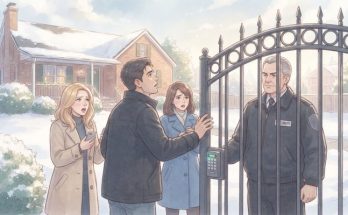
Outside, snow covered the driveway where Michael once tried to climb the gate.
Inside, my home was full of voices.
Not the voices of people discussing what would happen after I died.
The voices of people grateful that I was alive.
I had spent most of my life believing a good mother kept every door open.
I know better now.
A good mother can love her children and still say no.
A widow can honor her husband and still tell the truth about him.
A woman can forgive and still refuse access.
And growing old does not turn a living person into someone else’s future property.
My name is Margaret Hale.
I was seventy-two when my children told me to stop calling.
At seventy-five, I no longer waited beside a silent phone.
I had my own work.
My own friends.
My own plans.
My own life.
My children had been right about one thing.
They had their own lives.
But they had forgotten something far more important.
I had mine too.
And this time, I intended to live every day of it before leaving anyone a single thing.
THE END!!

One Comment on “PART9: My three children told me, “Stop calling us. We have our own lives.” So I stopped calling. I stopped asking them to visit. I stopped waiting for them to care”