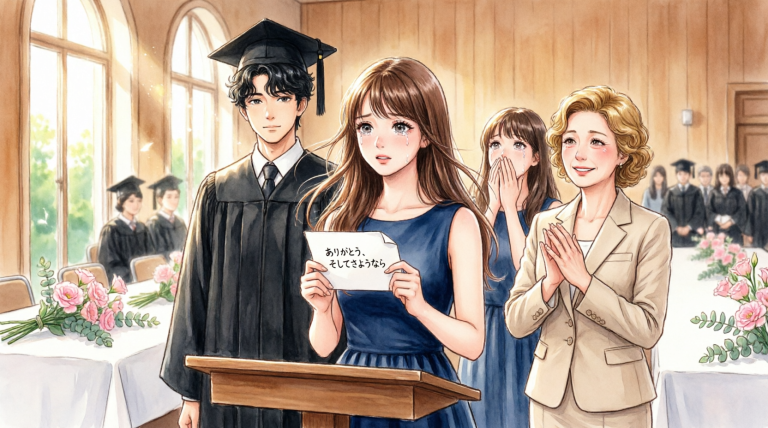


On the morning my son graduated from college, he told me I would be better off sitting in the audience.
He said it gently.

That was the part that hurt most.
Daniel stood in the hallway of my small brick house, turning slightly in front of the narrow mirror beside the coat closet.
His black gown hung from his shoulders, still folded in stiff places from the garment bag.
The gold cords around his neck caught the morning light coming through the front windows.

For a second, he looked like every prayer I had ever whispered had put on a cap and gown.
Then I reached up to smooth the collar of his shirt.
He moved away.
“Mom,” he said, his voice low.
“Please.”
My hand stayed in the air between us.
I pulled it back slowly and tucked it against my purse strap.
“I just wanted the collar to sit right,” I said.
“I know.” He exhaled through his nose and glanced toward the kitchen.
“But I need today to go smoothly.”
From the kitchen came Valerie’s laugh, soft and bright, followed by her mother’s voice.
Beatrice Langford always sounded composed, even when she was asking for coffee.
She had arrived that morning in a cream silk dress and pearl earrings, carrying a garment steamer in one hand and a wrapped gift box in the other, as if she had stepped out of a magazine spread about gracious family milestones.
I had been awake since five.
I had ironed Daniel’s shirt twice.
I had packed tissues, water, safety pins, and a protein bar because I still remembered him getting dizzy before his eighth-grade awards ceremony.
I had placed a slim envelope in my purse, inside of which sat a letter I had rewritten four times and a small key on a red ribbon.
The key was to the old cedar chest in my bedroom.
Inside that chest were every receipt, every acceptance letter, every scholarship form, every late notice, every photo, and every note I had saved from the life we built when there was no one else in the house to build it with us.
I planned to give it to him after the ceremony.
I thought it would mean something.
Daniel adjusted his sleeve and looked toward the kitchen again.
“When you get emotional,” he said carefully, “people don’t always know what to do with that.”
I felt the sentence land softly, then cut deep.
“I see,” I said.
He looked relieved, which hurt in a different way.
Valerie appeared in the doorway a moment later.
She was beautiful in a pale blue dress, nervous and glowing, her hair pinned back with tiny pearl clips.
She smiled at me, but there was discomfort in it, as though she had walked into the room one second too late and still knew something had happened.
“Ready?” she asked Daniel.
“Almost,” he said.
Beatrice stepped behind her, eyes moving over Daniel with admiration.
“You look perfect, sweetheart.”
Sweetheart.
The word slid into the hallway and took up space.
Daniel smiled at her in a way he had not smiled at me all morning.
We left in two cars because Beatrice had arranged for a photographer to meet us on campus before the ceremony.
She said it would be easier that
way.
She was always saying things would be easier.
The campus was already alive when we arrived.
White folding chairs spread across the lawn in clean rows.
Faculty members in velvet-trimmed robes crossed the stage like dark birds.
Families walked under the pale blue sky with flowers wrapped in tissue paper and phones held high, ready to turn joy into proof.
I stood for a moment beside the parking lot and let myself take it in.
This was the day I had pictured while working the overnight desk at the medical center.
This was the day I had imagined while clipping coupons at the kitchen table and pretending I was not counting the same twenty-dollar bill twice.
This was the day I carried in my head when Daniel came home from high school exhausted, certain he was not good enough for the colleges on his list.
I had told him then, “We will find a way.”
I had said it before I knew what it would cost.
Near the science building, the photographer began arranging everyone for pictures.
Daniel with Valerie first.
Then Daniel with Valerie and her parents.
Then Daniel with Beatrice alone because, she said, they had become very close during his final year.
I waited with my purse over my wrist.
At one point, Valerie turned and asked, “Should we get one with your mom?”
Daniel’s eyes flicked toward me, then toward Beatrice.
“Yeah,” he said.
“In a minute.”
But the minute became another pose, and then another adjustment, and then a group of Daniel’s friends arrived.
Someone handed him a bouquet.
Someone else asked about the graduate fellowship he had been offered.
Beatrice placed one hand at his back, guiding him toward better light.
I watched from beside a brick planter full of red geraniums.
A woman I did not know smiled at me and said, “Your son?”
“Yes,” I said.
“He looks so proud.”
I almost answered, “So do I.”
But my throat closed before I could.
When the announcement came for graduates to form the procession, everyone began moving toward the walkway near the stage.
Daniel straightened his cap.
I stepped closer, ready to walk beside him, ready for the small ceremonial moment that had been described in the family instructions emailed the week before.
One family member could accompany each honor graduate to the front seating area.
I had read that line so many times.
Daniel turned to me.
“You can head to your seat,” he said.
I stared at him.
“I thought I was walking in with you.”
He looked uncomfortable, but not surprised.
“Mom, I just think it’ll be better if you sit with everyone else.”
“Everyone else?”
His jaw tightened.
“Please don’t make this hard.”
The words were quiet, but they reached places in me I had kept carefully covered.
Before I could answer, he looked past me.
“Beatrice,” he called.
“Would you walk in with me?”
She put one hand to her chest.
“Oh, Daniel.
I would be honored.”
Valerie’s face changed.
Just slightly.
Her smile dropped, then returned in a smaller shape.
I waited for Daniel to look at me again.
He did not.
So I nodded once and stepped away.
I have learned that there are kinds of humiliation that do not make noise.
They do not
need shouting.
They do not need slammed doors.
Sometimes they happen in daylight, with string music playing and polite people all around you, while your only child gives another woman the place you spent your life earning.
I walked to the audience and found a seat three sections back.
Around me, families were laughing, rearranging programs, pointing toward the line of graduates.
A father behind me told his daughter to stand up straight so her grandmother could get a photo.
A mother in the row ahead dabbed at her eyes before anything had even begun.
I folded my hands over the envelope in my lap.
The procession started.
Daniel walked in beside Beatrice.
She looked radiant.
She touched his arm lightly as they moved, as though she were presenting him to the world.
People clapped.
Cameras rose.
Daniel smiled with the relaxed confidence of a young man who believed he had chosen the easier version of the day.
When they passed my row, Beatrice glanced at me.
Her smile was not cruel enough for anyone else to notice.
But I noticed.
The ceremony began under a clean, bright sky.
Speeches floated across the lawn.
The dean spoke about excellence, service, and the courage to pursue difficult things.
A brass ensemble played between sections.
Graduates shifted in their seats and adjusted tassels.
I listened, but part of me was far away.
I kept seeing Daniel at six years old, asleep on the couch with a library book open on his chest.
I saw him at twelve, crying because the other boys had laughed at his secondhand shoes.
I saw him at seventeen, opening his college acceptance letter with shaking hands, then turning to me with a face so full of disbelief that I had to sit down.
He had asked me then, “Can we afford it?”
I had lied with my whole heart.
“Yes,” I told him.
“We will make it work.”
Making it work had meant extra shifts.
It had meant cleaning offices on weekends.
It had meant selling my wedding ring after his father died because grief did not pay tuition deposits.
It had meant pretending the car was fine when the engine warning light glowed for six months.
It had meant answering every call from financial aid with a notebook open and a pen in my hand.
It had meant never telling Daniel how close he came to having to come home after sophomore year.
When Daniel’s name was called, the crowd cheered.
I stood before I could stop myself.
“Daniel Harper,” the dean announced, “summa cum laude.”
He crossed the stage tall and smiling.
He shook the dean’s hand.
His cords flashed in the sun.
Valerie cried openly.
Beatrice clasped both hands beneath her chin, perfectly moved, perfectly seen.
Daniel turned for the photographer.
He did not look for me.
I clapped until my palms stung.
After the ceremony, everyone drifted toward the alumni hall for the reception.
The room was cool and bright, with long tables covered in white cloth and trays of fruit, pastries, sparkling water, and small sandwiches.
Sunlight poured through tall windows.
Laughter bounced off the polished floor.
I found Daniel near the windows surrounded by Valerie’s family and two professors.
He was laughing.
It was the easy laugh I had not heard
PART 2-At graduation, he took his mother’s position, and the dean later revealed the truth.



from him in months.
I waited until the professors stepped away, then moved closer.


“You were wonderful,” I said.
Daniel turned.

For an instant, his face softened.
Then he seemed to remember where he was.
“Thanks, Mom.”
I pulled the envelope from my purse.
“I brought something for you.”
He looked at it, but did not reach for it.
“Maybe later,” he said.
“We’re going to speak with the dean and some department people.”
“It will only take a second.”
His eyes tightened.
“Mom.”
Just that.
Not loud.
Not angry.
A warning wrapped in exhaustion.
Beatrice appeared at his side and touched his sleeve.
“There you are, dear.
Dr.
Whitman is waiting.”
Daniel turned toward her immediately.
The envelope remained between us, unwanted.
Something inside me shifted then.
I had accepted many things in my life because I believed love required endurance.
I had accepted loneliness.
I had accepted fear.
I had accepted doing without so Daniel could have more.
But standing there with that envelope in my hand, I understood something I should have understood sooner.
Love can be patient without being invisible.
I stepped back.
No speech.
No tears.
No demand for a photograph.
I found an empty chair near the far wall and sat down.
From there, I watched the room arrange itself around status.
Valerie’s father spoke about a dinner reservation overlooking the river.
Beatrice introduced Daniel to alumni as though she had guided him from kindergarten to graduation.
Daniel leaned into that world eagerly, maybe because it was beautiful, maybe because it felt easier than remembering the old one.
I was not angry at his ambition.
I had fed it.
What broke my heart was the shame that seemed to come with it now.
A few minutes later, the dean returned to the microphone at the front of the hall.
Conversations softened, then quieted.
I assumed he was going to offer a final thank-you before everyone left for private celebrations.
Instead, he rested both hands on the podium and looked out across the room.
“Before we close,” he said, “there is one more recognition I would like to make.”
People shifted, curious but polite.
“Every year,” the dean continued, “we honor students whose achievements are visible.
Their grades are visible.
Their awards are visible.
Their names are printed in programs like the ones you are holding today.”
He paused.
“But there are other names that do not appear in those programs.
Names attached to night shifts, second jobs, long drives, hard conversations, and sacrifices a student may not fully understand until much later.”
My fingers tightened around the envelope.
Across the room, Daniel went still.
The dean looked down at a card in his hand.
“This year, our faculty asked permission to recognize a parent whose quiet perseverance became part of this institution’s story.”
A strange buzzing filled my ears.
I looked behind me, as though there might be another mother in the room waiting to be called.
The dean raised his eyes.
“Mrs.
Elaine Harper,” he said, “would you please join us on stage?”
For a moment, I did not stand.
The room turned toward me in waves.
Valerie covered her mouth.
Beatrice’s hand dropped from Daniel’s sleeve.
Daniel’s face drained of color so quickly that he looked younger, almost like the boy who
used to stand in my kitchen asking if we could afford the field trip.
I rose because staying seated would have looked stranger than moving.
The walk to the front felt longer than the entire morning.
I could feel every eye on my simple navy dress, my sensible shoes, the envelope pressed against my chest.
The dean stepped away from the podium and offered me his hand.
His expression was gentle, but there was something firm underneath it.
“Mrs.
Harper,” he said into the microphone, “most people in this room do not know your name.
But many of us know your work.”
A quiet murmur moved through the hall.
He continued, “Four years ago, when Daniel Harper was admitted to this university, our financial aid office received a letter from his mother.
It was not a complaint.
It was not a request for special treatment.
It was a promise.”
My breath caught.
I remembered the letter.
I had written it at two in the morning after Daniel’s first aid package still left a gap I did not know how to cover.
I had not told Daniel because he already looked terrified.
I had told the school that if they could help him get started, I would do everything in my power to keep him there.
The dean lifted the paper.
“With Mrs.
Harper’s permission, I will read one sentence from that letter.”
I had not given permission.
Not exactly.
Months earlier, a woman from the dean’s office had called and asked whether the university could acknowledge my contribution to Daniel’s success.
I thought she meant in a private note.
I had said they could do whatever they thought appropriate, as long as it did not embarrass Daniel.
The dean read, “My son has spent his life believing the world is bigger than what we have been able to afford.
Please do not let my bank account be the thing that teaches him otherwise.”
The room went silent.
Not polite silent.
Pierced silent.
Daniel lowered his head.
The dean folded the paper carefully.
“Over the next four years, Mrs.
Harper kept that promise.
She worked with our aid office.
She made payments in amounts large and small.
She sent updates when circumstances changed.
When Daniel was selected for a departmental research trip his junior year and considered declining because of cost, Mrs.
Harper privately covered the balance before he even knew there was one.”
Daniel looked up sharply.
I did not look at him.
I could not.
The dean turned slightly toward the audience.
“She also declined to be listed in donor acknowledgments after making a final gift this spring to our student emergency fund, a gift made in honor of her late husband and in gratitude for the aid Daniel received when he began here.”
A soft sound came from somewhere near the windows.
Valerie was crying.
Beatrice stood frozen, her face arranged carefully, but the confidence had gone out of it.
The dean smiled at me.
“Mrs.
Harper asked for no recognition.
In fact, she requested privacy.
But Daniel’s faculty felt strongly that today’s celebration would be incomplete without naming the person whose unseen labor made much of it possible.”
He picked up a small framed certificate from the table beside the podium.
“On behalf of the College of
Arts and Sciences, we would like to honor Elaine Harper with our first Family Stewardship Recognition, for extraordinary devotion, sacrifice, and service to a graduate of this university.”
Applause began slowly, then rose.
It was not the quick applause people give because a program requires it.
People stood.
One row, then another.
I saw professors standing.
I saw parents standing.
I saw Valerie press both hands over her face.
I saw Daniel standing in the center of it all, still and stunned, with shame written across him so plainly that for the first time all day, I recognized my son.
The dean handed me the frame.
My hands trembled.
“Would you like to say anything?” he asked softly.
I looked at the microphone.
Every part of me wanted to disappear.
Then I saw Daniel take one step forward.
So I leaned toward the microphone.
“I do not know what to say,” I began.
My voice shook, but it held.
“I only did what mothers do when they love their children.
I was proud to do it.
I am proud of my son today.”
Daniel’s eyes filled.
I swallowed and continued, “But I hope every graduate in this room remembers that no one arrives at a stage alone.
Sometimes the people who helped you get there are not the ones standing closest when the cameras come out.”
The room went very quiet again.
I did not look at Beatrice when I said it.
I did not need to.
When I stepped away from the microphone, the applause returned, warmer this time, almost protective.
The dean helped me down from the stage.
Before I reached the floor, Daniel was already there.
“Mom,” he said.
It was the first time all day he had said the word like he needed me.
His face crumpled.
“I didn’t know.”
I held the framed certificate against my side.
“You knew enough.”
The words were not sharp, but they landed.
He flinched.
“I knew you helped,” he said.
“I knew you worked hard.
I just didn’t know all of it.”
“No,” I said.
“You did not.
But that is not why today hurt.”
He wiped his eyes with the heel of his hand, suddenly careless about who might see.
“I’m sorry.”
Behind him, Valerie stepped forward, crying openly now.
“Elaine,” she said, voice breaking, “I’m so sorry.
I asked him this morning if you were walking with him.
He told me you preferred to sit.”
Daniel closed his eyes.
There it was.
Not the whole wound, but enough of it.
Beatrice approached slowly, her smile pale.
“I’m sure this was all just a misunderstanding.
Graduation days are emotional for everyone.”
I looked at her then.
For the first time that day, I did not make myself smaller.
“No,” I said.
“It was not a misunderstanding.”
The people nearest us pretended not to listen while listening completely.
Beatrice’s face tightened.
“I only wanted Daniel to feel supported.”
“So did I,” I said.
“For twenty-two years.”
Valerie turned toward her mother.
“Mom, you told me Elaine didn’t like ceremonies.”
Beatrice’s mouth opened, then closed.
Daniel stared at her.
“You said she would be more comfortable in the audience.”
“I said she might be,” Beatrice replied quickly.
“I did not tell you what to do.”
“No,” Daniel said slowly, pain
rising through his voice.
“But you made it sound like choosing you would make things easier.”
Beatrice looked around, aware now of how visible she had become.
“This is not the place.”
I almost laughed.
All day, everyone had found places to diminish me.
Now, suddenly, there was no proper place to tell the truth.
Daniel turned back to me.
“I am so sorry,” he said again.
“I was embarrassed by the wrong things.
I thought looking polished mattered.
I thought fitting into their world mattered.
I let you stand aside because I didn’t want anything complicated.”
His voice broke.
“And you were the whole reason I was standing there.”
I looked at my son, really looked at him.
He was twenty-two years old, brilliant and foolish, proud and ashamed, still learning the cost of becoming a man.
I wanted to reach for him the way I always had.
I wanted to smooth his collar, fix the hurt, make it easy.
But love had already been too easy for him to overlook.
I pulled the envelope from my purse and held it out.
This time, he took it with both hands.
“I was going to give you this after the ceremony,” I said.
He looked down.
“What is it?”
“A letter.
And a key to the cedar chest in my room.
Everything is in there.
Not because I want you to feel guilty, but because you are old enough to know what it took.”
His tears fell onto the envelope.
“I don’t deserve it,” he whispered.
“No,” I said.
“You do not deserve to be punished forever for one cruel day.
But you do need to understand it.”
Valerie reached for his hand, but she was looking at me.
“He will,” she said quietly.
“I’ll make sure we both do.”
Beatrice stepped back, her expression stiff.
The dinner by the river still happened, but not the way she had planned.
Daniel moved my chair beside his before anyone else sat down.
When the server came, he asked me what I wanted first.
It was a small thing.
Too small to erase anything.
But it was the first honest thing he had done all day.
Later, after dessert no one finished, Daniel asked me to walk outside with him.
The river was dark blue under the evening lights.
He held the envelope, now opened, folded carefully in one hand.
“I read the first page,” he said.
“I couldn’t read the rest in there.”
“That is all right.”
He stared at the water.
“I made you invisible.”
I did not soften it for him.
“Yes.”
He nodded, crying again, but quietly this time.
“I don’t know how to fix it.”
“You start by never asking me to disappear so you can feel more comfortable.”
He looked at me then.
“I won’t.”
I believed he meant it.
I also knew meaning it was only the beginning.
When he finally hugged me, I let him.
I held him as a mother holds the child she raised, but I did not pretend the day had not happened.
Forgiveness, I have learned, is not the same as erasing the record.
Sometimes love keeps the record so the lesson can survive.
A week later, Daniel sent me the graduation photos.
There were dozens of him with Valerie,
with professors, with Beatrice, with friends.
Then at the end was one new picture.
It had been taken by someone in the alumni hall at the moment I stood beside the dean, holding the certificate with both hands.
In the background, Daniel was watching me with his hand over his mouth, finally seeing what everyone else in that room had just learned.
He had captioned it with only six words.
“The person who got me here.”
I saved the photo, but I did not reply right away.
Some apologies are real.
Some lessons are painful enough to last.
And sometimes the hardest part of motherhood is deciding whether a child who finally sees you has earned the same closeness he once took for granted.
THE END.
