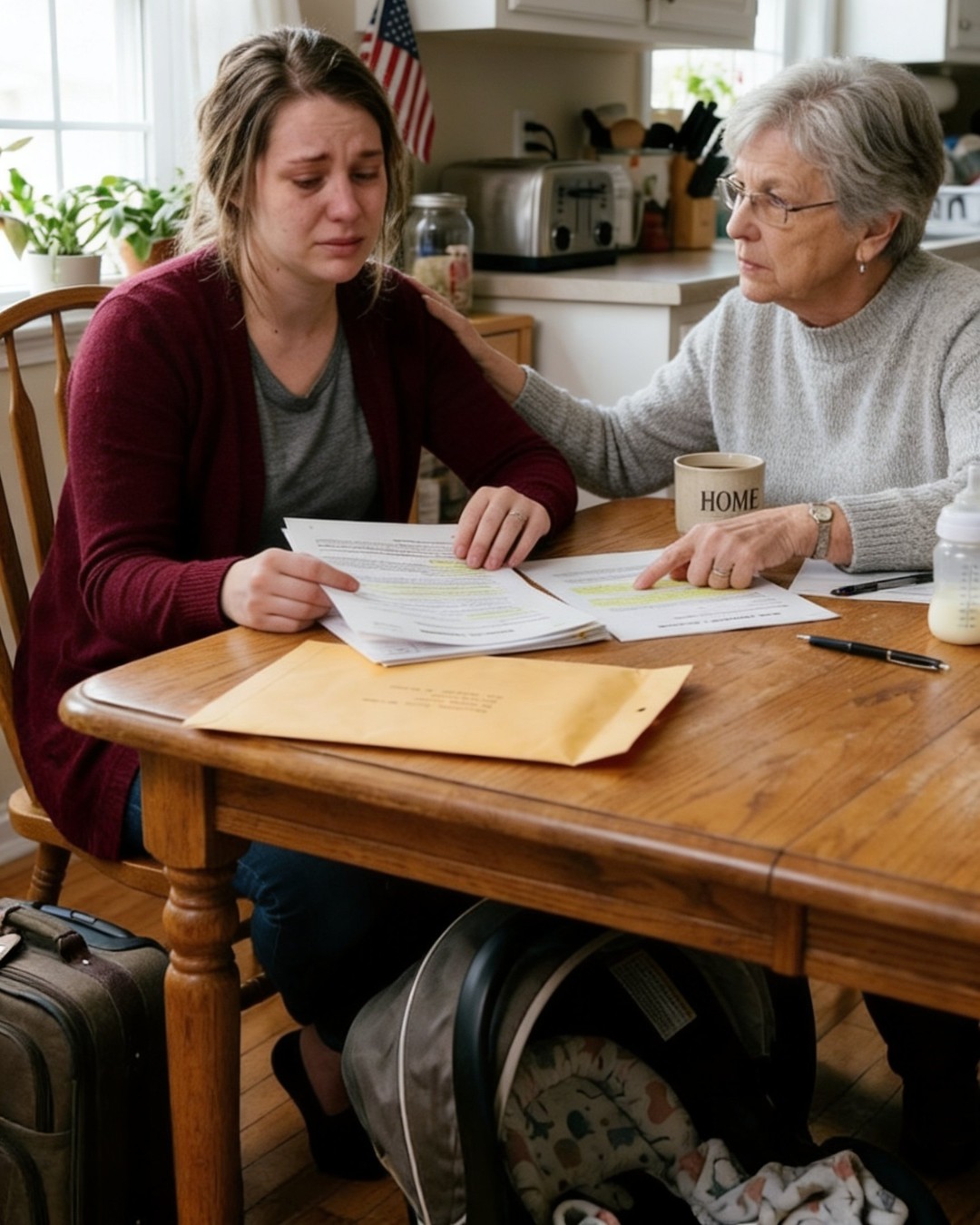
I knew the sound before I knew what it meant. The kitchen tile was cold under my bare feet, and bacon grease hung in the air with burnt coffee and the sour little smell of a baby bottle that had been warming too long in a mug of water. His cheek was damp against my T-shirt, his little fist twisted into the stretched-out collar, and his breath came in those tiny uneven pulls that only a newborn can make. I had been awake since midnight. Mark’s parents were coming at eight. His sister had texted at 1:17 a.m. to remind me that their mother liked her eggs soft and her toast dry. She had written it like a work order. Just instructions, delivered to a woman who had given birth eight weeks earlier and still moved through the house like her bones had not been fully put back in place. The refrigerator hummed. The pan hissed.



Mark’s key scraped in the lock. I tightened my arm around the baby before I turned around. Some part of me already knew that whatever had walked into that kitchen was not my husband coming home. It was the end wearing his navy suit. Mark stepped inside with his tie loose and his hair damp from the morning fog. He smelled faintly of expensive soap, cold air, and somebody else’s night. The folded napkins. The clean plates. The eggs waiting in a covered pan. The bottle beside the coffee. Then he looked at me like I was already furniture. “Divorce,” he said. No apology. No explanation. No softening of his voice because his son was sleeping against my chest. Just one word dropped into a kitchen where his wife was barefoot, exhausted, and still trying to keep breakfast warm for the people who had spent years treating her like hired help.


For one second, my heart hit my ribs so hard I thought the baby would wake.
But he only sighed, warm and small, milk on his breath.

I did not ask who she was.
I did not ask how long.


I did not ask whether his parents knew.
Women are taught to believe details make betrayal bearable.
They do not.
Details only give betrayal a floor plan.
So I reached over, turned off the stove, and tightened my arm around my son.
Mark blinked.
My silence bothered him more than my pain.
“Did you hear me?” he asked.
“I heard you.”
The answer came out even.
That surprised both of us.
I walked past him into the bedroom.
He did not follow at first.
I could feel him standing in the kitchen, waiting for the scene he thought he had earned.
Crying.
Begging.
Questions.
A woman trying to convince him not to abandon the life she had been holding together with dry toast, late-night feedings, and a smile for his mother.
But I had spent enough years auditing men who believed panic was a female condition.
Panic wastes time.
Inventory does not.
I pulled my old navy suitcase from the closet and began packing.
Diapers.
Bottles.
Two sleepers.
My laptop.
My birth certificate.
The baby’s hospital discharge papers.
Then I knelt beside the nightstand and pressed my fingers behind the loose back panel.
The folder was still there.
I had hidden it months earlier, back when I still hoped I would never need it.
Hope is a sweet thing until it becomes a blindfold.
My hands did not shake when I packed it.
That scared me more than crying would have.
By 4:52 a.m., I was standing in the driveway with my son buckled into his car seat, my suitcase beside my old SUV, and the small porch flag tapping softly in the wind.
The sky was still gray.
The neighborhood was quiet in that strange hour before garage doors and school buses and sprinklers.
Mark leaned against the doorframe with his phone in his hand.
“Where are you going?” he asked, like I was being dramatic.
“Out.”
His mouth twitched.
He thought I meant my mother’s house.
He thought I meant a cheap motel.
He thought I would be back before lunch because his family would arrive and somebody still had to serve breakfast.
Men like Mark do not fear quiet women.
They mistake restraint for permission.
I loaded my son into the back seat.
For one ugly heartbeat, I wanted to turn around and tell him everything I knew.
I wanted to see his face when he understood what had been sitting in that folder while he smiled across dinner tables and told people I was “taking a break from work.”
Instead, I closed the car door carefully so the baby would not wake.
Then I drove away.
At 6:08 a.m., I was sitting at the kitchen table of Mrs. Henderson, the retired partner who had trained me ten years earlier.
Her house smelled like peppermint tea and lemon furniture polish.
A small American flag sat in a jar by the window beside a stack of old tax journals.
She did not hug me right away.
That was why I trusted her.
Mrs. Henderson had never wasted comfort where clarity was needed.
She put a mug in front of me, looked at the baby sleeping in the car seat by my foot, and said, “He said it while you were holding the baby?”
I nodded.
“And you left?”
“I packed one suitcase.”
Mrs. Henderson smiled without warmth.
“Good. Let him think that was all you had.”
I looked down at my son.
His little mouth moved in his sleep.
“His family thinks I’m helpless,” I said.
“No,” she said, sliding a yellow legal pad toward me. “They need you to be helpless. That’s different.”
By 7:31 a.m., Mark’s mother called.
I let it ring.
Then his sister.
Then Mark again.
By 8:04, he texted.
My parents are here. Don’t embarrass me.
I read it twice while my son made tiny sleeping sounds beside my ankle.
The nerve of that message almost made me laugh.
Not because it was funny.
Because he had destroyed our marriage at dawn and still believed the real emergency was whether his mother got breakfast.
I opened my laptop.
Before I married Mark, before I learned which serving bowl his mother preferred and which shirts needed dry cleaning, I was a senior corporate auditor.
I knew how to read what men hid between line items.
I knew how shell companies breathed.
I knew how family money disappeared through consulting fees, vendor advances, and bank transfers scheduled at 2:13 a.m.
For eight months, I had documented everything.
Screenshots.
Account numbers.
Wire transfer ledgers.
A county clerk filing connected to a property Mark swore he never owned.
A folder labeled HOME EXPENSES that had nothing to do with our home.
Not suspicion.
Not jealousy.
Proof.
Mrs. Henderson did not ask me whether I was sure.
That is another reason I trusted her.
She looked through the first five pages and said, “Who else has seen this?”
“No one.”
“Good.”
The first thing she did was call a forensic accountant she trusted.
The second thing she did was make me print every document twice.
The third thing she did was take my phone, turn off the message previews, and place it face down on the table.
“You do not answer him emotionally,” she said.
“I wasn’t planning to.”
“I know. I am saying it out loud because women get blamed later for the tone they used while surviving.”
That sentence stayed with me.
At 9:46 a.m., Mark texted again.
You’ll get nothing if you make this ugly.
PART 2-At 4:30 A.M., my husband came home, saw me holding our 2-month-old baby while I cooked breakfast for his whole family-tete
I stared at those words, then looked at the baby bottle cooling beside my coffee. He still thought the marriage was the only thing I could lose. Mrs. Henderson placed the first printed report in front of me. “Start with the account he opened three weeks before the baby was born,” she said. I turned the page. There was Mark’s signature. There was the transfer I had never authorized. And beside it, in black ink, was a name that made Mrs. Henderson stop breathing for half a second. She did not touch the page at first. She leaned closer, her reading glasses low on her nose. The lemon-polish quiet of her kitchen seemed to tighten around us. My son stirred in his car seat. I pressed my foot gently against the carrier like I could keep the whole world steady with one toe. “That name,” I whispered. Mrs. Henderson looked at me, then back at the report. “You know her.”


I laughed once, but it came out flat. Because the name beside Mark’s unauthorized transfer was not a stranger. It was not a girlfriend. It was not a vendor. It was tied to the woman who had been calling me since 7:31 a.m., furious that I was not home frying eggs for guests who already knew more than they had admitted. Mark’s mother. Her name was on the account. Not as a victim. Not as a confused parent. As a receiving party. I sat very still. There is a special kind of cold that enters you when betrayal stops being romantic and becomes architectural. One person hurts you. A family builds the room where it happens. Mrs. Henderson reached for the second envelope. I had not opened that one yet. It was thinner than the others, sealed with a white county clerk label. When she slid the pages out, a second document fell onto the table.
A notarized spousal acknowledgment.
My initials were on it.

Only they were not mine.
The slant was wrong.


The pressure was wrong.
The little hook at the end of the last letter was something I had not done since college.
Even sleep-deprived and bruised from the inside out, I could see it.
Mrs. Henderson’s face changed.
Not anger.
Worse.
Professional focus.
She picked up the document by the corner and said, “Do not touch this again.”
At 10:03 a.m., Mark called.
This time, Mrs. Henderson nodded for me to answer.
I put it on speaker.
His voice came through sharp and low.
“Where are you?”
I looked at the forged initials.
Then at the account name.
Then at my sleeping son.
Before I could say anything, Mark’s mother’s voice came through behind him.
“Did she find it?”
The room went silent.
Even the refrigerator seemed to stop humming.
Mark hissed something away from the phone.
His mother said, “I told you she was always too quiet.”
Mrs. Henderson took the legal pad and wrote three words in block letters.
Do not react.
So I did not.
I breathed in.
I breathed out.
Then I said, “Find what?”
There was a pause.
A tiny one.
But I had spent years listening for tiny pauses in conference rooms, depositions, and audit calls.
People think lies sound like words.
They sound like timing.
Mark came back on the line.
“You need to come home.”
“No.”
“My parents are here.”
“I know.”
“You are making this worse.”
“No, Mark. I am documenting it.”
Mrs. Henderson’s pen stopped moving.
On the other end of the phone, nobody spoke.
That was the first moment he understood I was not standing in some motel bathroom with a crying baby and an empty checking account.
I was sitting across from the woman who had taught me how to dismantle a ledger without raising my voice.
Mrs. Henderson turned over the last page of the acknowledgment and pointed to one more signature.
Not Mark’s.
Not mine.
His mother’s.
Witness.
I looked at the word until it blurred.
Then I understood why she had treated me like staff.
Staff can be dismissed.
A wife with proof cannot.
Mark said, quieter now, “What do you want?”
That question should have made me feel powerful.
It did not.
Power, I learned that morning, does not always arrive like fire.
Sometimes it arrives as a tired woman in yesterday’s T-shirt, holding a baby bottle and refusing to be hurried.
“I want every communication in writing,” I said.
Mrs. Henderson nodded once.
“I want you to stop contacting me except about the baby.”
He scoffed, but there was no strength in it.
“And I want you to tell your mother that the next time she says my name, she should remember hers is already on the paperwork.”
His mother made a sound then.
Small.
Cracked.
Not guilt.
Fear.
Then the line went dead.
For a few seconds, nobody moved.
The baby slept on.
The coffee cooled.
The little American flag by the window barely stirred in the heat from the vent.
Mrs. Henderson gathered the papers into neat piles.
“Now,” she said, “we do this correctly.”
Correctly meant copies.
Correctly meant dates.
Correctly meant a timeline that began before my son was born and ended with the phone call where Mark’s mother had asked whether I had found it.
Correctly meant no dramatic posts, no angry voicemail, no late-night texts that could be twisted later.
By noon, the forensic accountant had confirmed the first account trail.
By 2:15 p.m., Mrs. Henderson had marked the forged initials on the acknowledgment and placed the original in a clear sleeve.
By 4:40 p.m., I had fed my son, changed him on a folded towel in her guest room, and finally sat down on the edge of the bed long enough to realize my whole life had split open.
That was when I cried.
Not in the kitchen.
Not in the driveway.
Not when Mark said divorce like he was ordering me out of his way.
I cried in a quiet guest room because my baby grabbed my finger in his sleep and held on like I was still the whole world.
Mrs. Henderson found me there.
She did not ask me to be strong.
She put a sandwich on the nightstand and said, “Eat half. Then we keep going.”
That was the kind of kindness I could survive.
The next morning, Mark sent an email.
It was formal in the way cowards become formal when they realize casual cruelty has been recorded.
He wrote that we had both been emotional.
He wrote that decisions made at 4:30 a.m. should not define a marriage.
He wrote that he hoped we could handle things privately for the sake of our son.
Mrs. Henderson read it once and said, “He is not asking for peace. He is asking for privacy.”
There was a difference.
There had always been a difference.
Over the next week, the story Mark had planned for me began to fall apart.
His family had expected me to be embarrassed.
They had expected me to come back because the baby needed diapers and I needed money.
They had expected me to trade silence for temporary comfort.
Instead, there were records.
There were transfers.
There were signatures.
There was the county clerk filing.
There was the spousal acknowledgment with my copied initials.
There was the account opened three weeks before my son was born.
And there was the 10:03 a.m. call, where his mother’s first instinct had not been confusion or concern.
It had been, “Did she find it?”
That sentence did more than expose her.
It exposed the family habit.
They did not panic because Mark had ended his marriage.
They panicked because I had taken the folder.
Weeks later, when Mark finally sat across from me in a plain conference room with his lawyer beside him, he looked smaller than he had in our kitchen.
His suit was still expensive.
His hair was still perfect.
But his confidence had thinned.
Mrs. Henderson sat on my side of the table.
My son was with a sitter she trusted.
For the first time in months, my arms were empty.
They felt strange that way.
Mark’s lawyer opened with the kind of polite language people use when they hope documents will behave like feelings.
Mrs. Henderson let him talk.
Then she opened the file.
She placed the wire transfer ledger on the table.
She placed the county clerk filing beside it.
She placed the spousal acknowledgment last.
Mark stared at it.
His lawyer stared longer.
Then his lawyer looked at him in a way I had seen only once before, during an audit where a CFO realized his own counsel had not been told the truth.
I did not smile.
I did not need to.
My silence, once mistaken for weakness, had become the room’s most expensive fact.
Mark asked for a private minute.
Mrs. Henderson said no.
He looked at me then.
Really looked.
Not at the wife who made coffee.
Not at the tired woman with a baby on her chest.
Not at the person he thought would fold under shame.
At the senior corporate auditor he had forgotten existed.
“I didn’t think you’d go this far,” he said.
That was the closest he came to telling the truth.
I looked back at him and thought of the cold kitchen tile, the bacon grease, the bottle warming too long, the one word he had dropped on me while our son slept against my chest.
Divorce.
He had thought it was a weapon.
It turned out to be a door.
I walked through it with one suitcase, one baby, and a folder he should have feared more than my tears.
He thought I had nothing.
He forgot what I did before I became his wife.
And by the time he remembered, the proof was already on the table.
THE END.
