
At exactly 12:01 a.m. on my eighteenth birthday, I stole my future back from the people who had been smiling while sharpening knives behind my back.
The Beverly Hills mansion was silent around me, glowing under soft gold lights like a palace built for ghosts. Downstairs, my mother slept in silk sheets bought with money she had married into. My stepfather, Richard, probably slept with his phone beside his face, waiting for markets to open and lies to mature. My half-sister Chloe dreamed in designer logos, luxury cars, and the belief that the world owed her applause.
And I sat alone in the smallest bedroom of the house, my late father’s photograph beside my laptop, my fingers trembling over the keyboard.
Forty-five million dollars.
That was what my father had left me.
Not to make me spoiled. Not to make me powerful. He had left it because he knew my mother better than I did.
When I clicked the final confirmation, the screen flashed once.
Transfer complete.
By 12:04 a.m., my entire inheritance was inside an irrevocable corporate trust, protected by clauses my family could not touch, control, borrow against, or charm their way into.
For the first time in years, I breathed.
Then I whispered to the photograph, “Happy birthday to me, Dad.”
By sunrise, they were waiting in the kitchen.
My mother stood beside the marble island wearing cream cashmere and a perfect smile. A birthday pastry sat on a porcelain plate, untouched and ridiculous, with one pink candle stabbed into the center. Next to it lay a manila folder thick with papers.
Richard leaned against the counter, calm and polished, a blue pen resting between his fingers.
Chloe sat on a stool, scrolling through her phone with glittering nails, already bored by a day that was supposed to belong to me.
“Good morning, sweetheart,” my mother said. “Happy birthday.”
I looked at the folder.
“Thanks.”
Richard slid the pen across the counter. “Now that you’re legally an adult, we need to handle some family business.”
Chloe smiled without looking up. “Don’t make it dramatic, Mia. It’s just paperwork.”
Just paperwork.
That was what they called the trap.
For most of my childhood, I believed loneliness had a sound. It was the echo of my footsteps on polished floors. It was laughter from rooms I was not invited into. It was my mother saying, “Not now,” until the words became a wall.
After my father died, I moved into that mansion with my mother and her new husband. From the outside, our life looked perfect. Glass walls, ocean views, imported stone, charity galas, photographers, captions about family.
But inside, I was treated like a guest who had overstayed.
Chloe received the balcony suite with the custom closet and private bathroom. I got the narrow room near the laundry area because, as my mother said, “You’re practical. You don’t need all that space.”
Chloe’s birthdays filled the house with florists, DJs, and celebrities from the internet. Mine were forgotten, postponed, or folded into someone else’s convenience.
Two weeks before I turned eighteen, my mother canceled the small dinner I had asked for all year.
“Chloe needs the terrace for her skincare launch mixer,” she said, as if explaining weather.
Chloe had lifted her eyes from her phone just long enough to say, “Thanks for being easy about it.”
I had smiled.
That was my great talent in that house.
I smiled while disappearing.
They thought I was obedient. Soft. Lonely enough to accept crumbs and call them love.
They never noticed that silence can become a weapon.
The truth found me by accident.
Three days before my birthday, I came home early from school after a calculus review session was canceled. The housekeeper was out. Chloe was at a photoshoot. My mother was at lunch. Richard had left his iPad on the kitchen island.
As I passed it, the screen lit up.
An email notification appeared.
Whitman Family Capital LLC — Execution Draft.
Whitman was my father’s last name.
My hand stopped in midair.
For several seconds, I only stared. I knew opening it was wrong. I knew there were lines people were not supposed to cross.
But then I remembered every canceled birthday. Every locked door. Every “be grateful.” Every time Richard had said “family money” while looking at me like a safe waiting to be opened.
I tapped the screen.
Forty-two pages appeared.
At first, I barely understood the language. It was legal, polished, carefully sanitized. But then phrases began cutting through.
Transfer of assets.
Managing authority.
Family investment vehicle.
Collateral obligations.
Brand development funding.
Eighty percent of my inheritance would be moved into a new company. Richard would control the company. My mother would hold an executive role. Chloe’s failing skincare brand would receive funding. Richard’s collapsing tech business would use my father’s fortune as collateral.
My stomach went cold.
It was not guidance.
It was not protection.
It was theft wearing a tailored suit.
That night at dinner, I watched them with new eyes.
Chloe complained that investors did not take her brand seriously without “real capital behind it.” Richard smiled and said, “That problem will solve itself soon.” My mother reached for my hand and stroked my knuckles like I was five years old.
“You don’t need to worry about complicated financial decisions,” she said softly. “That’s what we’re here for.”
I looked at her face—the face that had kissed my forehead in public and forgotten me in private.
And finally, I understood.
They had not been ignoring me because I was worthless.
They had been waiting until I became useful.
The next morning, I skipped school and went to see Malcolm Price.
He had been my father’s attorney, a severe man with silver hair, narrow glasses, and an office so quiet it felt like a courtroom before sentencing. I brought printed photos of every page. Screenshots. Timestamps. Notes from conversations. Everything.
He read in silence.
When he finished, he removed his glasses.
“They have set a trap,” he said.
My throat tightened. “Can they do it?”
“If you sign after midnight on your birthday, yes. They can make recovery difficult. Very difficult.” His eyes sharpened. “But they made one mistake.”
“What?”
“They assumed you would wait.”
So I didn’t.
At 12:01 a.m., I acted first.
And now, at sunrise, I sat at the kitchen island while my family waited for me to walk willingly into the cage they had built.
My mother opened the folder and turned it toward me.
“This is simply a structure to help manage your father’s money responsibly.”
“My father’s money?” I asked.
Richard’s expression flickered. “Your inheritance, yes. But wealth at this level affects the whole family.”
Chloe finally looked up. “Exactly. And honestly, Mia, it’s not like you need forty-five million dollars just sitting there. I mean, you don’t even like shopping.”
I opened the folder.
Page by page, I read the documents I already knew by heart.
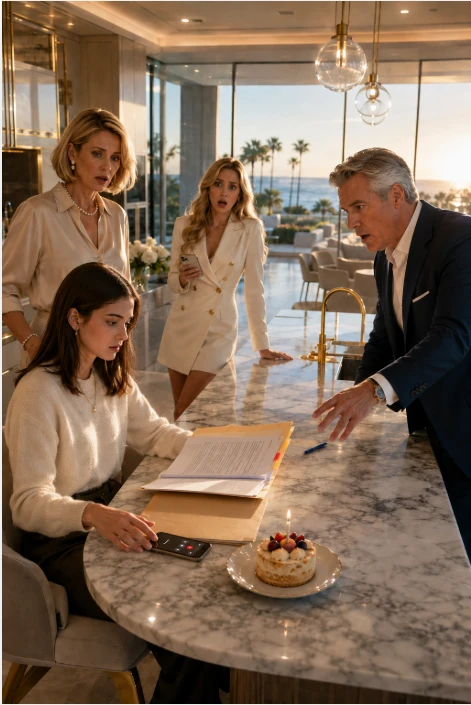
My mother watched my face closely.
Richard’s fingers tapped once against the counter.
Chloe sighed. “Can you hurry? I have a call with a dealership at ten.”
“A dealership?” I asked.
“For the Porsche,” she said, smiling. “It’s good for brand image.”
Something inside me almost laughed.
I reached the final page.
Signature line.
My name printed beneath it.
Mia Whitman.
The name my father gave me.
I placed the papers flat on the counter. Then I took out my phone, set it beside the folder, and tapped one contact.
The call connected.
“Good morning, Mia,” Malcolm Price said.
I pressed speaker.
“Mr. Price,” I said clearly, “you’re on speaker.”
The kitchen went still.
My mother’s smile vanished.
Richard straightened.
Chloe blinked. “Who is that?”
Malcolm’s voice filled the room, dry and precise. “Richard. Elise. I assume the folder in front of Mia contains the Whitman Family Capital documents?”
No one answered.
I looked at Richard. “He asked you a question.”
Richard’s face hardened. “This is a private family matter.”
“No,” Malcolm said. “It became a legal matter the moment you attempted to induce an eighteen-year-old beneficiary to transfer inherited assets into an entity controlled by individuals with direct conflicts of interest.”
My mother grabbed the edge of the island. “Mia, what have you done?”
I met her eyes.
“I protected what Dad left me.”
Richard’s lips parted slightly. Not in anger.
In fear.
Malcolm continued, “At 12:04 this morning, Mia transferred the entirety of her inherited assets into an irrevocable corporate trust. The trust prohibits family-controlled lending, collateralization, management access, and related-party investment without independent board approval.”
Chloe’s mouth fell open. “Wait. So the money is locked?”
“Yes,” I said.
“For how long?”
I looked at her.
“Forever, if necessary.”
My mother slapped the counter so hard the pastry plate jumped.
“How could you do this to us?”
The words hit me harder than I expected. Not because they surprised me, but because some wounded, foolish part of me had still wanted her to say, How could we have made you feel this afraid?
Instead, she said us.
I stood slowly.
“You canceled my birthday dinner for Chloe’s brand launch. You gave her the best room. You let Richard call my father’s legacy family capital. You put papers in front of me before breakfast because you thought I was too desperate for love to read them.”
My voice shook, but it did not break.
“You did this to yourselves.”
Richard’s face had turned gray.
Malcolm said, “There is more.”
I frowned. “More?”
On the other end of the line, papers rustled.
“Mia, after reviewing the draft last night, I investigated Richard’s company filings. His tech business is not merely failing. It is under federal inquiry for investor fraud.”
My mother gasped.
Richard snapped, “That is confidential.”
“So it’s true,” I said.
Chloe slid off the stool. “Dad?”
Richard ignored her. His eyes locked on me, cold and furious.
“You stupid little girl,” he said softly. “Do you have any idea what you’ve ruined?”
There he was.
The man beneath the polished charity dinners.
My mother whispered, “Richard, stop.”
But he was no longer pretending.
“That money was supposed to stabilize everything,” he said. “The company. The house. Chloe’s launch. Your mother’s obligations.”
“My mother’s obligations?” I repeated.
His mouth closed.
The air shifted.
My mother looked like someone had opened a door she had spent years leaning against.
“What obligations?” I asked.
Malcolm’s voice became quieter. “Mia, I need you to listen carefully. Your father amended his estate plan shortly before his death.”
My pulse stumbled.
“My father died in a car accident.”
“Yes,” Malcolm said. “But before that accident, he discovered substantial unauthorized withdrawals from accounts jointly accessible by your mother during their marriage.”
My mother’s face drained of color.
I turned to her. “What is he talking about?”
She shook her head. “Mia…”
Malcolm continued, “Your father chose not to pursue charges immediately because of you. But he created conditions in the trust. If your mother or any spouse of hers attempted to access, coerce, redirect, borrow against, or benefit from your inheritance, a sealed affidavit would be released.”
Richard whispered, “No.”
My mother covered her mouth.
I felt the room tilt.
“What affidavit?”
There was a pause.
Then Malcolm said, “Your father believed his accident might not have been accidental.”
The kitchen disappeared beneath a roaring silence.
Chloe whispered, “What?”
My mother began crying then. Not beautiful tears. Not controlled ones. Real, ugly, terrified sobs.
“I didn’t know,” she said. “I didn’t know he would die.”
I stepped back.
“What does that mean?”
Richard slammed his hand on the counter. “Shut up, Elise.”
But she was unraveling now, thread by thread.
“He was leaving me,” she said. “He found out about the money. About Richard. About everything. He was going to take you, Mia. He said I would never see a cent. Richard said he could scare him. Just scare him.”
My skin went numb.
“Scare him how?”
Richard lunged toward her, but Malcolm’s voice cut through the phone.
“Richard, this call is being recorded.”
Richard froze.
My mother looked at me with a face I had never seen before—not cold, not perfect, not maternal. Just ruined.
“The brakes,” she whispered.
Chloe screamed.
I did not.
I could not.
The world narrowed to my father’s photograph upstairs. His careful hands. His quiet laugh. The way he used to kneel to tie my shoes even when he was late for meetings. The way he had once told me, “Never confuse kindness with weakness, Mia.”
All these years, I thought my mother had abandoned me after grief changed her.
But grief had not changed her.
Guilt had.
Outside, tires crunched against the driveway.
Richard turned toward the windows.
Black SUVs rolled through the gates.
Malcolm said, “Mia, when the trust transfer was completed, the affidavit was automatically transmitted to federal authorities.”
My mother sank to the floor.
Richard stared at me like I had become something impossible.
“You planned this,” he said.
“No,” I whispered. “Dad did.”
The front doorbell rang.
Once.
Then again.
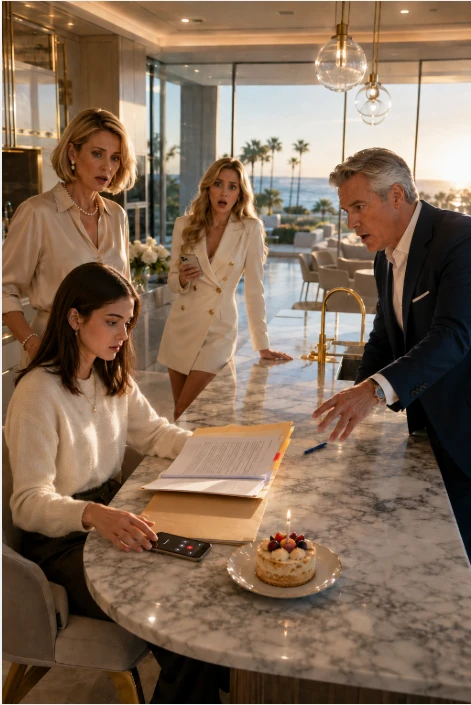
Chloe was sobbing into both hands. My mother rocked on the marble floor, repeating, “I didn’t know he would die,” as if the words could become innocence if she said them enough.
Richard stepped toward me.
For one terrifying second, I saw calculation return to his eyes. Not remorse. Not fear.
Survival.
Then the kitchen doors opened.
Two federal agents entered with badges raised.
“Richard Vale,” one said. “Elise Whitman-Vale. We have warrants for your arrest.”
My mother screamed my name as they lifted her from the floor.
“Mia, please! I’m your mother!”
I looked at her, and at last, the child inside me—the lonely girl in the laundry-room bedroom, the girl who waited for birthday candles that never came—stopped reaching.
“No,” I said quietly. “You were my father’s mistake.”
Richard fought until they forced his hands behind his back. As they dragged him past me, he leaned close enough for me to smell his expensive cologne.
“You think this is over?” he hissed.
I looked him dead in the eyes.
“No,” I said. “I think it finally started.”
Three weeks later, the mansion was empty.
The furniture was covered in white sheets. Chloe had vanished from social media. My mother’s face appeared on news channels beneath words like conspiracy, fraud, and obstruction. Richard’s investors lined up like vultures around his corpse of a company.
I moved into my father’s old beach house, the one place my mother had always called “too sentimental to keep.”
On my first night there, Malcolm arrived with a small locked box.
“Your father left instructions,” he said. “This was to be given to you only after the affidavit was released.”
Inside was a letter.
My hands shook as I opened it.
My dearest Mia,
If you are reading this, then I was right to be afraid, and I am sorry. I tried to protect you from the truth for as long as I could. But I also knew that one day, you might have to protect yourself from the people who mistake love for ownership.
There is something else you must know.
The forty-five million was never the real inheritance.
I stopped breathing.
Malcolm handed me a second document.
My father’s letter continued.
The real inheritance is Whitman Systems. I placed controlling shares in a blind trust under your name before anyone knew what I had built. By the time you turn eighteen, it may be worth far more than money. Use it wisely. Trust slowly. Love bravely. And never let anyone make you small.
I stared at Malcolm.
“How much?” I whispered.
For the first time since I had known him, he smiled.
“Current valuation?” he said. “Just under two billion.”
Outside, the ocean crashed against the cliffs, wild and endless.
I looked down at my father’s signature, and tears finally came—not from fear, not from loneliness, but from the unbearable ache of being loved so carefully by someone who was gone.
Everyone had thought I was the girl waiting to inherit a fortune.
They were wrong.
