The Friday I was supposed to pick up Emily, the late-afternoon heat had settled over the neighborhood so heavily that the inside of my car smelled like old coffee, warm vinyl, and the faint plastic scent of the custody schedule folded in my cup holder.
My blinker clicked at the stoplight while I watched the minutes change on the dashboard.
I kept telling myself the knot in my stomach was traffic.

I should have stopped calling it traffic.
Every other Friday, my ten-year-old daughter came running down the front walk with her backpack half-zipped, her ponytail already coming loose, and at least three things she needed to tell me before she even reached the passenger door.
Usually, her first question was about dinner.
“Are we getting pizza?”
“Can we make pancakes?”
“Dad, do you still have those frozen fries?”
Emily had always been like that when she felt safe—small for her age, full of noise, quick opinions, and stories that somehow started in the middle because she assumed I already knew the beginning.
On Sunday nights, though, she became quiet.
Sometimes she would press her forehead against my shoulder before I drove her back and whisper, “Dad, can I stay just a little longer?”
I always thought I understood why.
The divorce had been hard on her.
Two houses meant two sets of rules, two bedrooms, two toothbrushes, two routines, and a child constantly remembering which version of her life she was waking up in.
I told myself that was what I was seeing whenever she seemed different.
I told myself I was being responsible by not turning every strange look or nervous pause into an accusation.
Sarah had remarried the year before.
Her husband, Jason, knew how to behave when other adults were watching.
At school pickup, he shook my hand.
At the grocery store, if we happened to cross paths, he spoke politely enough that anyone nearby would have thought we were two reasonable men handling an awkward family situation like adults.
He never raised his voice around me.
He never gave me anything obvious to point at.
But Emily changed whenever his name came up.
She would stop talking.
Her shoulders would pull inward.
Sometimes she would answer a question with a shrug even when I knew she had more to say.
Once, when I asked whether Jason helped her with homework, she stared out the passenger window for so long that I finally changed the subject.
Sarah said I was jealous.
She said I was searching for reasons to dislike her new husband because I had not accepted that she had moved on.
She reminded me that the divorce had been difficult for everyone and told me I needed to respect her marriage instead of looking for trouble.
I wanted to be the father who protected his daughter.
I also wanted to be the father who did not make his daughter live inside a permanent war between her parents.
So I swallowed my instincts longer than I should have.
I explained things away because explanations were easier than admitting I might be watching warning signs and doing nothing about them.
A missed call became a dead battery.
A quiet car ride became a bad day at school.
A child who suddenly did not want to talk about home became a child adjusting to remarriage.
Some warnings do not arrive as screams.
Sometimes they look like a ten-year-old making herself smaller in the passenger seat while her father studies the road ahead and tells himself the custody paperwork says everything is normal.
At 3:42 p.m. that Friday, I called Emily’s phone.
It went straight to voicemail.
That was unusual, but not impossible.
Maybe Sarah had taken the phone away.
Maybe Emily had forgotten to charge it.
Maybe they were running late.
I waited.
At 6:10, I called again.
Straight to voicemail.
By then, I had checked my messages enough times that I could have drawn the empty screen from memory.
Still, I did not drive over.
That is the part that stayed with me later.
I kept obeying the habits that had formed after the divorce: do not escalate, do not arrive unannounced, do not hand Sarah another reason to say I was interfering.
I told myself I would hear from Emily the next morning.
Saturday passed.
Then Sunday.
There were no calls, no texts, no little voice asking whether I could pick her up early.
I checked the custody app.
I checked old emails to make sure I had not missed some schedule change.
I checked my missed-call list even though I knew every number on it.
I unfolded the paper schedule from my cup holder, flattened it against the kitchen counter, and stared at the dates as though the paper might finally admit that something was wrong.
It did not.
Paper is good at pretending life follows rules.
By Sunday night, Emily had been silent for three days.
Something inside me stopped negotiating.
I grabbed my keys and drove to the suburban house Sarah and I had bought when Emily was born.
I knew every turn without thinking.
I knew which part of the road dipped after heavy rain.
I knew where the afternoon sun hit the windshield.
I knew the house before I could fully see it because I had once believed I would grow old there.
The cracked driveway was still there.
So was the front porch.
So was the mailbox I had painted myself years earlier, back when Emily had been small enough to sit on the lawn with sidewalk chalk while I worked.
I still helped pay the mortgage after the divorce for one reason only: my daughter slept under that roof.
When I pulled up, the gate was chained shut.
I sat behind the wheel for a few seconds, staring at it.
The chain did not belong there.
Jason’s black SUV sat polished in the driveway.
Every curtain was closed despite the bright sun.
Sarah’s flower beds, once something she fussed over every spring, were dry and tangled.
Near the porch steps, one of Emily’s faded chalk hearts was still visible on the concrete, bleached by weather but recognizable enough that I knew exactly who had drawn it.
That tiny heart bothered me more than the locked gate.
It looked like evidence of a normal life that had simply stopped.
I got out and rang the bell.
Nothing.
I rang again, harder this time.
I listened for footsteps.
A television.
A door upstairs.
Anything.
The house gave me nothing back.
Then the front door of the neighboring house opened.
Mrs. Harris stepped outside wearing a robe and clutching a rosary so tightly that the beads disappeared between her fingers.
She had lived next door for years.
She knew Emily.
She had watched her learn to ride a bike on that street.
The second she saw me, her face changed.
“Michael,” she whispered, hurrying toward the edge of her yard, “thank God you’re here. I didn’t know what else to do.”
Those words erased every excuse I had been carrying with me.
I crossed toward her.
“What happened?”
Her eyes moved toward Sarah’s house before returning to mine.
She told me she had heard yelling for weeks.
Not one argument.
Not one bad night.
Weeks.
She said she had called the police twice, but no one opened the door when they came.
Sarah refused to make a statement.
The calls became welfare concerns, notes in a file, lines of paperwork that had never reached me and had never put Emily into my arms.
I felt anger rise so quickly that I had to concentrate on understanding the rest of what she was saying.
Emily had stopped playing outside.
That mattered because Emily loved being outside.
She used to cover that sidewalk with chalk, drag toys onto the porch, and wave at every dog that passed as if it were an old friend.
Mrs. Harris said she had barely seen her recently.
Jason had added tall privacy panels to the fence.
Then Mrs. Harris stepped closer.
Her voice dropped.
“Last night, I saw him carrying black trash bags into the backyard,” she said. “He threw them into the pool.”
For a moment, the street seemed to contract around me.
The bright afternoon, the parked cars, the dry grass, the mailbox, the sound of distant traffic—everything remained where it was, but none of it felt ordinary anymore.
“What was in them?” I asked.
She shook her head.
“I couldn’t see.”
I looked at the chained gate again.
Then at the fence.
Then at Mrs. Harris.
“Can I get through your yard?”
She did not hesitate.
Her back wall was lower where the properties met.
I moved through her side yard, around a lawn chair and a garden hose, until I reached the barrier between the houses.
I climbed.
The wood was hot under my hands.
My shoe slipped once, scraping against rusty metal near the top.
Something sliced my palm.
I felt the sting, saw the fresh cut, and immediately forgot about it.
I dropped into the tall grass on the other side with my phone already in my hand.
The backyard looked wrong before I even knew why.
The grass had grown high in patches.
The pool water was green.
The patio looked neglected.
Nothing matched the neat front driveway or Jason’s polished SUV.
I took a few steps forward.
Then I saw a torn blue tarp in the far corner of the yard.
Part of it had fallen away.
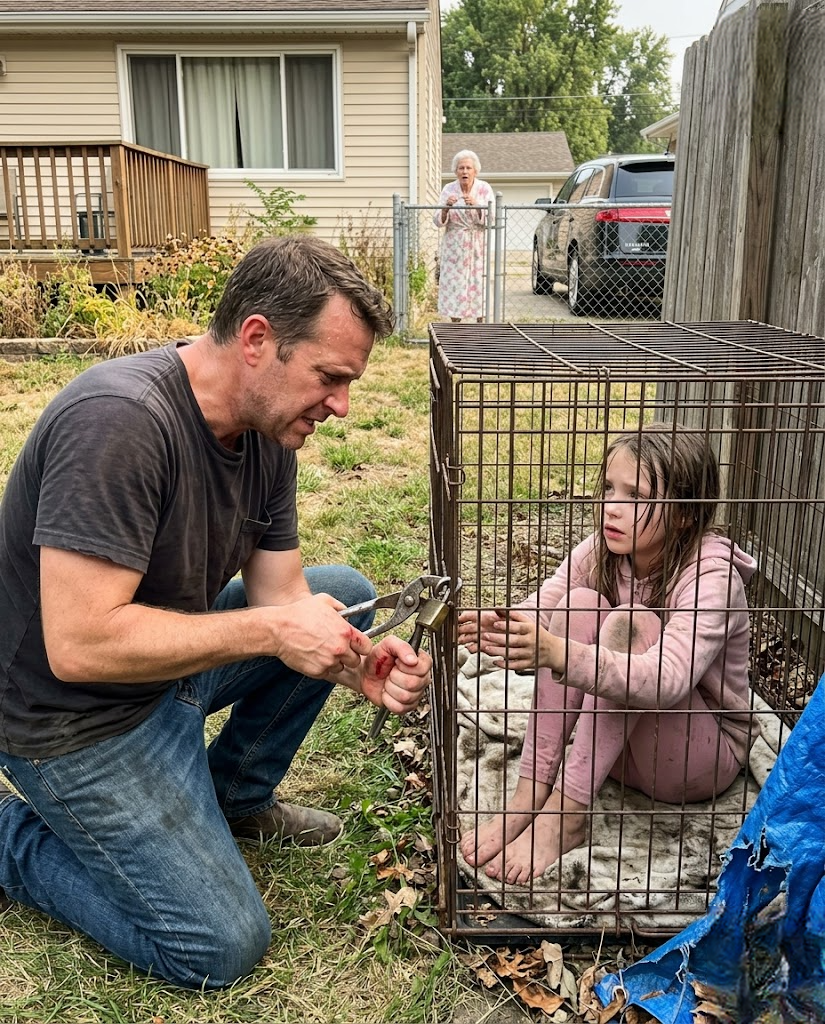
Underneath was a large metal dog cage.
I stopped moving.
At first, my brain refused to understand what my eyes were showing me.
Then I saw the small figure inside.
My daughter.
Emily sat on a filthy blanket with her knees pulled tight against her chest.
Her hair was matted against her cheeks.
Her face looked thinner than it had two weeks earlier.
A dry split marked her lower lip.
She was not crying.
That frightened me almost as much as the cage.
Emily had always worn her feelings plainly when she was with me.
If she was mad, I knew it.
If she was hurt, I knew it.
If she wanted something, the entire neighborhood probably knew it.
But the child inside that cage was completely still.
“Emily.”
Her eyes moved toward me.
They did not widen.
She did not jump up.
She stared as though she was afraid I might vanish if she believed in me too quickly.
“Daddy?” she said.
One word.
Barely more than a breath.
That one word nearly dropped me to my knees.
I crossed the yard and grabbed the cage door.
A heavy padlock held it closed.
I pulled at it once even though I knew strength alone would not open it.
“Daddy,” Emily whispered again.
“I’m here.”
My voice sounded strange to me.
Too calm for what I was seeing.
“I’m getting you out.”
I searched the ground around the cage.
Weeds had grown through the edges of the patio, and discarded garden tools were scattered near the fence.
Then I spotted a pair of gardening pliers.
I snatched them up and jammed the jaws against the lock.
My cut palm slid against the handles.
I missed the shackle once.
Then again.
My hands would not stop shaking.
For one heartbeat, rage took over every other thought I had.
I wanted to smash every window in that house.
I wanted to kick through the back door.
I wanted the entire street to hear what had been done to my daughter.
But Emily was still inside the cage.
She did not need my rage.
She needed the door open.
So I forced my hands back onto the pliers.
I closed them around the shackle and pulled.
The metal resisted.
I repositioned them.
Pulled again.
Nothing.
“Stay with me, sweetheart.”
Emily watched my hands.
On the third try, the lock snapped.
The sound was small compared with everything I was feeling, but I would remember it for the rest of my life.
I tore the door open.
Emily moved immediately.
She threw herself into my arms so hard that I nearly lost my balance.
She felt lighter than she should have.
Much lighter.
I could feel the sharpness of her shoulders through her clothes as I lifted her out.
She wrapped both arms around my neck and held on with the desperate strength of a child who believed the world might take her back the second she loosened her grip.
“I’ve got you,” I told her.
I kept saying it because I did not know what else to say.
“I’ve got you. I’ve got you.”
Her face pressed into my shoulder.
I could feel her breathing against my neck.
I wanted to ask a hundred questions.
Where was Sarah?
How long had Emily been in there?
Where was Jason?
Why had nobody told me?
What had happened in that house while I was sitting in traffic, checking apps, studying schedules, and trying so hard to be reasonable?
But there would be time for questions once Emily was away from that yard.
Getting her out was the only thing that mattered.
I stood with her in my arms and turned toward the gate.
That was when her whole body went stiff.
Not gradually.
Instantly.
Her fingers tightened behind my neck.
I felt the change before I understood what caused it.
“Emily?”
She was no longer looking at me.
She was staring past my shoulder.
At the pool.
I followed her gaze only far enough to see the surface.
The water was green and unnaturally still.
An oily film caught the afternoon light.
Beneath it, dark shapes rested where Mrs. Harris had said the black trash bags had disappeared the night before.
I remembered her voice at the fence.
He threw them into the pool.
Emily made a small sound and buried her face against my neck.
Her body trembled in my arms.
“Daddy, please…” she whispered.
I held her tighter.
“What is it?”
She would not look back at the water.
“Don’t look at the pool.”
The words came quickly now, frightened and urgent in a way her voice had not been when she first saw me.
“Let’s go. Just let’s go.”
I stood there holding my daughter, the broken padlock lying in the weeds behind us, my palm stinging around the pliers, and those dark shapes barely visible beneath the green water.
For three days, I had been afraid something was wrong because Emily had stopped calling me.
Now she was finally in my arms.
And the one thing she was begging me not to see was waiting only a few yards away.