Richard didn’t ask what it was.
That was what condemned him.
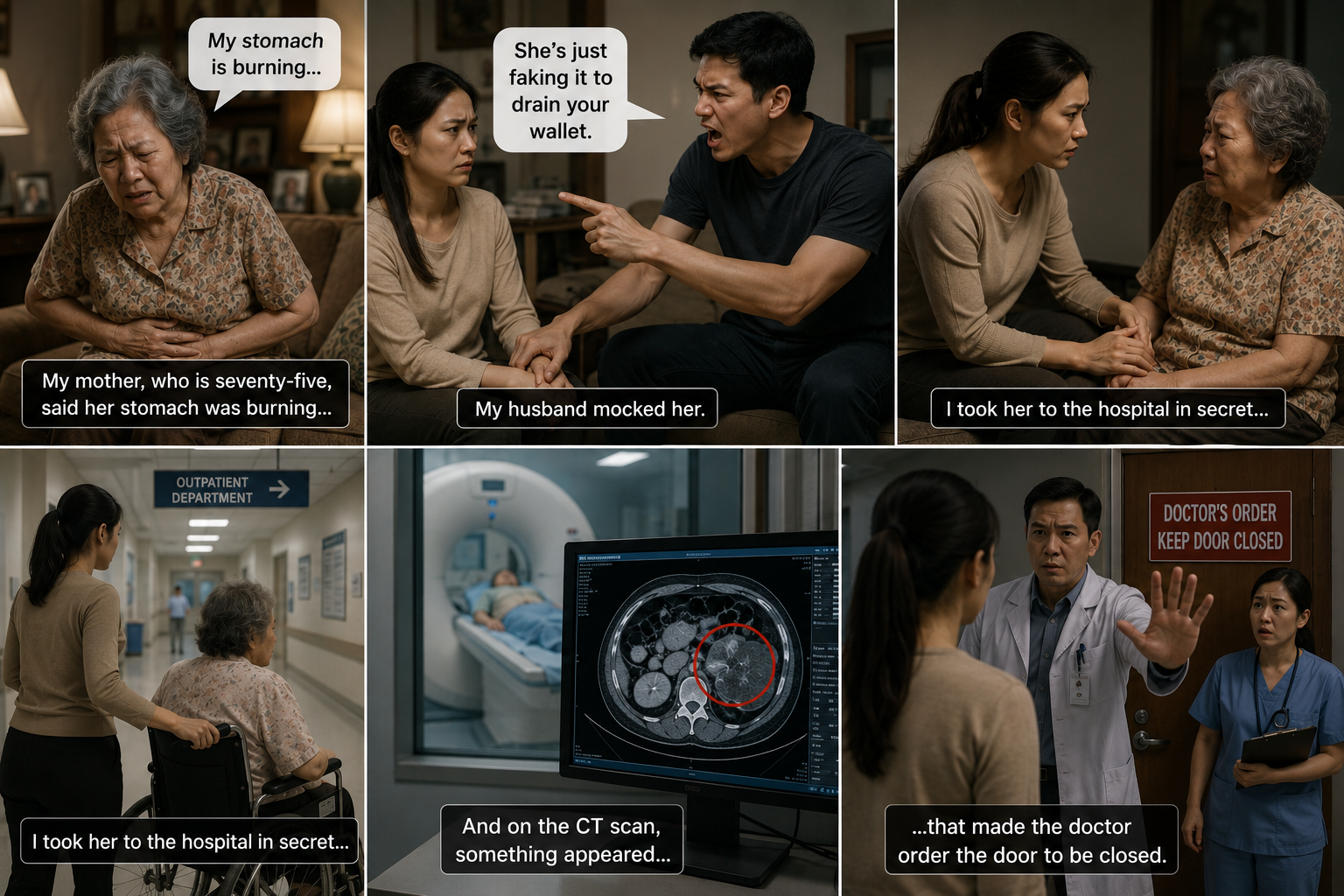
He didn’t say, “What’s wrong with my mother-in-law?” or “Is she in danger?” He didn’t even look at my mother with pity. He stared at the screen like someone looking at an overdue debt, a piece of forgotten evidence—something that was supposed to stay buried, suddenly illuminated in black and white.
“Turn that off,” he ordered.
The doctor didn’t move. “Sir, leave the exam room.”
Richard let out a harsh laugh. “This is my family.”
“No,” I said, my voice firmer than I expected. “My mother is my family. You are the man who just got terrified seeing something inside her.”
My mother closed her eyes. Her lips were trembling, but not from fear. It was as if, after carrying a heavy stone for so many months, the moment had finally arrived for her to drop it.
Richard walked toward me. “Sarah, we’re leaving.” “My mother is staying.” “You don’t know what you’re doing.” “No. What I didn’t know was who I was sleeping next to.”
The doctor opened the door and called for the nurse. Richard looked at him with a fury I had never seen him display in public. At home, yes—that knife-like stare when dinner wasn’t ready, when I visited my mother without telling him, when he went through my phone as if my life were also a property under his name.
“I’m going to call for security,” the doctor said. “This requires surgery and, because of the nature of the object, notification to the authorities.”
Richard turned paler. “You don’t have the right.”
My mother raised her hand—thin, weathered by the years—and pointed at the screen. “He does. That little piece of metal knows more about you than my own daughter does.”
I felt the world splitting apart. “Mom, tell me what it is.”
She swallowed hard. The pain washed over her face like a shadow. “A capsule.” “What capsule?” “The one I swallowed so you wouldn’t find it,” she said to Richard.
He lunged toward her. “Shut up, you crazy old bat!”
I stepped in front of her without thinking. Richard braked because a security guard was already coming down the hall, and the nurse had her phone in her hand. For the first time, I saw fear in his eyes. Not fear of losing me. Fear that my mother would keep talking.
“Four months ago, he came to my house,” she said. “He brought donuts from the corner shop and a coffee, acting like the perfect son-in-law. I already knew something was wrong.”
The doctor looked at me. I couldn’t breathe.
My mother went on. “I saw him at the East Side farmers market, Sarah. I had gone with Mrs. Higgins for heirloom tomatoes and fresh herbs. There, by the loading docks where everything smells of ripe fruit and exhaust, I saw him take a thick envelope from a man.”
Richard clenched his fists. “You lying old hag.”
“I recorded him,” my mother said. “With my old cell phone, the one you said looked like a brick.”
I remembered her pink flip phone, held together by tape, always kept in her grocery tote. I remembered Richard mocking her for not using apps, for not knowing how to use rideshares, for pausing to pray before crossing the busy intersections of Austin.
“What did you record?” I asked.
My mother looked at me with a sadness that aged me in an instant. “Your husband saying he had the insurance policies ready. That he just needed you to sign a few papers. That if I died first, even better. That a sick old lady wouldn’t cause trouble for anyone.”
The room fell into silence. I felt nauseous.
Richard opened his mouth, but nothing came out. The guard was already inside. The nurse stood by the door.
“When I realized what was happening,” my mother continued, “I hid the memory card in a metal capsule that used to belong to your father. He used it to keep a small silver cross safe. I thought about hiding it behind the porcelain angel on the mantel, but Richard came back that same night.”
“Why didn’t you tell me?”
My mother looked down. “Because I saw you come home many times with swollen eyes, claiming you were just tired. Because a mother knows her daughter’s silences. Because if I spoke without proof, he would have turned you against me.”
Her voice broke. “He grabbed my arm, Sarah. He told me he knew I’d seen something. He tore through my drawers, ripped up my rosebushes, shattered your father’s photo. So I put the capsule in my mouth and I swallowed it.”
I brought my hands to my chest. “Mom…”
“I thought it would pass. It didn’t. And then the burning started.”
Richard exploded. “This old lady is insane! She swallowed garbage and now she wants to pin it on me!”
The doctor spoke with icy calm. “The object is lodged, causing severe inflammation. If the intestine perforates, she could die.”
My mother didn’t look at the doctor. She looked at me. “That’s why I didn’t want you to bring me here. I knew that if it showed up on a scan, he would come.”
Richard took a step toward the screen. The guard stopped him with a heavy hand on his chest. “Don’t touch me,” he growled. “Sir, step back.” “That capsule is mine.”
That said it all.
No one breathed.
I looked at him the way one looks at a stranger who accidentally entered your life and spent years occupying your table, your bed, your Sundays. I no longer saw the elegant husband in ironed shirts. I saw the man who counted my pennies, isolated my mother, and taught me to ask permission to exist.
“Thank you,” I said. Richard frowned. “What?” “For confessing.”
The nurse, trembling, kept recording with her phone.
Everything happened fast after that. The doctor called an ambulance to take my mother to a hospital with an emergency surgical unit. He also insisted she not be left alone. Richard left the exam room shoving the guard and disappeared down the hall, but he didn’t go far; I could feel his rage lurking like a dog off its leash.
While we waited, my mother tugged at my sleeve. “There’s a blue notebook at my house,” she whispered. “Behind the porcelain angel. Names, dates, license plates. I wrote it all down in case the capsule didn’t hold.” “Don’t talk, Mom.” “Listen to me. Richard has copies of your signatures. He was going to put you in massive debt, sweetie. He was going to leave you without a house and without a mother.”
Tears filled my eyes. “I didn’t see anything.” “Because when you live in fear, you learn to keep your eyes on the floor.”
That hurt more than any blow.
I called Mrs. Higgins, my mother’s neighbor—a woman who sold breakfast tacos out of her food truck near the Capital Metro station and knew everyone in the neighborhood. I told her to go in with the spare key hidden under the aloe plant and get the notebook. I didn’t ask questions. Neither did she.
“I’m heading there right now, honey,” she said. “And if that scumbag shows up, I’ll take a cast-iron skillet to his head.”
The ambulance arrived as the sun began to set. Outside, you could hear car horns, food trucks closing up, and the sound of the city swallowing the afternoon. My mother was pale, sweating cold sweat, but as we pulled onto the avenue, she squeezed my hand.
“Look,” she murmured.
In the distance, you could see Mount Bonnell, dark against the orange Texas sky. As a child, my mother took me there every Easter for the sunrise service. She used to tell me that up on that hill, faith walked with dusty feet, and that people didn’t carry wooden crosses, but rather the heavy things they couldn’t say out loud.
That day, I understood. My mother had carried hers inside her own body.
At the hospital, the minutes turned into stones. They took her to surgery. I stayed with her knitted shawl in my hands, smelling of Ivory soap, old cinnamon, and home. Two police officers came to take my statement. I spoke without embellishment, with a calm I didn’t recognize.
Then my phone rang. Richard. I didn’t answer. A text message came through. “Your mother is leaving that place in a body bag if you open your mouth.”
I showed the screen to the police. One of them asked dispatch to check nearby traffic cameras. I barely heard him. I only saw the surgery room doors.
Two hours later, the surgeon came out. “She’s alive.” I doubled over and sobbed like a child. “We removed the capsule. It has been secured. We didn’t touch it more than necessary.”
Behind him came a detective from the District Attorney’s office with gloves and a transparent evidence bag. Inside, I saw the small, scratched, dark cylinder. So insignificant. So capable of destroying an entire life.
When they opened the capsule in front of the authorities, there was a tiny memory card wrapped in plastic. Also a small, rolled-up piece of paper, almost disintegrated by moisture. I couldn’t read it all, but I recognized my mother’s shaky handwriting.
“If something happens to me, it was Richard.”
That sentence took away my last shred of doubt.
Mrs. Higgins arrived almost at midnight with the blue notebook tucked under her sweater. She was sweaty, disheveled, and smelled of cooking oil, as if she had sprinted across all of East Austin. “I saw him,” she said without greeting me. “That wretch went to your mother’s house.” My blood ran cold. “Richard?” “Yes. He tried to break in. But a few of the neighbors were already out on the porch. We made it clear the street wasn’t empty.”
The police exchanged looks. Mrs. Higgins placed the notebook on the waiting room table as if she were handing over a holy relic.
Inside, there were names of insurance clients, license plates, dates, amounts, and clipped receipts. There was also a printed photo of Richard with another man in front of a warehouse at the farmers market. My mother, with her seventy-five years and her old cell phone, had put together a better file than any detective.
But Richard wasn’t arrested yet. He showed up at three in the morning.
I was in the hallway, next to a vending machine that sold stale coffee. He stepped off the elevator with his shirt wrinkled and his eyes bloodshot. He was no longer wearing his mask. He was no longer faking it.
“Give me the memory card,” he said. I stood up slowly. “I don’t have it anymore.” “Always so obedient to everyone except your own husband.” “You are not my husband anymore.”
He smiled with pure hatred. “Without me, you are nothing, Sarah.”
Before, that phrase would have made me lower my head. That night, I looked toward the room where my mother was breathing with IVs, bandages, and a blessed stubbornness.
“I am the daughter of Teresa Miller,” I said. “That’s enough for me.”
Richard grabbed my arm. Hard. The pain ignited something in me that had been extinguished for years. I didn’t scream out of fear. I screamed so everyone would hear. “Let go of me!”
Two police officers came around the corner. Richard tried to bolt, but Mrs. Higgins appeared on the other side with a steaming cup of coffee in her hand. “Don’t you dare, you piece of trash.”
He found himself trapped between the badge and the neighborhood. They handcuffed him right there, under the hospital’s harsh white lights. As they took him away, he looked at me as if he could still command me to live in fear. “You’re going to regret this.”
I showed him my arm, marked by his fingers. “No. I’ve already started to remember who I was.”
My mother woke up at dawn. She opened her eyes little by little, like an old shutter. I approached her bed. Her mouth was dry, her voice dusty.
“And him?” “Locked up.” A tear slid down to her ear. “The capsule?” “It spoke, Mom.”
She closed her eyes and smiled faintly. “I told you my body would speak for me.”
I kissed her forehead. For the first time in a long time, I didn’t ask her to be strong. I asked her to rest.
The following days were a blur of statements, signatures, lawyers, and truths that hurt more later, when the house was quiet. I learned that Richard had used my name for massive loans. That he had a secret policy on my life. That he had tried to officially label my mother as mentally incompetent to invalidate any report she might make.
I also learned that my mother had gone three times to the local Family Violence Center, but turned back at the door because she was afraid of “ruining my marriage.” That sentence haunted me. Mothers sometimes break in silence, believing that’s how they protect us.
When she finally returned home, the rosebushes were trampled, but alive. Mrs. Higgins had swept the porch, watered the plants, and left a fresh batch of chili on the stove. The porcelain angel was still in its place, watching over a new candle, and the blue notebook was far away, now locked up as state evidence.
My mother walked slowly to her rocking chair. “I thought I’d never come back.” “Me too.”
She sat looking out at the street. A local vendor passed by ringing a bell, and further away I heard the rumble of the commuter rail rolling past like a heartbeat in the city. East Austin remained the same and different: tough, noisy, full of people who save each other even if nobody puts it in the newspapers.
Weeks later, I took her to Mount Bonnell. We didn’t climb the stairs. Her body was still healing. We stayed near the bottom, where the air smelled of cedar trees, warm earth, and quiet faith. There were families walking, children running, and the steady hum of life moving forward.
My mother looked up at the peak in silence. “Your father proposed to me here,” she said suddenly. I smiled. “You never told me.” “There are things you save until they stop hurting.”
I held her hand. “Don’t save anything alone anymore, Mom.” She squeezed my fingers. “Neither should you.”
That day, there was no movie-like miracle. No lightning struck Richard in his cell. The debts and the lost years weren’t magically erased. But my mother breathed without burning, and I returned to my own house without asking for permission to unlock the door.
Sometimes justice doesn’t arrive like thunder.
Sometimes it arrives like a CT scan, a neighbor with a notebook under her sweater, a mother who swallows her terror so her daughter can finally spit out the truth.
And ever since then, every time I pass through the city and see Mount Bonnell silhouetted against the evening sky, I remember her on that hospital bed—tiny, and enormous all at once.
My mother was seventy-five years old.
Richard said she just wanted attention.
He was right about one thing.
My mother wanted someone to look.
And when we finally did, we found inside her not an illness, but proof that even the most tired body can become a witness.
An altar.
A cry.
A sentence.