At exactly 1:58 a.m., my eight-year-old granddaughter called me whispering that she felt burning hot — and when I broke into my son’s empty house, I found her drugged on the hallway floor, her brother locked inside a closet, and a note on the counter warning me not to believe her about it.
My bedroom was dark except for the blue numbers on the clock.
For half a second, I almost let the phone ring again.
Then I saw LILY glowing across the screen.
She was eight years old, the kind of child who still drew purple hearts around people’s names and called me every Sunday because my late wife, Carol, had once told her, Grandpas need checking on too.
I answered.
At first, there was only breathing.
Thin.
Shaky.
Wrong.
“Grandpa?”
Her voice was barely there.
I sat up so fast I knocked my glasses off the nightstand.
“Lily?”
“I feel really hot.”
My hand stopped searching for the lamp.
Something in her voice had reached straight through sleep and grabbed me by the throat.
“Where are you?”
“At home.”
“Where’s your mom? Where’s your dad?”
Silence.
Then:
“They left.”
I was already pulling on jeans.
My son Brian and his wife, Marissa, had told the family they were taking Lily’s ten-year-old brother Mason to Florida for his birthday weekend. Lily supposedly had a cold and was staying with Marissa’s sister.
That was the story.
But Lily wasn’t with an aunt.
She was alone.
“Are the doors locked?” I asked.
“I don’t know.”
“Can you stand?”
“I tried.”
Her breathing hitched.
“My head feels funny.”
“Stay on the phone with me.”
“I’m scared.”
“I’m coming.”
Brian’s subdivision normally took fourteen minutes from my house.
I made it in eight.
I remember the dashboard showing 2:06 a.m.
I remember driving through red lights after slowing just enough to make sure no one was coming.
Mostly, I remember talking to Carol.
“Stay with her,” I muttered into the dark windshield. “If you’re anywhere, stay with that little girl.”
The driveway was empty when I arrived.
No SUV.
No luggage.
No lights upstairs.
Only the kitchen window glowing yellow against the black house.
I used the emergency key beneath the porch planter.
The moment I pushed the door open, a medicinal sweetness hit me.
Cough syrup.
Warm stale air.
Something chemical.
“Lily!”
No answer.
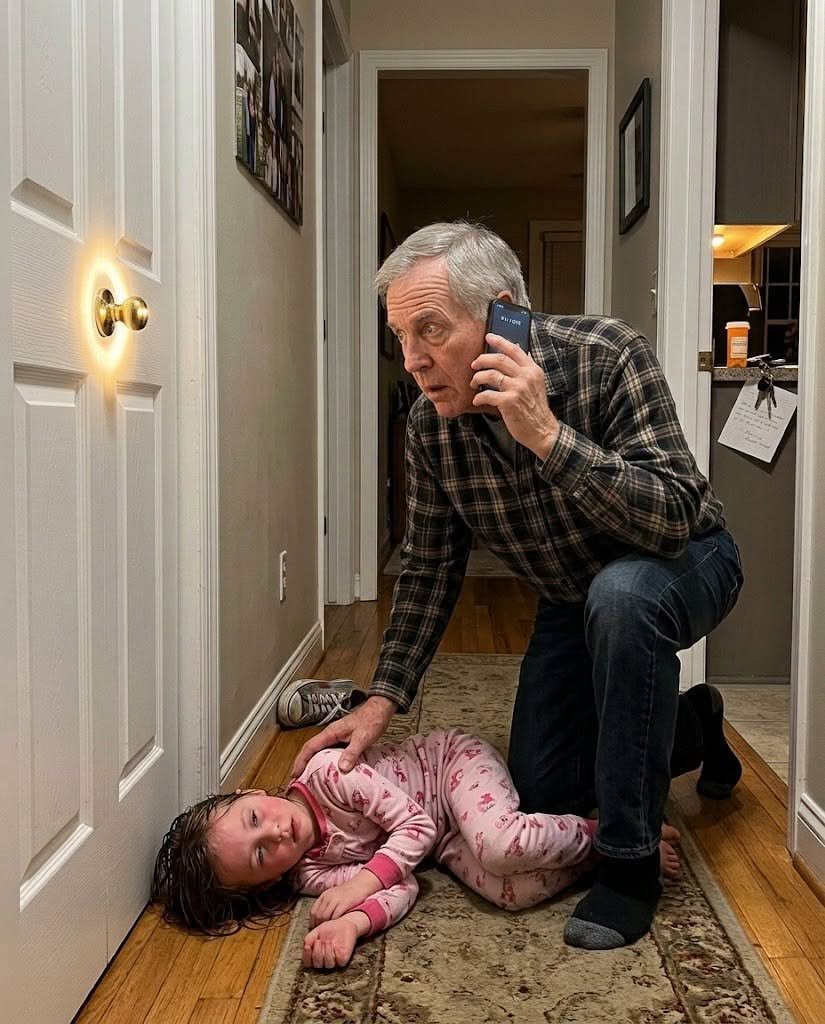
Then I saw one of Mason’s sneakers lying sideways in the hallway.
And beyond it—
Pink pajamas.
Bare feet.
A small body curled against the hardwood.
“Jesus Christ.”
I dropped beside Lily.
Her cheek was pressed to the floor. Damp brown hair clung to her forehead. Her skin was flushed a frightening crimson.
“Grandpa…”
I touched her face.
She was burning.
I called 911, tucked the phone between my shoulder and ear, and lifted her.
Her head sagged against me.
The dispatcher began asking questions.
Was she breathing?
Yes.
Was she conscious?
Barely.
Had she taken anything?
“I don’t know.”
Then I looked toward the kitchen counter.
An orange prescription bottle sat beside a half-empty glass.
I carried Lily closer.
The bottle wasn’t hers.
It wasn’t prescribed to any child.
Beside it rested Brian’s keys and a folded note.
I opened it with one hand.
Dad, don’t overreact. Lily gets dramatic when she’s sick. We gave her something to sleep so she wouldn’t ruin Mason’s birthday trip again. We’ll be back Sunday. Please don’t call anyone.
My vision blurred.
I read it twice.
Then the final line.
And whatever she tells you, don’t believe her about the closet.
I stopped breathing.
The hallway closet was ten feet away.
Lily suddenly clenched a fist in my shirt.
A knock came from behind the door.
Soft.
Then another.
The dispatcher’s voice seemed to move a thousand miles away.
“Sir? What was that sound?”
I carried Lily toward the closet.
“Grandpa,” she whispered.
“Yes, sweetheart?”
“Don’t open it.”
I looked down.
Her eyes were barely open.
“Why?”
Her lips trembled.
Before she could answer, the closet knob began turning from the inside.
Slowly.
I moved Lily behind my shoulder and opened the door.
“Mason?”
The turning stopped.
Then a voice so dry and small I almost didn’t recognize my grandson.
“Grandpa?”
I pulled the door wide.
Mason sat on the closet floor with his knees drawn to his chest.
One sneaker was missing.
His tablet lay beside him, dead.
There was an empty water bottle near his foot and a blanket twisted beneath his legs.
He blinked against the kitchen light.
Then immediately looked at Lily.
“Is she okay?”
“Help is coming.”
I crouched.
“Why are you in here?”
His face changed.
Not confusion.
Fear.
“Dad said I had to stay until I learned not to lie.”
I felt something cold settle inside me.
“What did he say you lied about?”
Mason stared at the medicine bottle.
Then at Lily.
Then he picked up his dead tablet and hugged it against his chest.
“I recorded them.”
“Recorded what?”
He looked toward the front windows.
“Not here.”
Outside, sirens grew louder.
“Dad said if anybody heard it, he’d tell everyone we weren’t supposed to be living with him anymore.”
That sentence changed everything.
Red emergency lights flashed through the curtains.
Paramedics rushed in seconds later.
One took Lily from my arms.
Another examined Mason.
A police officer entered behind them.
“What happened?”
I handed him Brian’s note.
His face hardened as he read.
Then Mason tugged my sleeve.
“There’s something else.”
“What?”
“My tablet battery is dead.”
“We’ll charge it.”
“No.”
He shook his head urgently.
“The recording isn’t on there anymore.”
“Where is it?”
Mason glanced at the ceiling.
“Mom made me delete it.”
A terrible disappointment hit me.
Then he whispered:
“But Grandma Carol taught me not to trust only one copy.”
I stared at him.
Carol had died two years earlier.
She’d been a school librarian for thirty-four years, and she had taught both grandchildren how to back up family photos to the little cloud-storage account she’d created for them.
Mason had uploaded the recording before deleting it.
At the hospital, Lily’s temperature was 104.2.
The doctor told me they found a sedating medication in her system that should never have been given to her without medical supervision.
I sat beside her bed watching fluids drip through a clear tube.
Every few minutes, I checked that her chest was still rising.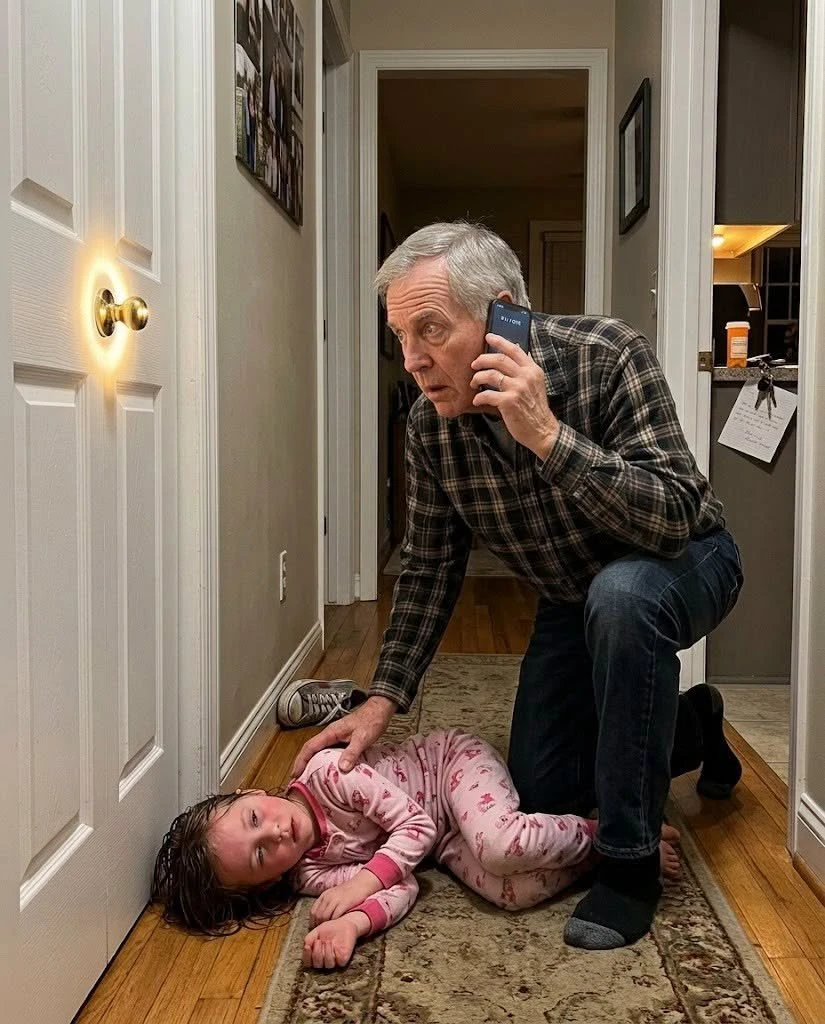
Across the hall, Mason sat wrapped in a hospital blanket while a detective named Elena Ruiz spoke gently to him.
Around four-thirty, she came to me.
“Mr. Parker?”
I stood.
“Is Lily going to be all right?”
“The doctors are optimistic.”
My knees nearly gave way.
Then Ruiz lowered her voice.
“We recovered Mason’s file.”
The relief lasted one second.
Her expression told me the rest.
“You need to prepare yourself.”
She placed headphones in my hands.
“Do you want to hear it?”
I almost said no.
I wish I had.
Instead, I put them on.
At first, there was the muffled scrape of furniture.
Marissa’s voice came first.
“We can’t keep doing this.”
Brian answered.
“It’s one weekend.”
“No, Brian. She tells people things.”
“She’s eight.”
“She told your father I slapped her.”
“You did.”
Silence.
Then Marissa:
“And Mason records everything now.”
Brian laughed.
“Because Mom gave him that stupid tablet.”
My stomach twisted at the word Mom.
Carol.
The recording continued.
Lily was crying somewhere nearby.
“I don’t want the medicine.”
Brian’s voice sharpened.
“You have a fever. Take it.”
“It makes me sleepy.”
“That’s the point.”
Then Mason.
“Dad, the bottle says Marissa.”
A chair scraped.
“What are you doing with that tablet?”
Nothing for three seconds.
Then a smack—not flesh, I later learned, but the tablet hitting a countertop.
Mason shouted.
Marissa said, “Take it away.”
Brian’s voice became frighteningly calm.
“You want to ruin the trip? Fine. Closet.”
“No.”
“Now.”
Then Lily screamed.
“No! Don’t put him in there!”
The audio became chaotic.
Crying.
Footsteps.
A door slamming.
A lock clicking.
Then, from farther away, Brian said something I couldn’t understand.
I turned up the volume.
My blood went cold.
“Once Dad sees the note, he’ll think Lily imagined the whole thing because of the fever.”
Marissa answered, “And Mason?”
“He stays in there until we come back. There’s water.”
Three seconds later, she said:
“What if Dad calls the police?”
Brian laughed softly.
“He won’t.”
I stopped the recording.
My hands were shaking.
Detective Ruiz removed the headphones.
“Mr. Parker?”
“He knew I would come.”
She frowned.
“What?”
“My son knew Lily would call me.”
I could suddenly see it.
The emergency key.
The note addressed specifically to me.
The kitchen light left on.
“He expected me to find her,” I whispered.
Ruiz’s expression shifted.
“But why?”
I didn’t know.
Not yet.
Brian and Marissa were arrested at 5:17 a.m. at a hotel sixty miles away.
They had never gone to Florida.
There was no birthday trip.
Police found dinner receipts, packed clothes, cash, and two one-way airline tickets leaving the country the following evening.
That should have answered everything.
Instead, it created a darker question.
Why leave Lily sedated and Mason locked inside?
Why write a note for me?
Why count on me being the one to arrive?
The answer came the next afternoon.
Lily was awake.
Her fever had broken.
She looked impossibly small beneath the white hospital blanket.
I sat beside her holding a paper cup of coffee I hadn’t touched.
“Grandpa?”
“Yes?”
“Is Daddy mad?”
The question broke something in me.
I put the cup down.
“No, sweetheart. Your dad can’t come near you right now.”
She watched my face carefully.
“Because he gave me the medicine?”
“Yes.”
She swallowed.
“That’s not why.”
I leaned closer.
“What do you mean?”
Lily reached beneath her blanket.
A nurse had allowed her to keep the purple backpack paramedics found near the hallway.
From its front pocket, she pulled a folded piece of paper.
It was a child’s drawing.
Four people stood beneath a yellow sun.
Lily.
Mason.
Carol.
Me.
But in the corner was another figure.
A man.
Gray hair.
Glasses.
A red shirt.
I pointed.
“Who’s that?”
Lily whispered:
“That’s the man Daddy said you killed.”
The room went silent.
I actually laughed at first.
Not because it was funny.
Because the words made no sense.
“What man?”
“The one from Grandma’s accident.”
My body went still.
Carol had died after a car crash two years earlier.
Rainy road.
Late evening.
Hit-and-run.
The police had never found the driver.
“What did your father tell you?”
Lily’s fingers twisted in the blanket.
“He said you were driving.”
I felt dizzy.
“I wasn’t even there.”
“I know.”
“How?”
“Because I heard Mommy and Daddy fighting.”
She began crying.
Not loudly.
That somehow made it worse.
“Mommy said the police would find out the car was Daddy’s someday.”
I couldn’t speak.
Then Lily said the sentence that rearranged the last two years of my life.
“Daddy was driving the night Grandma died.”
Detective Ruiz returned within minutes.
Mason confirmed it.
Three months earlier, he had overheard Brian and Marissa arguing in the garage.
Brian had been drinking the night Carol died.
He had borrowed a friend’s pickup.
Carol had called me from the grocery store because she’d forgotten her umbrella.
She had walked across the parking lot.
Brian never saw her.
Or said he never saw her.
He panicked.
Drove away.
Later, when the family gathered at the hospital and Carol died before sunrise, my son had stood beside me with his hand on my shoulder while I wept.
For two years, he had watched me blame an unknown stranger.
Mason had heard enough to understand something terrible had happened.
So he recorded his parents the next time they argued.
They discovered him.
And that was why there had been no Florida trip.
Brian and Marissa had planned to leave.
But before disappearing, they needed to make Mason unreliable.
And Lily too.
The closet.
The medication.
The note.
It had all been designed to create a story.
Two confused children.
A grieving grandfather.
A family under stress.
But there was still one piece that didn’t fit.
Why address the note to me?
Detective Ruiz answered that question three days later.
She came to the hospital holding an evidence bag.
Inside was Brian’s phone.
“Your son searched your medical records.”
“My medical records?”
“Not directly. He accessed an old insurance portal you once gave him permission to use.”
I stared.
“And?”
“He knew about your heart condition.”
I said nothing.
Ruiz continued carefully.
“He also searched whether severe emotional distress could cause cardiac arrest.”
The hospital room tilted.
She didn’t need to say the rest.
But she did.
“We believe your son expected you to find the children, panic, and potentially suffer a fatal medical event.”
I felt nothing for several seconds.
No rage.
No grief.
Just emptiness.
Then I understood.
My will.
After Carol died, I had changed it.
Everything went equally to Brian and the grandchildren.
If I died while the children were still minors, Brian controlled their shares.
The locked closet hadn’t only been punishment.
The drugged child hadn’t only been neglect.
They had been bait.
For me.
My own son had created a scene designed to break my heart.
And he almost had.
Brian asked to see me before his arraignment.
I refused twice.
Then Mason asked me a question.
“Grandpa, do bad people know they’re bad?”
I thought about it for a long time.
“Sometimes.”
“Does Dad?”
I didn’t know.
So I went.
Brian sat behind thick glass wearing county-issued gray.
For the first time in his forty-one years, he looked old to me.
Not tired.
Old.
He picked up the phone.
I did the same.
“Dad.”
I said nothing.
His mouth trembled.
“I didn’t mean for Mom to die.”
There it was.
Not I’m sorry.
Not I killed her.
Just the smaller version he could survive saying.
“I was scared.”
I stared at him.
“You were thirty-nine.”
“I know.”
“You left your mother on wet pavement.”
His eyes filled.
“I went back.”
My fingers tightened around the receiver.
“What?”
“I went back after twenty minutes.”
I could hear my own heartbeat.
“She was gone. Ambulance was there.”
“And you said nothing.”
“I had kids.”
“So did she.”
Brian closed his eyes.
I leaned toward the glass.
“She had a son.”
He opened them.
I had never seen such shame.
But shame is not redemption.
Sometimes shame is only the body realizing there is nowhere left to hide.
“I never wanted to hurt Lily,” he whispered.
“You drugged her.”
“Marissa—”
“No.”
My voice cracked across the visitation room.
“Don’t you dare climb inside another person’s blame.”
He flinched.
“You locked Mason in a closet.”
“I panicked.”
“You tried to use my grandchildren to frighten me to death.”
His face crumpled.
For one horrible second, I saw the five-year-old boy who used to fall asleep on my chest during thunderstorms.
That was the cruelest part.
Monsters rarely arrive with unfamiliar faces.
Sometimes you remember teaching them to ride a bicycle.
I stood.
Brian pressed the phone harder to his ear.
“Dad, please.”
I looked at him one last time.
“Your mother called me from that parking lot eleven minutes before she died.”
He froze.
“I didn’t answer because I was in the shower.”
My throat closed.
“For two years, I thought the worst thing I’d ever done was miss that call.”
Brian started crying.
I put my palm against the glass.
Not for him.
For Carol.
“For two years, you let me believe that.”
Then I hung up.
Lily and Mason came home with me six days later.
The court approved emergency placement while the criminal cases moved forward.
Their first night in my house, neither child wanted a bedroom.
So we built a nest in the living room.
Blankets.
Pillows.
Two mattresses.
Cartoons playing quietly.
At 2:00 a.m., I woke and found Mason sitting upright.
“You okay?”
He looked toward the hallway.
“Can we leave the closet doors open?”
Every closet in my house stayed open after that.
For months.
Lily recovered physically first.
Children often do.
Her fever disappeared.
Her appetite returned.
She laughed again.
But sometimes she would wake asking whether she had “ruined the trip.”
Every time, I gave her the same answer.
“There was never a trip.”
Mason took longer.
He hated closed doors.
He charged his tablet obsessively.
Three chargers stayed plugged into three different rooms.
One evening, I asked why.
He shrugged.
“Dead batteries make people able to erase things.”
I had to walk into the kitchen so he wouldn’t see me cry.
The trials came the following year.
Brian pleaded guilty after prosecutors recovered traffic-camera footage placing the borrowed pickup near the crash that killed Carol.
Marissa accepted a plea agreement in the child-endangerment case and testified against him.
I attended sentencing.
Not because I wanted revenge.
Because Carol had spent thirty-four years teaching children that the truth mattered even when it was inconvenient.
I thought someone should sit there for her.
Brian was sentenced to prison.
Before deputies led him away, he turned toward me.
I saw the question in his face.
Could I forgive him?
Maybe one day I would understand forgiveness differently.
But forgiveness is not the same as pretending a wound never happened.
So I only nodded once.
Goodbye.
Almost eighteen months after the night Lily called me, I found an envelope tucked inside one of Carol’s old cookbooks.
I had finally started clearing the cabinet above the refrigerator.
The envelope had my name on it.
Her handwriting.
I sat down before opening it.
Inside was a birthday card she had bought years earlier and apparently never used.
There was no birthday message.
Just a note.
Tom, if I ever go before you, don’t turn the house into a museum. Let the children spill things. Let somebody laugh too loudly. Keep the good plates where people can reach them.
I smiled through tears.
Then I saw the line beneath it.
And if Brian ever gets lost, remember that loving him does not require following him into the dark.
I read that sentence over and over.
Carol had known something.
Not the crash.
Not what would happen.
But maybe she had seen the cracks before I did.
A drinking problem.
A temper.
A talent for making every mistake someone else’s responsibility.
I folded the note and held it against my chest.
From the living room came Lily’s laughter.
Then Mason shouted, “Grandpa! She cheated!”
“I did not!”
“You moved three spaces!”
“I sneezed!”
“That doesn’t move game pieces!”
I stood.
The hallway was warm with afternoon sun.
Every closet door was open.
On the wall beside the living room hung a framed drawing Lily had made in therapy.
Four people beneath a yellow sun.
Her.
Mason.
Me.
And Carol.
No fifth figure.
No shadow in the corner.
Just us.
Lily saw me holding Carol’s note.
“Was that Grandma’s?”
“Yes.”
“What did she say?”
I looked at both children.
At Mason’s tablet charging safely on the table.
At Lily’s bare feet tucked beneath her.
At the house Carol had once filled with books and cinnamon and arguments about whether Christmas decorations could legally go up before Thanksgiving.
“She said the good plates are supposed to be used.”
Lily frowned.
“What does that mean?”
I laughed.
“I think it means we’re having ice cream.”
“At four in the afternoon?”
“Especially at four in the afternoon.”
They raced me to the kitchen.
That night, after the dishes were washed and both children were asleep, I walked through the quiet house turning off lights.
At Mason’s doorway, I stopped.
He was asleep on his side.
Tablet on the nightstand.
Charging.
At Lily’s room, purple stars from her night-light moved slowly across the ceiling.
She had kicked off her blanket.
I covered her.
Then, as I started to leave, she whispered without opening her eyes:
“Grandpa?”
“Yes, sweetheart?”
“You answered.”
My hand froze on the doorframe.
“What?”
“My call.”
Her breathing remained slow and sleepy.
“You answered me.”
My eyes filled.
I crossed the room and kissed her forehead.
This time, cool.
Normal.
Alive.
I stood there longer than I needed to, listening to her breathe.
For years, I had believed the call I missed from Carol was the defining failure of my life.
The unanswered phone.
The eleven lost minutes.
The silence I could never undo.
But at 1:58 a.m., another little name had glowed in the darkness.
And this time I had answered.
In the hallway behind me, every closet door stood open, and somewhere in the dark beyond memory, I could almost hear Carol say that once was enough.