Patricia pinned the phone against her cardigan and spoke before my hand reached it.
“Emily called me that night,” she said. “I got there before anyone else.”
For a second, the laundry room seemed to tilt around me.

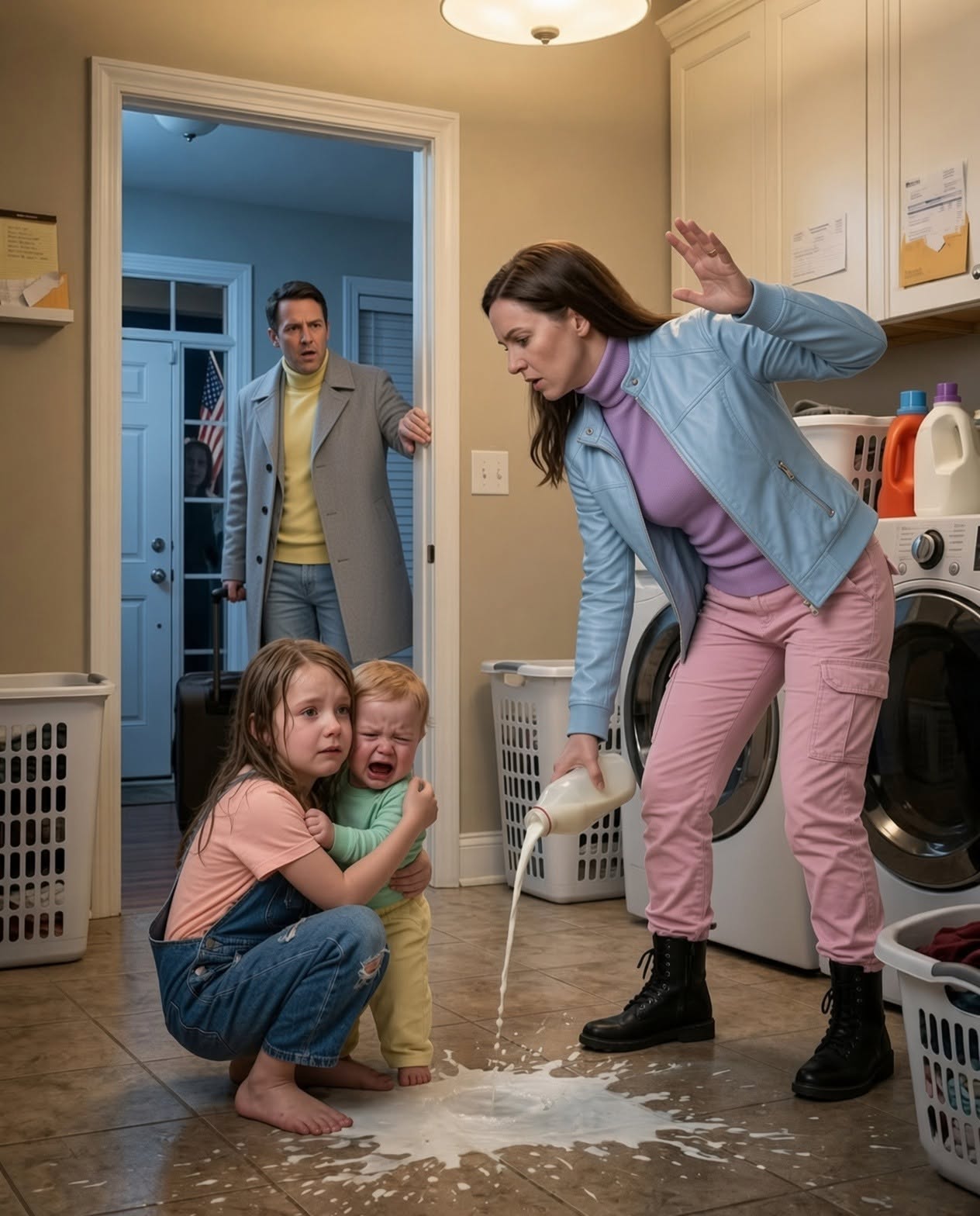
Lucas was on the floor beside my leg, too tired even to cry properly, and spilled milk was creeping through the grout lines under our feet.
I stared at Patricia.
“What did you say?”
She looked at Ava first, not me.
Ava was still pressed against my chest.
That mattered.
Then Patricia tightened both hands around her phone and said, “Your wife was alive when I arrived.”
I had spent almost two years believing a different story.
The story Patricia had helped me survive.
Emily had died suddenly while I was away for work, and Patricia had always told me she learned about it afterward, when other people did.
She had brought food to the house after the funeral.
She had helped me sort paperwork.
She had sat beside Ava’s bed when my daughter woke up screaming for her mother.
She had held Lucas while I stood in the garage pretending I had gone out there to find a screwdriver instead of to cry where the kids couldn’t see me.
And now she was telling me she had been with Emily before help arrived.
I looked at the phone in Patricia’s hands.
“What happened?”
Her jaw tightened.
“You want the truth?”
“Yes.”
“Then stop acting like I’m some monster because the kids skipped a few meals.”
Ava made a tiny sound against my shirt.
That ended the conversation for me.
Not the questions.
The negotiation.
I bent and lifted Lucas with my free arm.
He felt frighteningly light.
Patricia stepped toward the doorway.
“Where are you going?”
“To get them help.”
“If you call anyone, I’m done talking about Emily.”
I kept moving.
Patricia followed me into the hall.
“You hear me?” she said. “You bring strangers into this house, you’ll never know what she said to me.”
I carried both children toward the kitchen.
My suitcase was still by the front door.
The cold coffee cup I had carried in from the airport sat on the entry table exactly where I had dropped it.
Everything looked ordinary.
That was almost the worst part.
The family calendar was still stuck to the refrigerator.
Ava’s drawing from school was still held up by a magnet.
Lucas’s plastic cup was upside down beside the sink.
Patricia’s takeout bag sat in the trash.
I opened the pantry.
There was food.
Cereal. Crackers. Peanut butter. Applesauce cups.
Enough.
The children had not gone hungry because the house was empty.
They had gone hungry because someone had decided they should.
I called for help.
Patricia stood ten feet away with her phone clutched against her chest.
She didn’t scream.
She didn’t beg.
She watched me explain that my six-year-old daughter and two-year-old son said they had not eaten for three days and that I had found them locked inside the laundry room.
Then she said something so quietly I almost missed it.
“You’re going to regret making this official.”
I looked at her.
“Why?”
“Because when they ask where you’ve been, what are you going to tell them?”
There it was.
Her real leverage.
My absence.
For months I had accepted more travel, more meetings, more late nights, more excuses to stay away from the rooms where Emily’s memory still seemed to live.
Patricia knew that.
She had encouraged it.
Every time I apologized for leaving again, she told me the same thing.
The kids are fine.
I’ve got them.
Go work.
And I had gone.
“I’ll tell them the truth,” I said.
Patricia gave a short laugh.
“That you abandoned your kids with me?”
“That I trusted you.”
Her expression changed slightly.
Not fear.
Calculation.
She was already looking for the next version of the story.
Help arrived soon after.
I stayed with Ava and Lucas while the adults who came into the house documented what they could see and separated Patricia from us.
Nobody gave a speech.
Nobody needed to.
Ava’s cracked lips, Lucas’s exhausted body, the locked laundry-room door, the milk on the floor, and a kitchen full of food said enough for that night.
When someone asked Ava if she felt safe answering questions with Patricia nearby, my daughter buried her face against me and shook her head.
Patricia was moved farther away.
Only then did Ava whisper, “She makes us practice.”
I lowered myself until we were eye level.
“Practice what?”
“What to tell people.”
My stomach tightened.
Ava looked toward the hallway.
“She says if anybody asks, we eat dinner every night.”
I said nothing.
“She says if my teacher asks why I’m sleepy, I have to say Lucas keeps me awake.”
Her fingers twisted my shirt.
“And she says Mommy Emily wanted her to be our new mom.”
That sentence hit differently.
Patricia had told me something almost identical after Emily died.
Not immediately.
She was smarter than that.
Months later, after she had become the person everyone depended on, she told me Emily had once joked that if anything ever happened to her, Patricia was the only woman she would trust with the kids.
I had believed it because I needed to.
Now Ava was telling me Patricia had turned that same claim into a script.
I checked the door. I checked the pantry. I checked the stack of school papers on the counter. I checked every ordinary place I should have been checking all along.
The deeper I looked, the less ordinary anything felt.
There were school notices I had never seen.
There were messages about Ava arriving tired and distracted.
There were missed calls I had assumed Patricia handled because she always told me she had.
There were grocery receipts for food the children could name but said they had barely been allowed to touch when I traveled.
None of those things proved what happened to Emily.
They proved something else.
Patricia had been controlling the information that reached me for a long time.
And she had become very good at it.
That night, I did not chase her for the secret.
I stayed with my children.
Lucas eventually fell asleep against me.
Ava refused to let go of my sleeve.
She ate slowly after she was checked and cleared to do so, watching the doorway between bites as if someone might appear and take the food away.
I remember placing another small portion in front of her.
She looked at me and asked, “Is this mine?”
“Yes.”
“All of it?”
“Yes.”
She touched the edge of the plate.
Then she started crying again.
Quietly this time.
I had spent months believing grief was the hardest thing our family had survived.
I was beginning to understand that grief had simply made the door easier for Patricia to walk through.
The first real break in Emily’s timeline came from Patricia herself.
She had been so confident that my guilt would silence me that she repeated her claim more than once.
Emily called her.
Patricia went to the house.
Emily was alive.
Help came later.
Those four facts did not match the story Patricia had told after the funeral.
Back then, Patricia had said she heard about Emily’s collapse only after emergency help was already on the way.
She had even described being shocked when someone contacted her.
I remembered her standing in my kitchen the morning after I came home, making coffee because my hands would not stop shaking.
“I wish she had called me,” Patricia had said.
I can still hear it.
I wish she had called me.
Now Patricia was saying Emily had done exactly that.
The contradiction was enough to make the old timeline matter again.
Over the following days, the children stayed with me away from Patricia while the immediate situation was reviewed.
I changed every access code I controlled.
I changed the locks.
I changed my work schedule.
I called the school myself.
I called the people I had previously allowed Patricia to speak for me with.
I called my mother and told her everything, including the part I was most ashamed to admit: I had been so relieved that somebody else seemed capable of holding our family together that I stopped checking whether it was actually being held together at all.
My mother cried.
Then she said, “Bring the kids here whenever you need to.”
No judgment.
No excuse either.
That was what I needed.
Patricia tried a different approach once she realized I was not going to keep the household problem private.
She said the children were exaggerating because they resented discipline.
She said Ava was jealous.
She said Lucas was picky.
She said I had misunderstood the locked door.
She said the milk had spilled accidentally.
She said a lot.
But she could not explain why Ava knew exactly how to brace herself when Patricia raised a hand.
She could not explain the food inside the pantry.
She could not explain the scripts Ava described.
And she could not make her two versions of Emily’s final night agree with each other.
Then came the phone.
I had not forgotten it.
Neither had Patricia.
The Notes app had been open in the laundry room because Patricia had been using it with Ava.
What she had called a recording was not some secret confession about Emily.
It was worse in a different way.
Patricia had been recording practice sessions with my daughter.
Ava’s voice could be heard repeating simple statements about our home.
She was fed every day.
She loved Patricia.
Her father was away because he did not want to be home.
Patricia never scared her.
Then Patricia’s voice would stop her and make her repeat a sentence when it did not sound convincing enough.
Again.
Again.
Again.
Ava had not been imagining the rehearsal.
Patricia had preserved it herself.
That changed the household story immediately.
But Emily’s death still sat behind everything like a closed door.
The old phone history eventually gave that door a crack.
Records associated with Patricia’s device placed her at our house substantially earlier than she had claimed after Emily died.
Message history showed Emily had contacted her that evening.
The timing of Patricia’s arrival and the later request for emergency help were separated by twenty-seven minutes.
Twenty-seven minutes.
I read that number until it stopped looking like a number.
Patricia finally admitted she had gone inside.
Her explanation was that Emily had been upset and confused.
She said Emily did not want anyone called.
She said she thought the situation would pass.
She said she had panicked.
Then another part of their final conversation came out.
Emily had already told Patricia she wanted distance from her.
Weeks before her death, Emily had become uncomfortable with Patricia’s habit of entering our house too freely, reading family messages left on counters, inserting herself into decisions, and behaving as if our home belonged partly to her.
Emily had asked for a spare key back.
Patricia had not returned it.
That detail changed the meaning of everything that came after.
After Emily died, Patricia had presented her access to our house as proof of closeness.
In reality, Emily had been trying to reduce that access.
After Emily died, Patricia told me Emily trusted her above everyone else.
In reality, Emily had been setting boundaries.
After Emily died, Patricia became indispensable.
And once she was indispensable, she became my wife.
I asked Patricia the question I had been avoiding.
“Why did you wait twenty-seven minutes?”
At first she gave me the same answers.
Confusion.
Panic.
Emily refusing help.
I let her talk.
Then I asked, “Were you angry because she wanted her key back?”
Patricia went quiet.
Not for long.
“She treated me like I was some stranger,” she said.
That was the first answer that sounded real.
She had helped Emily for years, she said.
She had been there for birthdays, errands, school pickups, bad days, good days.
She believed she belonged inside our family.
Emily had disagreed.
“And that made you wait?” I asked.
Patricia looked away.
“She was always dramatic when she was upset.”
I felt something in me go still.
That was the same word she had used about Ava.
Dramatic.
My six-year-old said she had not eaten for three days.
Patricia called her dramatic.
Emily had needed help.
Patricia called her dramatic too.
The word was not an explanation.
It was permission Patricia gave herself not to respond when someone else’s need interfered with what she wanted.
I did not know whether twenty-seven minutes would have changed Emily’s outcome.
No responsible person could promise me that.
I stopped asking people to give me certainty they did not have.
What I did know was enough.
Patricia had been there.
Patricia had waited.
Patricia had lied to me afterward.
She had then used Emily’s death to move closer to the children and to me while claiming Emily had wanted exactly that.
Years later, when Ava resisted her control, Patricia again used food, fear, isolation, and rehearsed stories to maintain the version of our family she wanted outsiders to see.
The pattern mattered more than the theatrical confession I had once imagined I needed.
Patricia still tried to bargain.
She said if I ended the marriage, everyone would hear how often I traveled.
She said people would ask why I had not noticed Ava changing.
She said they would ask why Lucas clung to his sister instead of his father.
She was right.
People did ask.
So did I.
I answered them.
I had been gone too much.
I had ignored small warning signs because the explanation Patricia offered was easier than admitting I had built a life that kept me away from my own children.
I had mistaken competence for kindness.
I had mistaken access for trust.
I had mistaken being needed for being safe.
But admitting those failures did not require me to accept Patricia’s version of what she had done.
That was the choice she had not expected.
She had built her control around my fear of looking like a bad father.
Once I stopped protecting my image, she lost the easiest way to control me.
I filed to end the marriage.
Patricia no longer had access to the house or the children while the allegations involving them were handled.
Emily’s death was reviewed again with the new timeline and Patricia’s changed account.
I did not turn that process into a family spectacle.
Ava did not need to grow up hearing adults debate whether her mother’s death was a mystery for her to solve.
Lucas did not need Patricia’s name attached to every memory of childhood.
They needed breakfast.
They needed school mornings.
They needed someone to answer when they called from the next room.
They needed doors that were not locked against them.
So that became my job.
I checked backpacks. I checked lunch boxes. I checked the school messages. I checked the bedroom doors before I went to sleep.
Then, slowly, I learned not to make checking feel like fear.
Ava started sleeping with her stuffed rabbit again instead of hiding snacks beside her bed.
Lucas stopped crying when I closed the bathroom door.
The first few times I traveled for work again, I was gone only briefly, and the children stayed with someone they already trusted and could contact me from directly.
Eventually, I changed the job arrangement itself.
Not because a grand gesture could erase what happened.
Because ordinary reliability was what I had failed to give them.
The hardest conversation came months later when Ava asked about Emily.
She was sitting at the kitchen table coloring when she said, “Did Mommy Emily really tell Patricia to take care of us?”
I put down the dish towel in my hand.
“No,” I said.
Ava looked up.
“Patricia said she did.”
“I know.”
“Was Mommy mad at her?”
I chose the smallest truth that was still honest.
“Your mom wanted Patricia to respect our family’s boundaries.”
Ava thought about that.
Then she asked, “Did Patricia listen?”
“No.”
That was enough for a six-year-old.
There would be more truth when she was old enough to carry it.
There would also be questions I might never be able to answer completely.
I had once believed healing meant finally knowing every detail of Emily’s death.
What I learned instead was that the children could not live inside my investigation.
They had already spent too much time living inside Patricia’s secrets.
One Saturday morning, Ava was pouring milk into her cereal while Lucas pushed toy cars beneath the kitchen table.
Her elbow caught the cup.
Milk tipped over and spread across the table.
Ava froze.
Her face changed before she could hide it.
For half a second, she was back on that laundry-room floor.
I reached for a towel.
“It’s okay,” I said.
She watched my hands.
I wiped the table, set the empty cup upright, and poured her another glass.
Lucas laughed because one of his cars had rolled through the milk dripping onto the floor.
Ava looked at him.
Then she laughed too.
This time, nobody was afraid of the milk.