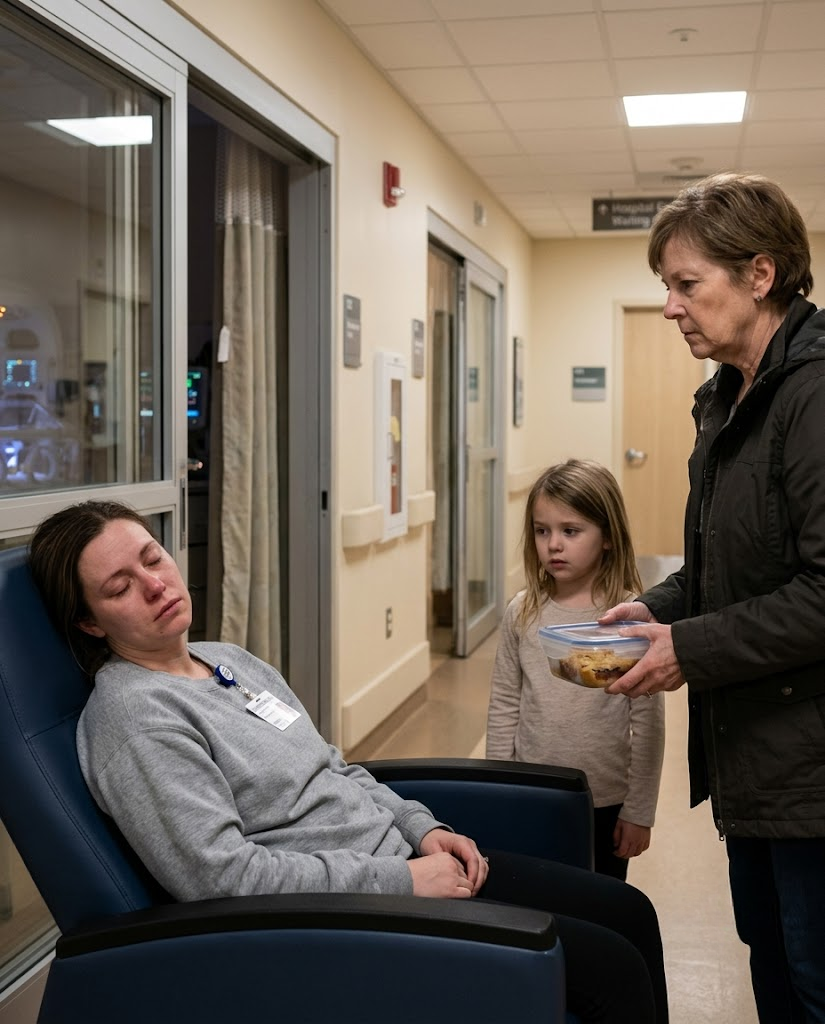
The nurse stepped into the room carrying a smartphone sealed inside a clear belongings bag, and the moment she told me where it had been found—under the edge of Rosalie’s incubator—I knew my mother’s visit had not been about seeing her granddaughter.
Brooklyn stared at the bag before I did.
“That’s Grandma’s phone,” she whispered.

My stomach tightened.
The nurse pulled a chair closer to me and lowered her voice because Rosalie was still sleeping beneath the soft glow of the NICU lights.
“We found it during the overnight check,” she said. “It was recording.”
For a second, the steady rhythm of Rosalie’s monitor seemed louder than everything else in the room.
I looked at Brooklyn.
She had pulled the hospital blanket all the way up to her chin.
“What did you see?” I asked her gently.
Brooklyn’s eyes moved toward the ventilator tubing.
“Grandma came over there,” she said. “She looked at you first because you were sleeping. Then she looked at me.”
Brooklyn swallowed.
“I pretended I was asleep.”
The nurse immediately stopped me from asking more.
“Let her tell it in her own words,” she said quietly.
So I waited.
Brooklyn rubbed one thumb across the edge of the blanket.
“She put her phone down,” she said. “Then she moved the blanket around Rosalie because she said it looked bad.”
I felt cold spread across my chest.
“What looked bad?”
“The tubes.”
The word came out barely louder than Rosalie’s machine.
Brooklyn continued.
“Grandma said people would think you had a reason not to go if they saw all the stuff on Rosalie.”
I stared at her.
The nurse stared too.
Brooklyn pointed toward the incubator.
“She reached by the machine, Mommy. Then the nurse came in and Grandma got scared.”
I could hear my own heartbeat.
“Did she touch anything?”
“I don’t know.”
That answer terrified me more than a confident yes or no would have.
The nurse put a hand on my forearm.
“Rosalie’s equipment remained connected,” she said. “Her readings stayed stable. We have no indication that her respiratory support was interrupted.”
I closed my eyes for one second.
One second only.
Then I opened them again.
Because my baby was still there.
Still breathing with help.
Still fighting.
And my six-year-old had spent part of the night lying awake, afraid to move, while the grandmother she trusted stood beside her baby sister’s incubator.
I wanted facts before anger.
That surprised even me.
Maybe three sleepless days in a NICU had burned away the part of me that still believed yelling could fix anything.
“Show me the phone,” I said.
The nurse explained that hospital staff had already contacted the appropriate supervisor after realizing an unauthorized visitor had entered despite my instructions.
They would not let me handle the device yet, but they could confirm what had been visible when it was discovered.
The camera had still been running.
My mother had apparently set the phone near the incubator with the lens pointed toward Rosalie.
She had been making a video.
Not a private video of a grandmother meeting her premature granddaughter.
Not a message telling Rosalie she loved her.
Not even some misguided attempt at comfort.
The recording had captured my mother rearranging the edge of Rosalie’s blanket and complaining that the equipment made everything look “too dramatic.”
Then came the sentence that finally explained why she had driven to the hospital after I explicitly told staff not to admit her.
She wanted a video showing that Rosalie looked peaceful so she could send it to my father and Courtney as proof that I was “using the baby as an excuse.”
I didn’t cry.
I thought I would.
Instead, something inside me became very still.
My mother had received a message from me saying her newborn granddaughter was on a ventilator.
She had responded by threatening to remove me from the family if I missed a gender reveal.
When I refused to leave my baby, she had come to the NICU looking for material she could use to prove I was exaggerating.
Brooklyn had watched her do it.
The nurse gave me a few minutes before another staff member came to speak with me.
I asked only one question at first.
“How did she get in?”
There had been a breakdown during an overnight handoff.
My mother had identified herself as the grandmother, knew my full name, knew Rosalie’s name, and knew enough details about the birth to sound convincing.
Someone had failed to verify the restriction already attached to our room.
The explanation made sense procedurally.
Emotionally, it changed nothing.
I asked that my mother, father, and sister be barred from receiving information or visiting unless I personally changed that instruction.
Then I asked them to document everything that had happened.
Not because I wanted revenge.
Because Brooklyn had been scared.
Because Rosalie could not protect herself.
Because I had finally understood that telling my mother no was not the same thing as making her respect it.
Brooklyn climbed into my lap carefully, avoiding the incision that still hurt every time I moved.
“Are you mad at Grandma?” she asked.
“Yes.”
She looked worried.
“Are you mad at me because I didn’t wake you up?”
That almost broke me.
I wrapped both arms around her.
“No. Never.”
“But I saw her.”
“You did exactly what you thought would keep you safe.”
Brooklyn pressed her face against my shoulder.
“I didn’t want her to get mad at me too.”
Too.
That little word told me more about my family than any argument ever had.
My daughter already understood that Grandma’s anger moved from person to person until somebody surrendered.
I had spent years calling that personality.
I had called it being difficult.
I had called it keeping the peace.
My six-year-old called it being scared Grandma would get mad at her too.
The difference mattered.
My phone began filling with missed calls later that morning because blocking someone does not prevent them from finding other ways to reach you.
My father used another number first.
Then Courtney tried through a family friend.
I answered neither.
Around lunchtime, a message appeared from Courtney through a number I did not recognize.
“Mom said hospital staff are making a huge deal out of nothing. She was checking on Rosalie. Are you seriously trying to get her in trouble the day of my reveal?”
I read it twice.
There was no question about Rosalie’s condition.
No question about whether she had come off the ventilator.
No question about Brooklyn.
Only the party.
Only Mom.
Only what I was supposedly doing to them.
I took a screenshot and put the phone facedown.
The old version of me would have written six paragraphs.
I would have explained the oxygen numbers.
I would have described the emergency C-section.
I would have reminded Courtney that I had been excited for her pregnancy before mine became an emergency.
I would have tried to build such a perfect argument that nobody could accuse me of being selfish.
I wrote four words instead.
“Do not contact me.”
Then I blocked that number too.
That afternoon, Rosalie’s respiratory team began reducing some of the support from the ventilator.
The nurse warned me not to turn one encouraging stretch into a guarantee.
Premature babies could have good hours and difficult hours.
I understood.
Hope in the NICU came in small pieces.
A better number.
A calmer alarm.
A nurse saying, “She handled that well.”
A tiny hand curling around the tip of your finger.
That afternoon Rosalie gave me one of those pieces.
Her fingers closed around mine.
Brooklyn leaned over as far as she was allowed and smiled.
“She knows you’re here,” she said.
I looked at both my daughters and realized how much of my life had been spent trying to prove to adults that I deserved basic consideration.
My mother had trained me to think every boundary required a defense.
Every absence needed an excuse.
Every disagreement required a trial.
But Rosalie did not need an argument from me.
She needed me present.
Brooklyn did not need me to explain Grandma until Grandma seemed reasonable.
She needed to know that when something frightened her, I would listen.
That was enough.
The gender reveal happened without us.
I knew because photos started traveling through extended-family group chats even though I had muted almost everyone connected to the event.
There were decorations, cake, smiling relatives, and Courtney posing with my parents.
I did not study them.
I did not look for signs that anyone felt guilty.
I closed the screen.
A few hours later, my father sent an email.
The subject line was simply, “Family.”
His message said my mother had been humiliated by the hospital response and that I had allowed “stress” to turn a misunderstanding into something ugly.
He said she had only wanted to reassure everyone that Rosalie was doing better.
That was when I knew he had not seen the recording.
Or he had seen it and was betting I had not.
Either possibility told me the same thing.
I stopped protecting him from the facts.
I replied with three sentences.
“Mom entered after I refused permission. She recorded my premature daughter without my consent while trying to make her condition look less serious. Brooklyn witnessed it.”
Then I added one more.
“I will not discuss this again while Rosalie is in intensive care.”
I sent it.
My hands did not shake.
Thirty-seven minutes later, my father called the nurses’ station repeatedly enough that the hospital asked me whether I wanted his number included in the communication restriction.
“Yes,” I said.
That word used to feel cruel.
Now it felt like a locked door around two children who needed one.
Courtney contacted me again two days later.
This time, the message was different.
She said Dad had finally admitted there was a recording.
She said Mom had told everybody she merely stopped by to “see for herself” whether I was really unable to leave.
Courtney had believed her.
Then she learned Mom had been filming.
“I didn’t know she did that,” Courtney wrote.
I stared at the screen for a long time.
Part of me wanted an apology so badly that I almost turned those words into one.
They were not an apology.
So I did not pretend they were.
I answered, “Brooklyn saw it happen.”
Courtney replied almost immediately.
“I didn’t know Brooklyn was awake.”
Again, the wording landed wrong.
Not: I’m sorry Brooklyn was frightened.
Not: I’m sorry I called your baby drama.
Not even: How is Rosalie?
Just surprise that there had been a witness.
I stopped responding.
On Rosalie’s sixth day in the NICU, a respiratory therapist and nurse stood beside her bed while I watched them prepare for another major step.
Brooklyn was not in the room for that part.
She was coloring at a small table nearby with someone from the care team keeping an eye on her.
I held my breath while the professionals did what they needed to do.
Then, for the first time since her birth, Rosalie was no longer relying on the ventilator in the same way she had before.
She still needed support.
She was still premature.
She was still a tiny four-pound baby with a long road ahead of her.
But when I saw more of her face without the same equipment covering it, I cried so hard I had to sit down.
The nurse handed me tissues.
Brooklyn came back in and stopped beside me.
“Is that a good cry?” she asked.
“Yes.”
She nodded seriously.
“Okay.”
Then she looked at Rosalie.
“Hi, baby sister.”
It was the most ordinary sentence anyone had spoken in days.
It was also the one I remember most.
My mother tried once more before Rosalie left the hospital.
She sent a letter through a relative because she could no longer reach me directly.
The first half explained her behavior.
She had been stressed about Courtney.
She had thought I was overreacting.
She believed families should “show up for each other.”
She had been embarrassed when I refused to attend.
She insisted she never meant to hurt Rosalie.
I believed that last part.
And strangely, believing it did not make what she did acceptable.
Intent was not the only thing that mattered anymore.
She had decided that proving me dramatic mattered more than respecting a medical boundary.
She had entered after being told no.
She had frightened Brooklyn.
She had treated Rosalie’s medical crisis like evidence in a family argument.
At the bottom of the letter, she wrote that she hoped I would “put family first” once I calmed down.
I folded the page and put it back into the envelope.
For years, that phrase had worked on me.
Put family first.
Come when summoned.
Apologize first.
Bring the dessert.
Ignore the insult.
Answer the phone.
Keep everyone comfortable.
But sitting beside Rosalie taught me something my mother never meant to teach me.
Putting family first did not mean obeying the loudest member of it.
Sometimes it meant disappointing an adult so a child could feel safe.
Rosalie stayed in the hospital beyond that first week, growing stronger in frustratingly small increments.
There were good mornings and frightening ones.
There were setbacks that made me cry in bathrooms and improvements I celebrated with vending-machine coffee.
Brooklyn became an expert at drawing pictures small enough to tape near her sister’s space.
She drew our family again and again.
Me.
Brooklyn.
Rosalie.
Sometimes a nurse.
Sometimes a giant purple cat even though we did not own a cat.
My parents were never in the pictures.
I never asked why.
Eventually, Rosalie was strong enough to come home.
I had imagined that day during every sleepless night in the NICU, but the reality was quieter than the fantasy.
There was no dramatic music.
No crowd waiting in the driveway.
No giant family reconciliation.
There was a diaper bag that seemed twice as heavy as it should have been, a folder of instructions I checked constantly, Brooklyn asking every few minutes whether Rosalie was comfortable, and me moving more slowly than usual because I was still healing too.
That first evening, I put Rosalie down safely and stood beside her for longer than necessary.
For weeks, machines had told me she was breathing.
Now the room was quiet enough that I kept leaning closer just to see the tiny rise of her chest.
Brooklyn came beside me.
“Mommy?”
“Yeah?”
“Are we still family even if Grandma is mad?”
There it was.
The question beneath everything.
I crouched so we were eye level.
“Yes.”
She thought about that.
“Even if we don’t go to parties?”
“Yes.”
“Even if we don’t bring cake?”
I laughed before I could stop myself.
It was the first real laugh I had made since Rosalie was born.
“Even then.”
Brooklyn smiled.
“Good.”
Months later, my relationship with Courtney remained uncertain.
She eventually apologized for calling Rosalie’s crisis drama, and I accepted the apology without pretending everything had returned to normal.
Trust does not come back because someone finally uses the correct words.
It comes back through what they do afterward.
My father continued to insist that the family had been torn apart over a misunderstanding.
My mother continued sending occasional messages through relatives until I made it clear that anyone forwarding them would also lose access to us for a while.
That boundary cost me relationships I once thought I could not survive without.
It also gave my daughters something I had never had growing up: a home where no meant no even when the person hearing it was family.
The strangest part is that when I think back to that week, I do not remember the gender reveal colors.
I do not remember who attended.
I do not remember the cake my mother demanded I bring.
I remember Brooklyn clutching a hospital blanket and telling me she had pretended to sleep.
I remember a nurse protecting a baby she had only known for a few days more fiercely than some relatives protected her.
I remember Rosalie’s fingers wrapping around mine.
And I remember the sound that once terrified me more than anything else in the world.
Beep.
Beep.
Beep.
For days, I thought that monitor was counting how close I was to losing my daughter.
Eventually I understood it differently.
It was counting the moments I stayed.
The moments Brooklyn saw me choose her and her sister.
The moments I stopped running toward people who demanded proof of my pain and started protecting the people who trusted me with theirs.
The chocolate mousse cake was never the real issue.
Neither was the party.
The real issue was that my mother believed my role in the family was to show up when called, absorb whatever was said to me, and make everyone else comfortable no matter what it cost.
Rosalie arrived six weeks early and shattered that arrangement without ever saying a word.
She needed air.
Brooklyn needed safety.
I needed to become the mother they could depend on, even if doing that meant finally refusing to be the daughter my mother demanded.
That night at home, Brooklyn carried one of her drawings into Rosalie’s room and placed it on the dresser.
Three stick figures stood beneath an enormous purple cat.
“Who’s that?” I asked, pointing at the cat.
Brooklyn shrugged.
“He protects everybody.”
I smiled and left the picture exactly where she put it.
Then I leaned over Rosalie’s crib.
No ventilator.
No grandmother filming.
No phone buzzing with demands.
Just my baby breathing softly while her sister stood beside me.
For the first time since Rosalie was born, I did not need a machine to tell me what mattered.
I could hear it myself.