PART 8 – My Parents Sold the Last Piece of Land Without Asking Either of Us
Seven years after that Christmas, Dad called me.
“We sold the land.”
I nearly dropped my phone.
“What land?”
“The eleven acres.”
“The trust parcel?”
“Yes.”
“Why?”
“Solar.”
I blinked.
“What?”
A regional energy cooperative had approached them about buying the parcel for a small solar installation.
The offer:
$310,000.
Far above the earlier estimated agricultural value.
“You accepted?”
“Your mother negotiated.”
From the background Mom shouted:
“Your father would have taken the first offer.”
Dad replied:
“It was a good offer!”
“It was insulting.”
I laughed.
“Did you call Margaret?”
“Retired.”
“New attorney?”
“Yes.”
“Independent appraisal?”
“Yes.”
“Trust company approved?”
“Yes.”
“Then why are you calling me?”
Dad was silent.
“Dad?”
“To tell you.”
“That’s it?”
“Yes.”
I smiled.
“Congratulations.”
He seemed almost disappointed.
“You don’t want to ask what we’re doing with the money?”
“No.”
“Why?”
“It’s yours.”
Long silence.
Then Mom said from the background:
“He finally learned.”
They used some proceeds to fund future long-term care.
They donated $25,000 to the local volunteer rescue squad.
Mom replaced her kitchen.
Dad bought a ridiculous pickup truck.
He was eighty-one.
I objected to the truck.
Not financially.
Medically.
“You can barely turn your neck.”
“It has cameras.”
“That is not the point.”
“It sees better than I do.”
That was unfortunately true.
The rest remained in trust.
Vanessa heard about the sale at Sunday lunch.
She said nothing.
Later she told me:
“The old me would have already spent it in my head.”
That honesty became part of how I measured her change.
Not perfection.
Recognition.
By then, she had completed probation.
Restitution was not fully repaid.
It probably never would be.
She paid monthly.
Not huge amounts.
Consistent amounts.
My parents eventually chose to forgive part of the remaining civil balance.
The court-approved restitution obligations connected to the criminal case were handled separately, but certain private claims could be settled.
I did not agree with forgiving the debt.
Dad reminded me:
“Not your money.”
I laughed.
“Okay.”
There it was again.
The sentence our family had finally learned.
Not your money.
Not your signature.
Not your house.
Not your choice.
Vanessa did not return to business ownership.
She eventually became office manager for the cleaning company.
She was trusted with schedules.
Staffing.
Supplies.
Not company banking.
Her employer knew her conviction.
She told them before they hired her.
Three years later, they promoted her.
With controls.
She once told me:
“The weird thing is, I like controls now.”
“Why?”
“Because I don’t have to pretend trust means nobody checks.”
That sounded like something Dad would say.
Mom’s health began declining first.
Not dramatically.
Age.
Heart disease.
Arthritis.
She moved from the condo into assisted living at eighty-three.
Dad moved with her even though he needed less care.
“I married her,” he said.
“That sounds suspiciously romantic.”
“Don’t tell anyone.”
Their apartment had no kitchen cellar.
Dad checked.
Vanessa visited.
So did I.
Neither of us made medical decisions alone.
My parents completed health-care directives.
Independent professionals handled finances.
Vanessa was listed as a daughter.
I was listed as a son.
Nothing more magical than that.
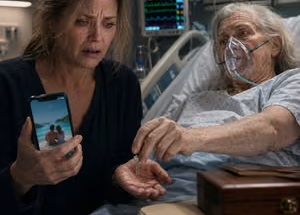
When Mom died at eighty-five, I was there.
So was Vanessa.
Dad sat between us.
Mom had pneumonia following heart failure.
It was not sudden.
We had time.
Near the end, she opened her eyes and saw Vanessa.
“Are you okay?” Mom whispered.
Vanessa began crying.
“Yes.”
Mom looked at me.
“You?”
“Yes.”
Then Dad.
“You’re impossible.”
Dad laughed through tears.
“Likewise.”
Those were nearly her final words.
Not a dramatic revelation.
No hidden key.
No secret account.
Just a marriage compressed into two words.
After she died, Vanessa and I stood in the hallway.
She said:
“I don’t deserve how kind she was to me.”
I answered:
“Maybe don’t make her kindness another debt.”
Vanessa looked at me.
“What do you mean?”
“She chose the relationship she wanted with you.”
“Let it be hers.”
That was a lesson I had learned from Mom.
Forgiveness is not a payment plan.
Dad survived her by three years.
He became quieter.
He missed her terribly.
Vanessa visited more often.
I did too.
One afternoon, he asked both of us to sit down.
“I changed the trust.”
Vanessa went pale.
I almost laughed.
Dad saw her.
“Relax.”
“I’m not asking either of you to sign anything.”
That broke the tension.
The new plan was simple.
After remaining expenses, half to me.
Half to Vanessa through a managed trust for five years.
Not because he believed she would steal again.
Because financial structure had become part of their estate plan.
Vanessa nodded.
“Okay.”
Dad looked at me.
“Problem?”
“No.”
“That’s boring.”
“I’m growing.”
Then he gave us each a copy.
No secrets.
No surprises after death.
“I don’t want either of you discovering my intentions in a box.”
Fair.
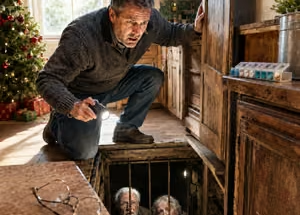
Before we left, he handed me something else.
His old broken glasses.
The same pair I had seen on the kitchen table that Christmas.
One arm still missing.
“Why did you keep these?”
“Evidence.”
“Of what?”
He smiled.
“That I was too cheap to throw anything away.”
I laughed.
Then he became serious.
“They were on the floor when Vanessa first pushed me toward the cellar.”
I stopped.
“She pushed you?”
“Once.”
“You never said that.”
“Didn’t matter to the case.”
“It matters to me.”
“I know.”
He looked at the glasses.
“I kept thinking I’d repair them.”
“Why didn’t you?”
“Some things don’t need repairing.”
He handed them to me.
“You just remember they broke.”
I kept them.
Not as a weapon.
Not even as evidence.
As a reminder that truth does not require every broken thing to look new again.
PART 9 – Dad’s Funeral Was the First Christmas We Were All Together Again
Dad died in October at eighty-eight.
Peacefully.
Stroke in his sleep.
No cellar.
No missing medicine.
No unanswered calls.
Vanessa found him.
She had arrived for breakfast.
For several minutes after calling emergency services, she sat beside his bed holding his hand.
Then she called me herself.
Not pretending to be him.
Not filtering information.
Just my sister.
“Michael.”
I knew from her voice.
“What happened?”
“Dad’s gone.”
I closed my eyes.
“Are you sure?”
“The paramedics are here.”
I flew in that afternoon.
The funeral happened six days later.
Dad had written his own instructions.
No expensive casket.
No long speeches.
No open microphone.
And one strangely specific instruction:
Do not let Warren Ellis sing.
Warren was furious.
Mom had been right.
Dad remembered every detail.
Vanessa gave no eulogy.
Neither did I.
Instead, Warren read a letter Dad had written years earlier.
It said:
My children will probably spend too much time deciding which one of them disappointed me more. Tell them to stop.
People laughed.
Then:
Michael left too much.
My throat tightened.
Vanessa stayed too hard.
She began crying.
One thought money could replace presence.
The other thought presence created ownership.
The church became completely silent.
Both were wrong.
I looked at Vanessa.
She was looking at me.
They also both learned.
I couldn’t see the page anymore through tears.
That is more than most parents get.
Warren continued.
If you remember our family, do not remember the cellar first.
Remember that we got out.
Dad.
Even dead, he refused to let the worst four months own the rest of his life.
After the funeral, the trust administration began.
Everything happened exactly as documented.
No challenge.
No secret amendment.
No fight.
Vanessa’s remaining inheritance was reduced by certain outstanding obligations according to Dad’s instructions and legal advice.
She accepted it.
My share was larger than I expected.
I did not need it.
I used part to establish a scholarship at the local community college for adults returning to school after business failure or financial hardship.
I did not name it after Vanessa.
That would have been unbearable.
I named it:
The Robert and Margaret Carter Second Start Scholarship.
Vanessa laughed when I told her.
“Subtle.”
“Very.”
“Is this your way of turning me into a charity project?”
“No.”
“Good.”
Then she surprised me.
“I want to contribute.”
I looked at her.
“How much?”
“Five hundred a year.”
I knew her salary.
That amount mattered.
“You don’t have to.”
“I know.”
That was the point.
She contributed every year.
A few months later, Christmas approached.
The first Christmas without either parent.
Vanessa called.
“What are you doing?”
“Probably staying home.”
“Come here.”
“Where?”
“Dad’s old town.”
She had rented a small house for the weekend.
Not our parents’ old property.
That had become part of Cedar Peak’s mixed-use development years earlier.
The old grocery building survived.
It was now a café.
The cellar house itself had been demolished.
I had complicated feelings about that.
Then I realized:
It was a building.
My childhood did not require the building to remain.
I agreed.
Christmas Eve, Vanessa and I ate dinner in the old grocery store, now called Carter’s Corner by new owners who had kept our family name after asking permission.
Warren came.
So did cousins.
No one talked about prison.
No one pretended it never happened.
At one point, Vanessa walked outside.
I followed.
Snow was beginning.
She stood beneath the old store sign.
“Do you ever think about what would have happened if you came two weeks later?”
“Yes.”
“All the time?”
“Not anymore.”
She nodded.
“The closing would have failed.”
“Probably.”
“The trust transfer too.”
“Probably.”
She looked at me.
“So I wouldn’t have gotten away with it.”
“Maybe not financially.”
I paused.
“But Mom and Dad would have been down there two more weeks.”
She started crying.
“That’s the part I can’t live with.”
I looked at her.
“You do live with it.”
“What?”
“You already do.”
She wiped her face.
“That sounds cruel.”
“It isn’t.”
I continued:
“You don’t honor them by spending the rest of your life trying to suffer enough.”
“What do I do?”
“The same thing Dad told us.”
“What?”
“Remember we got out.”
She smiled through tears.
“We?”
I looked toward the café.
“I did some getting out too.”
Not from a cellar.
From the idea that success excused absence.
From the idea that sending money meant I could avoid uncomfortable questions.
From the story where I was the successful son who returned and saved everyone.
I didn’t save my parents alone.
Warren spoke.
Police came.
Doctors treated them.
Lawyers protected their rights.
Bank employees questioned documents.
A title examiner noticed signatures.
My parents survived.
Systems worked where family trust failed.
That mattered.
Vanessa touched my arm.
“Michael?”
“Yeah?”
“Thank you for coming home.”
I thought about it.
Then:
“I should’ve come sooner.”
She shook her head.
“That isn’t what I said.”
I looked at her.
“Thank you.”
We went inside.
For the first time in twelve years, Christmas did not feel like something I was making up for.
It was simply Christmas.
PART 10 – Three Knocks
Twelve years after the night I heard three knocks beneath the kitchen floor, I retired from daily management of Carter Regional Logistics.
Not fully.
People who build companies are bad at the word retirement.
Priya became CEO.
I remained chairman for two years.
Then even that felt unnecessary.
The business did not collapse without me.
That was humbling.
And healthy.
I bought a smaller house outside Richmond.
Close enough to Vanessa that we occasionally had lunch.
Far enough that neither of us could show up unannounced without looking ridiculous.
She never remarried.
Neither did I.
Life does not require every healed person to end with a new spouse.
Vanessa became director of operations at the cleaning company.
No authority to move client funds.
She laughed about that.
“I’m the only operations director with a court-inspired job description.”
“You earned it.”
“Thanks.”
“Not a compliment.”
“I know.”
She had built a decent life.
Not wealthy.
Stable.
She rented a townhouse.
Drove a seven-year-old Honda.
Paid taxes.
Called before visiting.
Small things.
Boring things.
The things trust is actually made from.
One December afternoon, I was putting groceries away when I heard:
Knock.
I froze.
Then:
Knock.
Pause.
Knock.
Three.
My body reacted before my mind did.
Kitchen.
Floor.
Cellar.
Darkness.
Dad’s voice.
Mom’s thin hands through metal bars.
I stood motionless for several seconds.
Then the knocks came again.
From the front door.
I laughed at myself.
When I opened it, Vanessa stood there holding two grocery bags.
“You okay?”
“Yes.”
“You look weird.”
“I heard three knocks.”
She went still.
“Oh.”
For a moment, twelve years disappeared for both of us.
Then she lifted the bags.
“I brought pie.”
“What kind?”
“Apple.”
“Come in.”
She waited.
I looked at her.
“What?”
“You didn’t say I could.”
I almost smiled.
“Vanessa.”
“Old habits.”
“Come in.”
She entered.
That tiny pause meant more to me than any apology she had ever written.
On my office shelf were Dad’s broken glasses.
Visitors occasionally asked why I kept them.
I usually said they belonged to my father.
That was enough.
But that evening, Vanessa saw them.
She stopped.
“You still have those?”
“Yes.”
She stared.
“I remember when they broke.”
“I know.”
“I pushed him.”
“He told me.”
She closed her eyes.
“I hate that he told you.”
“Why?”
“Because I wanted one thing you didn’t know.”
I understood.
Shame likes secrecy even after confession.
I took the glasses from the shelf.
One arm still missing.
“I thought about fixing them.”
She looked at me.
“Why didn’t you?”
“Dad said not everything has to be repaired.”
Vanessa nodded.
“That sounds like him.”
We sat in the kitchen.
No marble counters.
No giant holiday decorations.
No legal folders.
Just coffee.
Pie.
Two aging siblings who had spent most of their lives misunderstanding what they owed each other.
Vanessa asked:
“Do you think Mom and Dad would be happy with us?”
“That sounds like a trap.”
“Why?”
“Because then we start living for dead people’s approval.”
She smiled.
“Therapy ruined you.”
“Completely.”
I thought about Dad’s last letter.
Both were wrong.
Both learned.
“I think they’d be glad we talk.”
“Same thing?”
“No.”
She accepted that.
Then she asked:
“Do you ever wish you hadn’t found the folder?”
I stared.
“What?”
“The trust.”
“The documents.”
“Everything.”
“You mean if I’d just gotten Mom and Dad out?”
“Yes.”
I thought a long time.
“No.”
“Why?”
“Because getting them out of the cellar wasn’t enough.”
She looked at me.
“They needed their lives back.”
Bank accounts.
Property.
Signatures.
Choices.
Freedom is more than an unlocked door.
That had been the real story.
Vanessa had taken their money.
But before money, she took something more fundamental.
The right to say no and have no mean no.
No, we will not sell the house.
No, you may not take that money.
No, we will not change the trust.
No, you may not decide who deserves our estate.
When those answers became inconvenient, she treated them as problems to solve.
I looked at my sister.
“You know what scared me most?”
“The cellar?”
“No.”
She waited.
“The fake messages.”
“Why?”
“Because I wanted to believe them.”
She looked confused.
“I wanted Dad’s ‘Doing fine’ to be true.”
“I wanted Mom’s silence to mean she was tired.”
“I wanted the transfers to prove I was a good son.”
I swallowed.
“You didn’t only lie to me.”
“You gave me lies that fit what I already wanted.”
Vanessa looked down.
“That’s ugly.”
“Yes.”
“I’m sorry.”
“I know.”
“I’m not saying it because I expect anything.”
“I know.”
That was also trust.
An apology no longer automatically requiring forgiveness in return.
We finished the pie.
Before leaving, Vanessa stood beside the door.
“Next Christmas?”
“What about it?”
“Your place or mine?”
“Mine.”
“You just want control.”
“Absolutely.”
She laughed.
Then became serious.
“Michael.”
“Yeah?”
“I’m glad you came home that Christmas.”
This time I did not answer with:
I should’ve come sooner.
That sentence was true.
It was also useless after twelve years.
So I said:
“So am I.”
She left.
The house became quiet.
I went into my office and picked up Dad’s glasses.
For years, I thought the most important thing I did that Christmas was move the pantry cabinet.
Then I thought it was calling police.
Later I thought it was stopping the sale.
Or preserving the trust.
Or making Vanessa answer for what she did.
I was wrong.
The most important thing happened before any of that.
I noticed.
Broken glasses.
Untouched medicine.
A winter coat.
A new lock.
Neighbors who hesitated before speaking.
Three weak knocks.
None of those things alone told the whole story.
Together, they demanded a question.
For twelve years, I had lived by answers.
How much money do they need?
Transfer it.
What bill?
Pay it.
Everything okay?
They say yes.
Good.
Move on.
That Christmas taught me that loving people sometimes means staying long enough to ask the second question.
And the third.
Not because you expect betrayal.
Because presence notices what money cannot.
Years later, when employees at my old company asked why I had become almost obsessive about independent approvals, verification calls, and never letting one trusted person control an entire process, I never told them the full story.
I simply said:
“Trust people.”
“Then build systems that don’t require them to be perfect.”
My father would have liked that.
My mother probably would have added an emoji.
Vanessa would have rolled her eyes.
And me?
I would have called home.
Not texted.
Called.
Because twelve years earlier, three knocks beneath a kitchen floor gave me back my parents.
But the harder truth was that they had been trying to reach me long before that night.
I had simply been too far away to hear them.

One Comment on “PART 8 – My Parents Sold the Last Piece of Land Without Asking Either of Us”