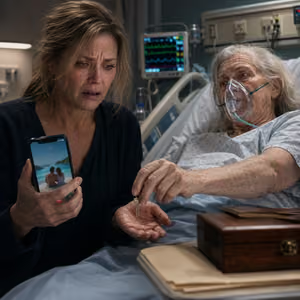
PART 2 – What Eleanor Had Been Protecting
Julian flew home the following afternoon.
Not immediately.
That mattered to me more than I wanted it to.
There were flights from Maui to Chicago the same night.
There were connections through Los Angeles and San Francisco.
He could have been home by morning.
Instead, he arrived at 4:20 p.m. the next day.
When he walked into our house, he looked exhausted.
Wrinkled shirt.
Unshaven face.
Red eyes.
He dropped his suitcase.
“Elena.”
I stood in the kitchen.
I had slept approximately three hours in two days.
“You knew.”
He stopped.
“About Vanessa?”
“Yes.”
I said nothing.
“It started last year.”
I still said nothing.
His shoulders sagged.
“I was going to tell you.”
“Were you going to tell me before or after Maui?”
He looked away.
“Elena…”
“Did your mother know?”
His face changed.
There.
A fraction of a second.
“Yes.”
“How?”
“She saw messages.”
“When?”
“Months ago.”
“And?”
“She was furious.”
“About the affair?”
“Yes.”
“What else?”
He looked at me.
“What do you mean?”
I watched him carefully.
Arthur had told me to ask broad questions.
People fill silence when they are afraid of what you know.
“Your mother and I talked before she died.”
That was true.
Julian swallowed.
“What did she say?”
“Not much.”
“Did she give you anything?”
Too fast.
I felt a chill.
“Like what?”
He recovered.
“I don’t know. Jewelry. Documents. Mom kept things everywhere.”
“Why would you ask about documents?”
He rubbed both hands over his face.
“Because probate is going to be complicated.”
His answer almost worked.
Almost.
Eleanor’s late husband, Charles Mercer, had founded Mercer Medical Supply with her in 1989.
By the time Charles died, the company distributed surgical equipment, mobility products, and hospital supplies across five Midwestern states.
Eleanor controlled 34 percent of the voting shares through her trust.
Julian personally controlled 26 percent.
The remaining shares were divided between two cousins, an employee ownership plan, and several early investors.
For years, everyone assumed Eleanor’s 34 percent would eventually pass directly to Julian.
Combined with his existing shares, he would effectively control the company.
“Mom had a trust,” Julian said.
“I know.”
“There will be board questions.”
“I know.”
“Did she sign anything recently?”
“I don’t know.”
That was also technically true.
I had not yet read everything.
Julian stared at me.
Then he asked:
“Where are her personal papers?”
“Arthur Harrison has some.”
His entire body went still.
“Harrison?”
“Yes.”
“How do you know him?”
“Your mother told me.”
Julian’s face drained.
“Elena.”
“What?”
“What did Harrison give you?”
I said nothing.
He stepped closer.
“If Mom gave him company records, we need to know.”
“We?”
“The company.”
“Or you?”
His jaw tightened.
“This is not the time.”
“You’re right.”
I walked past him.
“Your mother died while your girlfriend told me to stop ruining your vacation.”
He grabbed the edge of the kitchen island.
“I didn’t know she was dying.”
“No.”
That part was true.
I believed him.
Then I turned.
“But you knew your mother was sick.”
“She had been sick for years.”
“You knew I called thirty-one times.”
“My phone was on silent.”
“For thirty-one calls?”
“I was in the shower for some of it.”
“Vanessa said you were.”
He closed his eyes.
“I know how this looks.”
I almost laughed.
“Julian, I don’t think you do.”
He stayed in a hotel that night.
I asked him to leave.
He argued for about two minutes.
Then he stopped when I told him I would call my attorney if he refused.
I had never said those words to him before.
The following morning, Arthur Harrison explained the trust.
Eleanor had amended it eleven months earlier.
Not in secret from the law.
In secret from Julian.
Instead of leaving her voting shares directly to him, she placed them into a five-year voting trust.
The trustee was a retired corporate judge named Helen Monroe.
I was named co-trustee solely for matters involving family distributions and records.
Julian received economic benefits from part of the trust but no automatic control of the votes while the forensic review remained unresolved.
“She did this because of the fraud?” I asked.
“Because she was concerned about governance, conflicts of interest, and her son’s pressure.”
“Pressure?”
Arthur opened one of Eleanor’s notebooks.
November 3.
J. again wants signature on Pacific contract. Told him no. He said company will fail if I embarrass him before board.
November 17.
Vanessa at office after hours. J says she is consultant. Why does consultant use private elevator?
December 6.
Bank called about Harborview line. I did not authorize pledge.
I looked up.
“What pledge?”
Arthur handed me another document.
Eleanor’s trust owned a commercial property called Harborview Center.
Worth approximately $6.8 million.
A bank had issued a $1.9 million credit line secured partly by that property.
The authorization carried Eleanor’s signature.
Again.
Not hers.
“Was money drawn?”
“About $1.1 million.”
“Where did it go?”
“Primarily Mercer Medical Supply.”
“So Julian used it for the company?”
“Some.”
I waited.
“And some?”
Arthur handed me another schedule.
$310,000 to Pacific Crest.
$96,000 to a luxury property management company in Honolulu.
$78,000 for something labeled executive housing.
A mortgage statement was attached.
Condo owner:
Vanessa Reed.
I sat back.
“My husband used his mother’s property to help buy his mistress a condo?”
Arthur chose his words carefully.
“There is evidence company-related funds and proceeds from a disputed credit line were used in transactions connected to a property owned by Ms. Reed.”
“Is that lawyer language for yes?”
“It is lawyer language for we prove it before we say it.”
I almost smiled.
Then he gave me another document.
This one was not financial.
It was a petition prepared by Julian’s previous attorney.
Never filed.
Petition for Protective Proceedings – Eleanor Mercer.
“What is this?”
“A draft guardianship petition.”
I stared.
“He was going to declare her incompetent?”
“He explored it.”
The stated reasons:
Memory decline.
Medication confusion.
Paranoia regarding company finances.
Unreasonable accusations against executives.
I felt sick.
“She wasn’t paranoid.”
“No.”
“Did she have memory problems?”
“Some. After the strokes.”
“So maybe Julian actually believed—”
“Read the physician letter.”
I did.
Eleanor’s geriatric specialist had written:
Mrs. Mercer demonstrates mild post-stroke executive slowing but retains capacity to understand financial decisions and express consistent preferences.
“That doesn’t support incompetence.”
“No.”
“Then why—”
Arthur opened another email.
Julian to attorney:
We need options if she keeps blocking routine company business based on these accusations.
I closed my eyes.
The box did not show a cartoon villain.
It showed something more believable.
Julian needed his mother’s signature.
She had begun saying no.
So instead of asking whether she might be right, he started building a case that her no no longer counted.
Arthur said:
“Eleanor terminated the attorney who drafted that petition once she learned about it.”
“How?”
“Someone forwarded her the bill.”
I almost laughed at the absurdity.
A $4,800 legal invoice had exposed the plan.
“What happens now?”
“An independent forensic audit.”
“Can Julian stop it?”
“No.”
“Why?”
“Because the trust votes can demand it, and two other directors already support it.”
I stared.
“Other directors know?”
“They know there are irregularities. They do not know everything.”
My phone buzzed.
Julian again.
Then a message.
We need to plan Mom’s funeral. Please don’t let lawyers turn this into war.
I showed Arthur.
He read it.
Then returned my phone.
“Eleanor predicted that sentence almost exactly.”
“What?”
He opened her notebook.
A page dated seven months earlier.
If Elena ever learns the truth, J will say lawyers are dividing the family. Remember: he divided it when he made honesty dangerous.
I stared at Eleanor’s handwriting.
Then Arthur reached for the flash drive.
“There’s more.”
“What?”
“Audio.”
He inserted it into his computer.
The first file was dated ten months earlier.
Eleanor’s voice came through weak but clear.
“Julian, I told you I will not sign it.”
My husband answered.
“Mom, this is not optional if you want the company protected.”
“It is my property.”
“You don’t understand the exposure.”
“I understand my name.”
“Vanessa already structured the transaction.”
“I don’t care what Vanessa structured.”
A pause.
Then Julian said something that made every hair on my arms rise.
“You are going to sign eventually. The only question is whether we do this privately or I explain to the board that you’re no longer capable of handling these decisions.”
The recording ended.
I looked at Arthur.
“That sounds like coercion.”
“It may support that argument.”
“Did he know she was recording?”
“We don’t believe so.”
I stared at the frozen audio waveform.
Then the office receptionist called Arthur.
“Mr. Harrison? Julian Mercer is here.”
Arthur looked at me.
“I did not invite him.”
Neither had I.
A moment later Julian’s voice came through the outer office.
“I know my mother kept a box here.”
I felt the blood drain from my face.
Then he said:
“And I want it back before my wife sees what’s inside.”
He was too late.
PART 3 – The Funeral and the First Lie
Arthur did not let Julian into the room.
Instead, he met him in the conference room next door while I left through a second hallway.
I learned later that Julian demanded his mother’s files as her “natural heir.”
Arthur calmly informed him that estate documents did not work that way.
Eleanor had a trust.
A personal representative.
A corporate trustee.
A lawyer.
And written instructions.
Julian had no automatic right to remove records simply because he was her son.
He was furious.
But anger did not change the paperwork.
Eleanor’s funeral was four days later.
Julian gave the eulogy.
That was Eleanor’s wish, written before the worst part of their conflict.
I did not interfere.
He stood in front of nearly two hundred people and spoke about his mother’s courage.
Her discipline.
How she taught him that a family business was a promise to the people whose paychecks depended on it.
I listened from the front pew.
Some of it was true.
That made it harder.
People are rarely only the worst thing they have done.
Julian had loved his mother.
I knew that.
He had also threatened to use her health against her when she stopped agreeing with him.
Both were true.
Vanessa did not attend the funeral.
Julian told people she was “on leave.”
I wondered whether she was still in Maui.
After the burial, Julian approached me.
“Can we talk?”
“Not here.”
“Please.”
I looked around.
His cousins.
Company employees.
Eleanor’s old church friends.
“This is your mother’s funeral.”
“I know.”
“Then act like it.”
He flinched.
I walked away.
That evening, he came to the house anyway.
I did not let him in.
We spoke on the porch.
“Did Harrison show you the trust?” he asked.
“Yes.”
He closed his eyes.
“So you know.”
“That she didn’t leave you her voting shares outright?”
His expression hardened.
“She was manipulated.”
“By whom?”
“Harrison.”
“Anyone else?”
He looked at me.
“You.”
I almost laughed.
“I didn’t know the trust existed until after she died.”
“She always listened to you.”
“Not about the company.”
“You have no idea what she was like the last year.”
“I was at her medical appointments.”
“That doesn’t mean you understood the business.”
“Then explain it.”
He paced once across the porch.
“The company was under pressure.”
“From what?”
“Supply contracts. Interest rates. Reimbursement changes. We had a distribution expansion that underperformed.”
“Did that justify Pacific Crest?”
He froze.
There.
“How do you know that name?”
“Your mother kept records.”
“Elena.”
“What is Pacific Crest?”
“A consulting firm.”
“Owned by Vanessa.”
“She established it before we became involved.”
“Did Mercer Medical Supply pay it more than two million dollars?”
He stared.
“That number is misleading.”
“How?”
“It includes pass-through expenses.”
“For what?”
“Market expansion.”
“Hawaii?”
He clenched his jaw.
“Among other things.”
“What about the condo?”
His eyes flashed.
“What condo?”
That lie was almost insulting.
“The Honolulu condo.”
He looked away.
“I don’t know what Harrison told you.”
“So you do know.”
“Vanessa received compensation.”
“Did the company buy her housing?”
“No.”
“Did money from your mother’s disputed credit line end up connected to it?”
“You do not understand corporate cash flow.”
I nodded slowly.
“Then help me understand.”
He stopped pacing.
For a second, I thought he might.
Instead:
“This is exactly why Mom should never have involved you.”
There it was.
Not:
These records are wrong.
Not:
I can explain every transfer.
You should never have been allowed to see them.
I asked:
“Did you forge her signature?”
“No.”
“Did Vanessa?”
“No.”
“Who did?”
“No one forged anything.”
“Then why did your mother say those signatures weren’t hers?”
“She forgot signing documents.”
I stared at him.
“Your mother kept examples of her signature.”
“She was paranoid.”
The word landed heavily.
“Paranoid.”
“Yes.”
“Like in the guardianship draft?”
His face changed.
He had not expected me to know that.
“You read everything.”
“Not yet.”
“Elena, listen to me.”
He stepped closer.
“My mother had cognitive decline.”
“Her doctor said she had capacity.”
“Capacity isn’t binary.”
“Neither is truth.”
He rubbed his forehead.
“God.”
Then he said:
“I made mistakes.”
It was the first useful sentence.
“What mistakes?”
“My relationship with Vanessa.”
“That’s one.”
“Blurring company and personal expenses.”
“Two.”
“Not telling the board enough.”
“Three.”
He looked at me.
“But I did not steal from my mother.”
“Then the audit should help you.”
He stared.
“You approved an audit?”
“The trustees did.”
“You’re co-trustee.”
“For limited matters.”
“So you approved it.”
“Yes.”
He laughed bitterly.
“You have no idea what you’re doing.”
“Probably.”
That surprised him.
“I’m not a corporate attorney.”
“No.”
“I’m not a forensic accountant.”
“No.”
“That’s why I’m using them.”
He had no answer.
I continued:
“Julian, if the records clear you, I’ll accept that.”
He stared at me.
“Do you mean that?”
“Yes.”
“And if they don’t?”
I thought of Eleanor.
Destroy the lie.
“Then you accept what they show.”
His face hardened.
“You want revenge because of Vanessa.”
“No.”
“You expect me to believe that?”
“I want a divorce because of Vanessa.”
He stopped breathing for a second.
“I want the audit because of the documents.”
“Elena.”
“I’ve already retained counsel.”
He looked at me.
Twenty-five years of marriage.
Two grown stepchildren from Julian’s first marriage whom I had helped raise.
Christmases.
Illness.
Mortgage payments.
Fights about paint colors.
Funerals.
Vacations.
All reduced to one sentence I had never expected to say.
“I’m filing for divorce.”
He sat on the porch step.
For the first time that evening, the CEO disappeared.
He looked like a tired fifty-four-year-old man who had finally reached something money could not negotiate away.
“Is there nothing to save?”
I did not answer immediately.
“I called you thirty-one times.”
He covered his face.
“I know.”
“Your girlfriend answered.”
“I know.”
“Your mother heard her.”
His shoulders shook once.
“I know.”
“She died less than a minute later.”
“Elena, please.”
“You asked if there is something to save.”
I looked at him.
“I don’t know how to save a marriage where the truth had to come to me in a locked box.”
He began crying.
I cried too.
Not because I changed my mind.
Because twenty-five years can be real and still be over.
The next morning, the board of Mercer Medical Supply announced a special meeting.
Julian received notice at 8:03 a.m.
At 8:11, he called me.
“You did this.”
“No.”
“Don’t lie to me.”
“I didn’t call the meeting.”
“Who did?”
“Helen Monroe and two directors.”
“What do they want?”
“An independent investigation.”
He went silent.
Then:
“They cannot suspend me.”
I had read the bylaws the night before.
“They can.”
He hung up.
At 9:37, Arthur called.
“The forensic team found something in the accounts.”
“What?”
“Pacific Crest was not the only company.”
My stomach tightened.
“There’s another entity?”
“Yes.”
“Whose?”
“We’re still confirming beneficial ownership.”
“What is it called?”
Arthur paused.
“Thirty-One Ventures.”
I felt cold.
“Thirty-One?”
“Yes.”
The number might have meant nothing.
But I remembered the call.
Thirty-one times.
That afternoon, investigators traced Thirty-One Ventures to a trust administrator in Nevada.
And the listed beneficiary was not Vanessa.
It was Julian.
The affair had been expensive.
The fraud might have been personal.
And suddenly the question was no longer whether my husband had helped his mistress profit from the company.
It was whether he had built the entire system for himself.
PART 4 – The Board Meeting
The special board meeting lasted six hours.
I attended only the first twenty minutes.
That surprised Julian.
He expected me to sit there like a prosecutor.
Instead, Helen Monroe introduced the trust documents, Arthur confirmed Eleanor’s instructions, and I stated one thing for the record.
“I support an independent review. I have no opinion today on guilt.”
Julian stared at me.
Then I left.
It was one of the hardest things I had done.
Anger wants a front-row seat.
But an investigation cannot become credible if the CEO’s divorcing wife looks like she is directing it.
The board appointed an outside forensic accounting firm.
Julian was placed on paid administrative leave.
Not fired.
Not declared guilty.
His company access was restricted.
Vanessa was also placed on leave because Pacific Crest had received significant company payments while she simultaneously served as vice president of strategic partnerships.
That dual role had never been fully disclosed to the board.
By evening, local business reporters were calling.
We said nothing.
No revenge interviews.
No social media posts.
Arthur repeated Eleanor’s advice:
“Documents. Witnesses. Time.”
The first forensic report took seven weeks.
It found problems.
Real ones.
But not everything Eleanor had feared turned out to be criminal.
That mattered.
About $740,000 in Pacific Crest payments corresponded to legitimate consulting, travel coordination, and overseas market research.
Overpriced?
Possibly.
Poorly governed?
Definitely.
But real work existed.
That left roughly $1.69 million in payments requiring deeper explanation.
Of those, about $620,000 could be traced to related-party expenses that had not been properly disclosed.
The Honolulu condo.
Private travel.
Interior furnishings.
A luxury vehicle used primarily by Vanessa.
And $310,000 that had moved through Pacific Crest before reaching Thirty-One Ventures.
The Nevada entity.
Julian’s entity.
When the accountants showed him the records, he stopped denying it existed.
His explanation was that Thirty-One Ventures had been created as an “executive investment vehicle.”
Approved by whom?
Him.
Disclosed to the board?
No.
Why had company-connected money reached it?
“Deferred compensation.”
Where was the compensation agreement?
There wasn’t one.
That was bad.
But the forged signatures were worse.
A document examiner concluded that three of Eleanor’s signatures on corporate resolutions were digital reproductions taken from older signed forms.
Identical pixel artifacts.
Not naturally signed copies.
Who created them?
The files had been produced on a computer assigned to Julian’s executive office.
But several people had access.
Julian.
His executive assistant.
Vanessa.
Two administrative staff members.
The board could not simply say:
Julian forged them.
Then investigators found an email.
Vanessa to Julian:
Eleanor still refusing Pacific approval. Do you want me to use last year’s authorization format and move forward?
Julian replied:
We cannot miss another closing because she is having one of her episodes. Handle it.
Two hours later, a resolution bearing Eleanor’s copied signature had been created.
Julian’s attorney later argued that “handle it” did not mean “forge a signature.”
That was technically true.
But another email made the defense harder.
Three days later Vanessa wrote:
Done. Used the prior signature block. Don’t send her a copy.
Julian’s reply:
Good.
I read those two lines in Arthur’s office.
“Is that enough?”
“For what?”
“To prove he knew.”
“It is strong evidence.”
“Criminal?”
“That decision belongs to prosecutors.”
I hated how often reality refused to give me immediate certainty.
But Eleanor had been right about that too.
Use time.
Another finding surprised me.
Julian had not begun the scheme because of Vanessa.
The first questionable transaction predated their affair by almost a year.
Before Vanessa, Julian had already been moving money aggressively to hide losses from a failed regional expansion.
Mercer Medical Supply had purchased a distribution company in Ohio.
The integration went badly.
Customers left.
Inventory systems failed.
A major hospital contract was lost.
The acquisition caused nearly $4.8 million in losses over two years.
Julian concealed part of the severity from the board by shifting expenses between entities and delaying write-downs.
Not because he was buying yachts.
Because he was terrified of being the son who destroyed what his parents built.
Then Vanessa entered the picture.
First as a consultant.
Then an executive.
Then his lover.
Instead of stopping the hidden accounting, she helped professionalize it.
The scheme changed.
Some money continued plugging legitimate business holes.
Some became personal.
That distinction mattered.
Julian had not set out one morning to steal millions.
He began by hiding failure.
Then every hidden mistake required another.
Eventually, the line between saving the company and saving himself disappeared.
Arthur said:
“Most serious financial misconduct does not begin with someone saying, ‘Today I become a criminal.’”
“How does it begin?”
“Usually with, ‘I’ll fix it next quarter.’”
That sounded painfully like Julian.
At our temporary divorce mediation, he finally admitted the Ohio acquisition.
“I was ashamed.”
I looked at him.
“You could have told the board.”
“They would have removed me.”
“Maybe.”
“My father built that company.”
“I know.”
“Mom trusted me with it.”
“Until she didn’t.”
He flinched.
“I thought I could repair it.”
“By falsifying her approval?”
He stared at his hands.
“I never personally copied her signature.”
“Did you know Vanessa did?”
A long silence.
Finally:
“I knew after.”
“After what?”
“After the first time.”
I stopped breathing.
“You knew.”
“Yes.”
“And you let it continue.”
His eyes filled.
“Yes.”
“Why?”
“Because the transaction was already done.”
I almost laughed.
“That is your explanation?”
“No.”
He rubbed his face.
“It’s the pathetic truth.”
He looked at me.
“I told myself if we reversed it, questions would start.”
“So you chose the lie.”
“Yes.”
That one word changed the room.
No defensive speech.
No claim that Eleanor was confused.
Just yes.
I asked:
“Did you threaten to have your mother declared incompetent because she discovered it?”
He immediately shook his head.
“No.”
“Then why the guardianship petition?”
He took a long breath.
“Because I thought she was becoming unstable.”
“Convenient.”
“I know how it looks.”
“How did it feel when her doctor said she still had capacity?”
He closed his eyes.
“Like I needed another opinion.”
There it was.
I whispered:
“Because her answer wasn’t the answer you wanted.”
He cried.
I did not comfort him.
Some pain belongs to the person who created it.
The next twist came from Vanessa.
She had hired her own attorney.
And after the forensic report, she stopped sharing Julian’s defense.
Her lawyer contacted federal investigators.
She wanted to cooperate.
Julian called me that evening.
“She’s turning on me.”
I almost said:
You turned on me first.
Instead:
“That’s between you and her.”
“You don’t understand.”
“You’re right.”
“What?”
“I don’t understand why you’re calling your wife to complain that your mistress is disloyal.”
He went silent.
Then I added:
“But I suspect irony is not a legal defense.”
I hung up.
Three days later, Vanessa handed investigators 1,842 pages of emails, texts, and financial records.
Among them was a message Julian had sent from Maui.
The night Eleanor died.
Forty-two minutes before my thirty-first call.
If Mom won’t sign the final trust release when I get back, we move ahead without her. I’m done letting guilt run the company.
Vanessa replied:
Enjoy tonight. We deal with Eleanor Monday.
Eleanor died Friday night.
Julian had already been planning how to bypass her the following week.
And my thirty-one calls had interrupted a vacation celebrating a deal his mother was still refusing to approve.
PART 5 – Vanessa’s Version
I met Vanessa only once.
Not because I wanted closure.
Because our lawyers suggested a joint civil settlement conference could prevent years of litigation over marital and company assets.
She walked into the conference room wearing a plain navy suit.
No tropical dress.
No champagne.
No laughter.
She looked tired.
Human.
That annoyed me more than I expected.
For months, I had heard her as one cruel voice from Maui.
It was easier when she was only that.
She sat across from me.
“Elena.”
“Vanessa.”
Julian was not present.
His lawyers were negotiating separately.
Vanessa’s attorney began by clarifying that Vanessa did not admit responsibility for every transaction attributed to Pacific Crest.
Some services were legitimate.
Some expenses had been approved by Julian.
Some records were incomplete.
Then Vanessa spoke.
“I owe you an apology.”
I felt my body go cold.
“For Maui?”
“Yes.”
“You knew Eleanor was dying?”
“No.”
I studied her.
“I knew she was in poor health. I did not know she was in the ER.”
“You said to call a chaplain.”
Vanessa looked down.
“I was drunk.”
“That explains your judgment. Not your cruelty.”
“No.”
“Did Julian tell you I was calling?”
“He said you kept calling because you were suspicious.”
That sounded like him.
“So you answered.”
“Yes.”
“To humiliate me?”
She swallowed.
“Yes.”
At least she did not pretend otherwise.
“Why?”
She looked embarrassed.
“Because I had spent a year hearing that you were controlling.”
I almost laughed.
“Me?”
“He said you used his mother to monitor him.”
“That’s impressive.”
“I know.”
“He told you I was controlling while he hid a mistress and a shell company?”
She shut her eyes.
“Yes.”
I leaned back.
“Did you love him?”
Her eyes filled.
“Yes.”
I had not expected that answer to hurt.
It did.
“He told me your marriage was functionally over.”
“Of course.”
“He said you stayed for status.”
I looked at my wedding ring.
I had removed it after the funeral.
“Did he tell you I spent twenty years caring for his mother?”
“Not like that.”
“Did he tell you she hated your financial arrangements?”
“Yes.”
That surprised me.
“What did he say?”
“That she was old-fashioned and suspicious of outsiders.”
“Was she?”
“Sometimes.”
Fair.
Eleanor had not been easy.
“Did you copy her signature?”
Vanessa’s attorney moved.
Vanessa raised a hand.
“I’m cooperating with the government. I can answer generally.”
She looked at me.
“Yes.”
The room went silent.
“The first time?”
“Julian told me to move the transaction forward.”
“Did he explicitly say forge her name?”
“No.”
“Did you know you did not have her consent?”
“Yes.”
“Why?”
She cried quietly.
“Because I thought we were saving the company.”
“The second time?”
She looked at me.
“I knew exactly what I was doing.”
There was nothing satisfying about hearing that.
“Did Julian know?”
“Yes.”
“Before?”
She hesitated.
“Sometimes after. Sometimes before.”
Her lawyer interrupted.
“We’re getting into areas—”
“I understand.”
I turned back to Vanessa.
“The condo.”
She closed her eyes.
“What about it?”
“Did company money buy it?”
“Not directly.”
“Then how?”
“Pacific Crest earned fees.”
“Legitimate fees?”
“Some.”
“And you used them.”
“Yes.”
“But the down payment?”
Her face changed.
“Julian transferred money from Thirty-One Ventures.”
“How much?”
“One hundred eighty thousand.”
“Gift?”
“He called it an investment.”
“Did the company know?”
“No.”
“Did Eleanor?”
“No.”
I nodded.
“Thank you.”
Vanessa wiped her face.
“I know you hate me.”
I considered it.
“No.”
She looked surprised.
“I hated your voice for a long time.”
“That’s fair.”
“But you are not the reason my marriage ended.”
She began crying harder.
I continued:
“You helped hurt it.”
“Yes.”
“You participated in things you knew were wrong.”
“Yes.”
“But Julian was married to me.”
“Yes.”
“He owed me fidelity.”
“Yes.”
“And his mother was his responsibility too.”
Vanessa nodded.
I said:
“I’m not going to spend the rest of my life making you more important to my story than you deserve.”
She looked almost grateful.
I did not intend it as kindness.
It was freedom.
The civil agreement took another two months.
Vanessa returned a portion of compensation investigators found unsupported.
She sold the Honolulu condo.
Part of the equity went into an escrow fund connected to company restitution claims.
She resigned permanently.
Her cooperation later reduced her criminal exposure significantly.
She pleaded guilty to one count related to false corporate records and received probation, community service, restitution, and a professional ban from serving as an officer of certain regulated companies for several years.
People later told me she “got off easy.”
Maybe.
But she lost her career at Mercer.
The condo.
The man.
A large amount of money.
And the illusion that love could turn fraud into loyalty.
Julian did not cooperate as quickly.
He still believed he could separate “company rescue” from fraud.
Then the audit found the personal life insurance policy.
Not murder.
Nothing like that.
But ugly.
Four years earlier, Julian had purchased a $2 million policy on Eleanor through a family financial planning entity.
He was initially the beneficiary.
That itself was not automatically improper; adult children sometimes insure parents for estate liquidity.
The problem was that premiums had been paid by the company.
The board had not approved them.
And after Eleanor discovered the policy, she demanded the beneficiary designation be changed to her trust.
Julian delayed.
Eleanor eventually changed it herself with the insurer.
Julian did not inherit the insurance money.
The trust did.
When he learned that, he called Arthur and accused him of manipulating her.
Arthur recorded the call after giving legal notice.
Julian shouted:
“That money was supposed to stabilize the company.”
Arthur asked:
“Then why were you personally the beneficiary?”
Julian hung up.
The recording never became the center of the criminal case.
But it clarified something for me.
Julian no longer knew the difference between himself, his company, and his family.
If money came to him, he called it protection.
If someone refused, he called it betrayal.
That was the lie Eleanor wanted destroyed.
Then came the final piece from the wooden box.
A sealed video file.
Eleanor had recorded it nine days before she died.
Arthur called me.
“You should see this.”
I sat in the same office where I had first opened the box.
Eleanor appeared on the screen.
Weak.
Pale.
But unmistakably herself.
She looked directly into the camera.
“Elena, if you’re watching this, then Julian probably believes I did all of this because I was angry with him.”
She paused.
“He is partly right.”
I smiled through tears.
That was Eleanor.
No saint-making.
She continued:
“I am angry.”
Then her expression changed.
“But anger is not why I changed the trust.”
She leaned closer.
“I changed it because my son has confused being responsible for the family with owning the family.”
My throat tightened.
“And Elena…”
She took a breath.
“You have done the same thing in a gentler way.”
I froze.
Arthur glanced at me.
Eleanor continued:
“You have spent twenty years caring for everyone and calling it love, even when they stopped asking whether you wanted to.”
I began crying.
“You are not responsible for cleaning up Julian after I am gone.”
She smiled faintly.
“Make him answer for what he did.”
“Then stop.”
The video ended.
I stared at the black screen.
All this time, I thought the key was Eleanor’s command for revenge.
It wasn’t.
It was permission to stop carrying a grown man.
FOR ELEANOR’S FINAL DOSE…………….👇🏿👇🏿
👉👉Click Here to continue read nex FINAL PART: PART 6 – The Divorce Was Not the Criminal Case