The tiny voice on the emergency line was shaking so badly that Eric Dawson almost missed the sentence that changed the call.
“My daddy said he would only be gone for thirty minutes.”
Eric straightened in his chair.
Rain hammered the windows of the county communications center, hard enough to make the glass tremble. Three screens glowed in front of him. Radios hissed. Somewhere behind him, another dispatcher was coordinating a wreck on Highway 16.
Eric lowered his voice.
“What’s your name, sweetheart?”
“Ashley.”
“How old are you, Ashley?”
“Seven.”
“All right. And when did your daddy leave?”
Silence.
Not ordinary silence.
The kind in which a child was counting something too large for her age.
“Saturday.”
Eric looked at the date on his screen.
Wednesday.
His stomach tightened.
“Ashley, honey… what day do you think it is?”
“I don’t know.”
“That’s okay.”
“He said thirty minutes.”
Her breath hitched.
“But now it’s been four whole days.”
Eric stopped typing.
For twelve years, he had answered calls from burning houses, highway collisions, overdoses, frightened spouses hiding behind locked bathroom doors.
Nothing prepared you for a child trying not to cry because she believed crying might somehow make her missing parent stay away longer.
“Are you alone in the house?”
A whisper.
“Yes.”
“Have you eaten today?”
Another pause.
“I drank water.”
“What did you eat?”
“There was soup.”
“Was?”
“It smelled funny, so I didn’t.”
Eric closed his eyes for one second.
“You did the right thing.”
“I gave Buddy water.”
“Who’s Buddy?”
“My puppy.”
Eric immediately typed animal possibly present.
Then Ashley added, “He’s stuffed. But he still gets thirsty when I do.”
Eric deleted the note.
His fingers suddenly felt heavy.
“Okay, Ashley. I’m sending somebody to you.”
Her voice sharpened with panic.
“No!”
“Listen to me—”
“Daddy said not to open the door to strangers.”
“He taught you right. So you don’t open it until the officer tells you her name. Her name is Natalie. Can you remember that?”
“Natalie.”
“That’s right.”
“Will she be mad?”
“No.”
“Will Daddy?”
Eric swallowed.
“No, Ashley.”
He looked at the unit map.
Officer Natalie Ruiz was four minutes away.
“Keep talking to me until she gets there.”
Ashley was quiet.
Then:
“Can I ask you something?”
“Anything.”
“If Daddy comes home while I’m gone… how will he know where I am?”
Eric stared at the rain bleeding down the window.
“We’ll make sure he knows.”
Officer Natalie Ruiz arrived at 6:17 p.m.
By then, half the neighborhood knew.
That was the problem with certain streets. News traveled faster than ambulances and arrived with fewer facts.
The little rental house sat near the end of Willow Lane, paint peeling along the porch rail, a red bicycle lying in wet grass. A mailbox leaned toward the road as though exhausted.
Across the street, people stood beneath umbrellas.
One woman was filming.
“That’s the house,” a man called. “Father took off days ago.”
Another shook his head.
“Guy always seemed strange.”
Natalie ignored them.
She climbed the porch.
Before she knocked, she saw the curtain move.
A pale little face disappeared behind it.
Natalie crouched.
“Ashley? My name is Officer Natalie. Eric told you I was coming.”
Nothing.
Then the lock clicked.
The door opened two inches.
One brown eye appeared.
“You’re Natalie?”
“That’s me.”
“You’re not going to yell?”
The question hit Natalie harder than expected.
She slowly lowered herself until her knees touched the wet porch boards.
“No one is going to yell at you.”
The door opened.
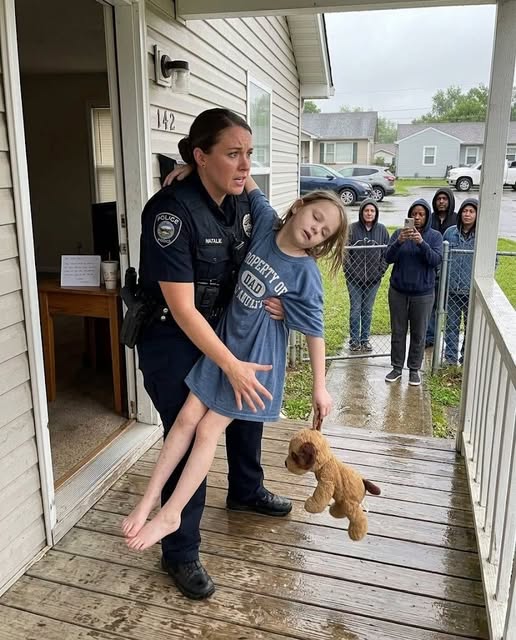
Ashley stood barefoot in an oversized gray T-shirt that reached almost to her knees. Her hair was tangled. Her lips were dry and cracked.
Clutched beneath one arm was a faded stuffed puppy with one floppy ear.
The smell inside told Natalie the rest.
Stale air.
Old soup.
Damp laundry.
A home paused in the middle of an ordinary weekend and never restarted.
Natalie stepped inside.
“Where’s your daddy, Ashley?”
“He went to get my medicine.”
“What kind?”
“For my stomach.”
On the kitchen table lay a handwritten list in large uneven letters.
RICE
CHICKEN
DRINKS WITH SALT
ASHLEY MEDICINE
Beside it was an appointment card.
MONDAY — 8:30 A.M.
DR. FELDMAN — URGENT FOLLOW-UP
Natalie studied it.
The refrigerator contained half a carton of milk, spoiled soup, mustard, two eggs.
A father planning to abandon his child did not usually schedule her medical appointment two days later.
He did not leave his work boots beside the door.
He did not leave his wallet charger plugged into the wall.
Something was wrong.
Outside, a woman’s voice drifted through the screen door.
“Poor baby. He just left her.”
Natalie turned.
The woman across the road was still recording.
Natalie’s jaw tightened.
Ashley swayed.
“Hey.”
Natalie caught her elbow.
“Are you dizzy?”
“No.”
The child’s eyelids fluttered.
“Ashley?”
“I’m just sleepy.”
Natalie lifted her.
She weighed almost nothing.
Ashley immediately buried her face against Natalie’s shoulder.
“Buddy.”
“I’ve got Buddy.”
“Promise?”
“I promise.”
Natalie reached for the stuffed animal.
Ashley’s body suddenly went slack.
“Ashley?”
No response.
“Ashley!”
Natalie dropped to one knee, holding the child against her chest while grabbing her radio.
“Dispatch, Unit Twelve. Unconscious minor, severe dehydration suspected. Start EMS now.”
Across the street, the talking stopped.
The phone recording lowered.
Natalie looked over Ashley’s limp body toward the watching neighbors.
Then she said the words that would later appear in the incident report.
“This does not look like abandonment.”
At 3:41 the next morning, a county road worker named Samuel Briggs saw a strip of blue metal beneath a wall of broken branches.
He stopped his truck.
The storm had washed away part of Mill Creek Road four nights earlier. Brown water still rushed through the ditch.
Samuel climbed down with a flashlight.
At first he thought the object was discarded sheet metal.
Then his beam found a taillight.
“Jesus.”
A pickup lay below the shoulder, nose buried in mud.
Sheriff’s deputies arrived sixteen minutes later.
Natalie came from the hospital.
The passenger window was shattered.
Inside the truck was a pharmacy bag.
Sealed.
Beside it, groceries.
Rice.
Chicken.
Electrolyte drinks.
Ashley’s prescription.
Everything on the kitchen list.
Natalie found the receipt.
Saturday.
8:14 p.m.
Thirty-six minutes after Andrew Mercer had left home.
He had gone exactly where he told his daughter he was going.
The driver’s door was jammed partly open.
Mud covered the seat.
No body.
One deputy swept his flashlight along the ditch.
“Here.”
Crushed reeds.
A smear of blood.
Footprints.
They led downstream.
They found Andrew shortly after sunrise.
He was wedged beneath the concrete lip of a drainage culvert, one hand still curled around a root.
Alive.
Barely.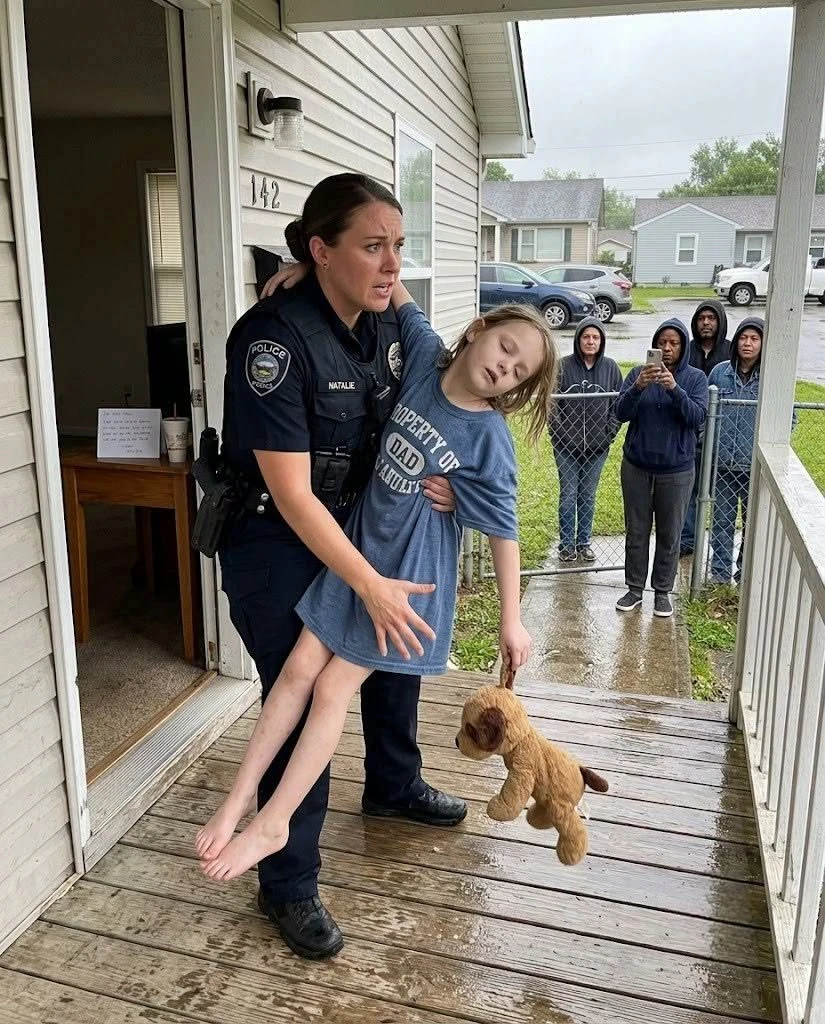
His ankle was fractured. His left shoulder was dislocated. Fever burned through him. His voice was almost gone.
The paramedic bent close.
“Andrew, can you hear me?”
His eyes opened.
He tried to sit.
Pain folded him immediately.
“My daughter.”
“Don’t move.”
“Ashley.”
“She’s safe.”
Andrew stared at him.
“What?”
“She’s in the hospital. She’s safe.”
His face crumpled.
Not dramatically.
Something quieter.
Something worse.
Four days of terror simply fell out of him.
He covered his eyes.
“I couldn’t get back.”
“We know.”
“I tried.”
“I know.”
“No, you don’t.”
Andrew seized the paramedic’s sleeve.
His cracked lips trembled.
“Tell her I was coming back.”
That afternoon, Ashley sat beneath two white hospital blankets eating dry toast in pieces no larger than postage stamps.
Buddy rested against her ribs.
Natalie entered quietly.
Ashley looked at her.
“Did you find him?”
Natalie smiled.
“Yes.”
Ashley stopped chewing.
“My daddy?”
“Yes.”
“Alive?”
“Yes.”
For one shining second, the room changed.
Ashley laughed.
It burst from her so unexpectedly that Natalie felt tears rise into her eyes.
Then the child asked:
“Is he mad at me?”
Natalie’s smile vanished.
“Why would he be mad?”
“Because I called 911.”
“Oh, sweetheart.”
Natalie moved closer.
“He is not mad.”
“I broke the stranger rule.”
“You saved yourself.”
Ashley looked uncertain.
Then whispered, “Did he buy my medicine?”
Natalie nodded.
“All of it.”
Ashley stared at Buddy.
“I knew.”
Andrew was brought upstairs that evening.
His ankle was casted. His arm rested in a sling. Bruises covered the right side of his face.
A nurse pushed his wheelchair into Ashley’s doorway.
Father and daughter saw each other.
Neither moved.
Then Ashley climbed from bed.
The IV line tugged.
Natalie caught the pole while the nurse started to protest.
Andrew opened his arms.
Ashley ran.
She hit his chest so hard his wheelchair rolled backward.
He gasped from pain and wrapped his good arm around her anyway.
“You took too long,” she sobbed.
“I know.”
“You said thirty minutes!”
“I know.”
“I waited!”
Andrew pressed his face into her hair.
“I know, baby. I know. I’m sorry.”
“You promised.”
“I did.”
“Why didn’t you come?”
His voice broke.
“The road disappeared.”
Ashley pulled back.
“What?”
“I was driving home and the road washed out. The truck went down. I couldn’t find my phone. I hurt my leg.”
“Why didn’t you walk?”
Andrew closed his eyes.
“I tried.”
“How far?”
Nobody answered.
Natalie looked away.
Andrew finally said, “As far as I could.”
Ashley touched the scrape along his cheek.
Then she climbed carefully into his lap.
“Next time,” she whispered, “take me with you.”
Andrew laughed once through his tears.
“There is never going to be a next time.”
For several minutes, even the nurses pretended they had something else to do.
It should have ended there.
A terrible accident.
A miraculous rescue.
A father exonerated.
A daughter returned to his arms.
But Natalie could not forget one thing.
Mill Creek Road was supposed to have been closed.
County records showed a closure order issued Saturday at 5:52 p.m.
Andrew’s accident occurred almost three hours later.
Barricades should have blocked both entrances.
Yet photographs taken Sunday morning showed the eastern entrance open.
Someone had moved them.
The sheriff began asking questions.
At first, nobody remembered anything.
Then a teenager came forward.
His name was Caleb Morse.
He lived across from Ashley.
“I saw someone moving the barricade,” he said.
“Who?”
Caleb hesitated.
“You’re not gonna tell them I said?”
Natalie leaned forward.
“Tell who?”
His eyes moved toward the window.
Across Willow Lane stood the woman who had filmed Ashley’s rescue.
Marlene Pike.
The loudest voice in the neighborhood.
The woman who had posted online that Andrew was a deadbeat father before Ashley had even reached the hospital.
Caleb whispered:
“Her.”
Marlene denied it.
Then investigators found her SUV on a gas-station camera near Mill Creek Road Saturday evening.
At 6:21 p.m., she had driven around the barricade to use the flooded road as a shortcut.
The barrier scraped her passenger door.
She got angry.
So she dragged it into the ditch.
“I was going to put it back,” she insisted.
“But you didn’t,” Natalie said.
“I forgot.”
“You forgot a barricade warning drivers the road was collapsing?”
Marlene began crying.
“I didn’t know.”
Andrew had reached the road two hours later.
In darkness.
In rain.
With no barrier.
No warning.
Just pavement ending beneath black water.
Marlene covered her mouth.
“I didn’t mean for anyone to get hurt.”
Natalie stared at her.
Through four days of searching?
Through four days of watching Ashley’s curtain?
Through filming the child being carried unconscious from the house?
Marlene had never mentioned the barricade.
“You called him a monster,” Natalie said quietly.
Marlene looked down.
“You told the entire neighborhood he deserted her.”
“I thought he had.”
“No.”
Natalie’s voice hardened.
“You needed him to have.”
Because if Andrew was cruel, then Marlene did not have to wonder whether the barricade she had dragged aside was the reason a seven-year-old had spent four nights whispering goodnight to an empty house.
Andrew refused interviews.
He did not care about becoming the innocent father in a viral redemption story.
He cared about getting Ashley home.
Two weeks later, he returned to the little rental house on crutches.
The neighbors avoided their windows.
Marlene’s house stood dark.
Ashley walked beside him holding Buddy.
When they reached the porch, she froze.
“What’s wrong?” Andrew asked.
Ashley pointed inside.
The kitchen table.
The grocery note still lay where Natalie had found it.
Andrew entered slowly.
He picked it up.
Ashley had written it the Friday before everything happened because he had let her practice spelling.
RICE.
CHIKEN.
MEDSIN.
DRINKS.
At the bottom, in smaller handwriting, was something Natalie’s photographs had cut off.
Andrew had never noticed it.
Neither had the deputies.
Neither had Ashley remembered writing it.
DADDY SNACK.
Andrew stared.
Ashley frowned.
“You didn’t get your snack.”
He laughed softly.
“No.”
“You forgot.”
“I guess I did.”
She took the paper.
“No, Daddy.”
“What?”
“You didn’t forget.”
Her finger touched the grocery list.
“You got everything for me.”
Andrew could not speak.
Ashley looked up.
“You always forget your stuff.”
Something inside him collapsed.
He sat heavily in the kitchen chair and covered his face.
Ashley climbed onto his good knee.
“I’m not mad anymore.”
“You’re allowed to be.”
“I was.”
“I know.”
“I thought…”
She stopped.
Andrew lowered his hands.
“What?”
Her eyes filled.
“I thought maybe you got tired of me being sick.”
His breath disappeared.
“Ashley—”
“Because medicine costs money. And you work a lot. And Mrs. Pike said once that kids are expensive.”
Andrew went perfectly still.
“Mrs. Pike said that to you?”
“She said you looked tired.”
Andrew pulled her close.
“Listen to me.”
She stared at him.
“You could need a hundred medicines. You could need a thousand doctors. You could wake me every night for the rest of my life.”
His voice shook.
“There is nowhere on this earth I would rather be than coming home to you.”
Ashley nodded as if accepting something she had desperately needed proof of.
Then she pressed the grocery note against his chest.
“Okay.”
Three months later, Andrew attended the county hearing about the road failure.
Marlene pleaded guilty to interfering with a traffic-control device and reckless endangerment.
But another fact emerged.
The barricade was only part of what had happened.
Investigators recovered Andrew’s phone after the truck was drained.
It no longer worked.
A technician managed to extract partial data.
There were seventeen failed emergency call attempts from Saturday night.
Then eleven more Sunday morning.
But one file remained intact.
A voice recording.
Timestamp:
Sunday, 4:37 a.m.
Natalie brought Andrew into a private office before the hearing.
“You should hear this first.”
“What is it?”
She placed the recovered audio device on the table.
Andrew listened.
Wind roared through the microphone.
Water rushed nearby.
Then came a man’s ragged breathing.
His own.
He had no memory of recording it.
The voice said:
“If somebody finds this… my name is Andrew Mercer.”
A long groan.
“My daughter’s home alone. Ashley. Seven years old.”
Breathing.
“Willow Lane. Number fourteen.”
Another pause.
Then:
“She’s sick. Medicine’s in my truck. Please get to her.”
Andrew closed his eyes.
The recording continued.
“If you find her before me…”
His past self began to cry.
Andrew gripped the table.
“Tell her Daddy didn’t leave.”
Natalie looked down.
Then came the final words.
Barely audible.
“I’m coming, baby.”
The recording ended.
Andrew sat frozen.
Natalie reached to stop the playback.
“Wait.”
“There’s nothing else.”
“Play the last second again.”
She did.
Static.
Rain.
A scraping sound.
Then something faint.
Three soft taps.
Andrew’s face changed.
“What?”
He pointed.
“Again.”
Three taps.
Natalie replayed it.
Andrew whispered, “That was me.”
“How do you know?”
His eyes filled.
“When Ashley was little, she used to get scared when I closed her bedroom door at night.”
He tapped the table.
Three times.
“So I taught her that. Three knocks.”
“What did it mean?”
Andrew smiled through tears.
“Daddy’s still here.”
That night, he returned home after Ashley was asleep.
He paused outside her bedroom.
The house was dark.
Quiet.
Ordinary again.
The most beautiful thing he had ever heard.
He tapped the door three times.
Tap.
Tap.
Tap.
For a moment, nothing happened.
Then, from the darkness on the other side, came three sleepy little taps in return.
Andrew rested his forehead against the door.
He had survived four nights in freezing water believing his daughter might think he had chosen not to come home.
Ashley had survived four nights in an empty house believing every passing pair of headlights might be him.
The town had needed a villain.
The truth had given them something harder.
A careless woman.
A broken road.
A thousand judgments made from warm living rooms.
And a father dragging a shattered ankle through mud because somewhere beyond the rain, a seven-year-old girl was waiting for a promise to walk through the door.
Andrew opened Ashley’s room.
She was asleep with Buddy beneath her chin.
He pulled the blanket over her shoulder.
Then he noticed something on the nightstand.
The old grocery note.
Ashley had placed it inside a cheap plastic picture frame.
Beneath the list, in purple crayon, she had added one new line.
DADDY CAME HOME.
Andrew sat beside her until dawn.
And when the first pale light entered the room, Ashley’s hand found his in her sleep and tightened around his fingers, as if some part of her still needed to make certain that this time, thirty minutes would never become four days again.