Marcus smiled as he placed the soup in front of me, and that frightened me more than any argument ever had.
“Your favorite,” he said, sliding the bowl across the dining table in our Lincoln Park kitchen. “You’ve seemed exhausted lately. I thought something comforting might help.”
His voice held the softness he used when other people were watching.
Except no one was watching.
At least, that was what he believed.
His shirtsleeves were rolled neatly to his elbows. Beyond the tall windows, Chicago glittered beneath a cold October sky, the glass towers catching the last amber light of evening. A train groaned somewhere beyond the neighborhood. The refrigerator hummed. Steam curled from the creamy mushroom soup between us.
Everything looked ordinary.
Domestic.
Safe.
But I had seen his hand.
A minute earlier, while he thought I was reaching for my napkin, Marcus had slipped a tiny glass vial from his trouser pocket.
He tilted it over my bowl.
Three drops.
Clear.
Silent.
Then the vial disappeared.
My husband had put something in my dinner.
And now he was watching me with the patient expression of a man waiting for a door to open.
“Eat,” he said.
I lifted my spoon.
My hand looked steady.
Inside, I was screaming.
For weeks, I had been sick.
It began with nausea in the mornings. Then came the stomach cramps, the dizziness, the exhaustion so deep that I occasionally sat inside my car in the hotel garage because I lacked the strength to walk to the elevator.
My wedding ring loosened around my finger.
My cheekbones sharpened.
Dark strands of hair appeared on my pillow.
Marcus noticed everything.
Or pretended to.
“You work too much, Victoria.”
“You need rest.”
“You can’t keep flying between Chicago, Miami, and Los Angeles.”
He rubbed my shoulders.
Brought me tea.
Cooked more often.
And asked questions.
So many questions.
“What happens to the hotels if you become incapacitated?”
“Who has signing authority on the Miami accounts?”
“Does the life-insurance policy still list me?”
At first, I told myself that married people discussed such things.
Then I came home early one Thursday.
My sister Sophia was sitting beside Marcus on our sofa.
Too close.
His knee between hers.
Her hand resting against his chest.
They moved apart when they heard the door.
“Family conversation,” Marcus said brightly.
Sophia stared at the carpet.
That night, after Marcus fell asleep, I checked the browser history on our home computer.
Search after search made my hands colder.
Symptoms of chronic poisoning.
Substances difficult to detect after death.
Life-insurance contestability.
Spousal inheritance.
How stress-related cardiac death appears in women under forty.
I printed everything.
Then I bought cameras.
One went behind the coffee tins in the kitchen.
One beneath a shelf in Marcus’s basement workshop.
One behind our wedding photograph in the living room.
For three days, nothing happened.
On the fourth, during a quarterly financial review at my office in Willis Tower, my phone vibrated.
Motion detected.
Living room.
I opened the feed.
Marcus sat beside Sophia.
His hand covered hers.
“How much longer?” she asked.
Marcus kissed her fingers.
“Tuesday.”
My breath stopped.
“One final dose at dinner. Afterward, everyone will believe the pressure finally killed her.”
Sophia leaned back and smiled.
My own sister smiled.
“Once she’s gone,” she whispered, “we get the hotels.”
I remember looking through the conference-room windows at Lake Michigan and thinking how absurdly blue the water looked.
People were walking along Wacker Drive.
Cars stopped at lights.
A woman in the building across from mine watered a plant.
And the two people I loved most were discussing my death.
Marcus showed Sophia documents on his phone.
Altered beneficiary forms.
Forged signatures.
Draft transfer agreements.
Everything designed to make my company pass into a trust controlled by Sophia while Marcus inherited personally from my estate.
They kissed before the recording ended.
I watched that part twice.
Not because I wanted to.
Because some pain is too large for the mind to accept the first time.
Then I spent five days pretending.
I smiled at Marcus.
I hugged Sophia.
I drank coffee only after secretly pouring it away.
I hid food in napkins.
At night, I lay beside my husband listening to him breathe and remembered the first apartment we shared, when we had slept on a mattress on the floor because I had put every spare dollar into opening my first hotel.
Back then, Marcus had held me and whispered, “One day everyone will know your name.”
I believed he meant it as love.
Now I wondered whether he had always been waiting for the day my name became valuable enough to inherit.
Tuesday arrived.
And the soup appeared.
Then Marcus’s phone rang.
He glanced at the screen.
“I need to take this.”
He stepped into the living room.
The instant he disappeared, I switched the bowls.
Porcelain clicked against wood.
My heart slammed against my ribs.
For one terrible second, Marcus stopped speaking in the next room.
I froze.
Then his voice resumed.
I positioned the bowls.
Folded my napkin.
Waited.
Marcus returned smiling.
“Sorry.”
“Work?”
“Always.”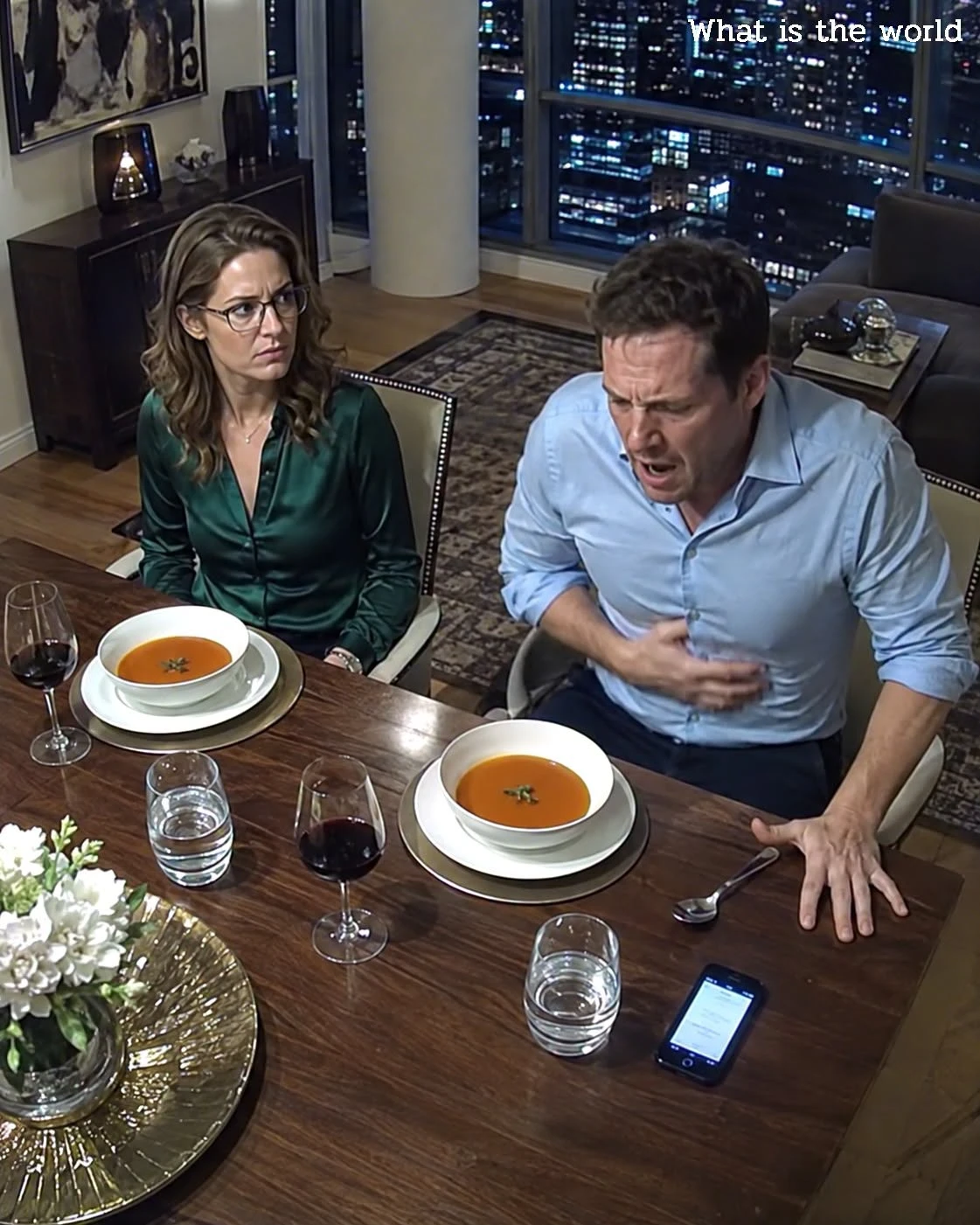
He sat.
We began eating.
I took one spoonful.
Then another.
Marcus watched me.
“This is wonderful,” I said.
His eyes brightened.
“Anything for my beautiful wife.”
Twenty-three minutes later, his spoon fell from his hand.
It struck the bowl with a metallic clatter.
Marcus went pale.
One hand grabbed the table.
The other pressed against his stomach.
“Victoria.”
I said nothing.
His breathing quickened.
“Something’s wrong.”
His phone illuminated on the counter.
A message appeared.
Sophia.
Is it done?
Marcus saw me looking at it.
Then he looked at his bowl.
Then mine.
Understanding reached his face slowly.
“No.”
I had imagined this moment for five days.
I thought I would feel triumphant.
I felt sick.
Marcus pushed himself upright.
His knees buckled.
“You switched them.”
His voice was barely audible.
I stared at him.
“You put something in my food.”
His face twisted.
“You don’t understand.”
“I understand perfectly.”
“No, Victoria.”
He staggered toward me.
I backed away.
“Don’t touch me.”
He stopped.
His eyes filled with something I had never seen in them before.
Not guilt.
Fear.
Pure, animal fear.
“Call an ambulance.”
I already had.
But not for the reason he believed.
I had contacted Detective Elaine Porter that afternoon and given her copies of the recordings, browser history, forged documents, and laboratory results from blood samples I had quietly obtained through a private physician.
She told me not to confront Marcus.
I had promised I wouldn’t.
Then I saw the vial.
And instinct took control.
Now sirens grew louder outside.
Marcus collapsed against the dining chair.
“You have to tell them what happened.”
“I will.”
“No.” He grabbed my wrist. “Tell them it was an accident.”
I pulled free.
“Was mine supposed to be?”
His mouth opened.
Nothing came out.
The front door burst inward moments later.
Paramedics entered first.
Police followed.
Marcus was placed on the floor, oxygen fitted across his face while an officer collected both bowls.
Detective Porter walked directly toward me.
“You switched them?”
I nodded.
She closed her eyes briefly.
“Victoria.”
“He was going to kill me.”
“I know.”
Those two words should have comforted me.
They didn’t.
Because then Porter looked toward Marcus.
And her expression changed.
“Get toxicology on that immediately,” she told an officer.
Marcus was loaded onto a stretcher.
As they carried him through the doorway, he looked at me.
Not angrily.
Desperately.
“Check the basement,” he rasped.
Porter leaned toward him.
“What?”
“The basement.”
His eyes found mine.
“Behind the furnace.”
Then he disappeared.
Sophia arrived eleven minutes later.
I never learned whether she came because Marcus stopped answering or because she intended to celebrate.
She walked into the kitchen wearing a camel coat and froze when she saw police.
“Victoria?”
Her face emptied.
Detective Porter intercepted her.
“Sophia Bennett?”
“What happened?”
“We’d like you to come with us.”
Sophia looked at me.
That was when I saw it.
Not grief.
Calculation.
“You told them?”
Her voice cracked.
I stepped closer.
“I heard everything.”
She shook her head.
“You don’t know everything.”
Marcus had said the same thing.
Maybe murderers said that when the walls finally closed in.
Or maybe—
A shout came from downstairs.
One officer appeared at the basement door carrying a metal lockbox.
Porter took it.
Inside were photographs.
Documents.
Medical reports.
And letters.
Dozens of letters.
All addressed to Marcus.
All written by Sophia.
Porter opened the first.
I watched her eyes move across the page.
Then she looked at me.
“Victoria, you need to see this.”
Sophia lunged.
“Don’t.”
Two officers restrained her.
Porter handed me the letter.
The handwriting was unmistakably Sophia’s.
Marcus, she still doesn’t remember. The doctors were right. Whatever happened after the crash is completely gone.
I read the sentence twice.
“What crash?”
Nobody answered.
I turned the page.
If she finds out what Dad did, she’ll never forgive us. Keep her away from the old accounts. Especially Harbor National.
I looked at Sophia.
“What does this mean?”
She started crying.
Not delicate tears.
Her whole face collapsed.
“Tell her,” Marcus’s voice said from nowhere.
No.
Not Marcus.
A recording.
One of the officers had activated a small digital recorder found inside the lockbox.
Marcus’s voice filled the kitchen.
“If Victoria ever finds this, then everything has already gone wrong.”
I sat down.
The room felt tilted.
“Fifteen years ago,” the recording continued, “Victoria didn’t build the first hotel with a modest family loan like she believes.”
My stomach tightened.
“She inherited the money.”
Sophia whispered, “Turn it off.”
Porter ignored her.
“Her mother left it to her. Eight hundred and forty thousand dollars.”
My mother had died when I was twenty-one.
A car accident.
My father told us there had been no significant estate.
“Victoria’s father redirected the inheritance through Sophia’s account. When Victoria discovered it, there was a confrontation.”
My hands began shaking.
Images flashed.
Rain.
Headlights.
Sophia screaming.
Glass.
Then nothing.
“The crash happened that night,” Marcus said on the recording. “Victoria suffered a head injury and lost several months of memory. Her father convinced her the hotel money had been a loan he arranged. Sophia helped him maintain the lie.”
I stared at my sister.
“You knew?”
She covered her mouth.
“We were young.”
“You knew?”
“Yes.”
The word broke something open inside me.
Marcus continued.
“Years later, I discovered the original banking records. I confronted Sophia. She begged me not to tell Victoria.”
Porter paused the recording.
Silence filled the kitchen.
I felt as though I had been dropped into somebody else’s life.
“So Marcus knew?”
“Yes,” Sophia whispered.
“Then why was he poisoning me?”
She looked at me.
And laughed.
It was a broken sound.
“He wasn’t.”
I almost slapped her.
“I watched him pour it into my soup.”
“The vial wasn’t poison.”
Porter immediately turned toward the forensic officer.
“What was it?”
“We don’t know yet.”
Sophia closed her eyes.
“It was a sedative.”
I stared at her.
“Why?”
She shook her head.
“Because you were starting to remember.”
The kitchen disappeared around me.
Sophia told the story in fragments.
My recent nausea had not begun because Marcus was poisoning me.
It had begun six weeks earlier, after I changed medications for migraines.
A specialist had warned Marcus that certain side effects, combined with stress, could trigger recovery of old traumatic memories.
I had started mentioning things.
A highway.
My mother’s bank.
My father shouting.
Sophia panicked.
She had far more to lose than shame.
After our father died, she had inherited several properties purchased with money stolen from my mother’s estate.
If I remembered and investigated, everything could unravel.
So Sophia created the searches.
Sophia altered the browser history.
Sophia forged documents.
And Sophia persuaded Marcus that I was becoming psychologically unstable.
“I told him you were having episodes,” she said. “That you’d threatened me.”
“You were on camera planning my death.”
Her face hardened.
“No. I knew about your cameras.”
I stopped breathing.
“I saw you install the one in the living room. I told Marcus we should frighten you into going to a psychiatric facility before your memories came back.”
Porter’s voice sharpened.
“So the recorded murder conversation was staged?”
Sophia nodded.
“Mostly.”
Mostly.
The word hung in the room.
“What does that mean?” I asked.
Sophia looked away.
Porter restarted Marcus’s recording.
His voice returned.
“I agreed to Sophia’s plan because I thought Victoria was in danger from herself. That is the truth I told myself.”
A pause.
“But three weeks ago, Sophia asked me what would happen financially if Victoria died.”
My sister went motionless.
“I realized she wasn’t pretending anymore.”
Porter stared at her.
Marcus continued.
“I began documenting everything. The forged beneficiaries. The transfers. Sophia’s messages. Tonight I planned to sedate Victoria just enough to keep her home while I met Detective Porter.”
I turned toward Porter.
She nodded slowly.
“He contacted me yesterday.”
My knees weakened.
Marcus had been trying to expose Sophia.
The soup had contained a sedative.
Not a lethal poison.
But then why had he collapsed?
The answer arrived from the paramedic standing near the doorway.
“Detective?”
Everyone turned.
“We received preliminary field results.”
Porter stepped forward.
The paramedic’s face was grim.
“The bowl Mr. Hale consumed contained a toxic cardiac medication at a potentially lethal concentration.”
Sophia stopped breathing.
I did too.
Porter looked at me.
“You said you switched the bowls?”
“Yes.”
“Then the toxin was originally intended for you.”
Marcus had added the sedative.
Someone else had added the poison.
Sophia whispered, “No.”
Every eye moved toward her.
Her legs gave way.
She sat hard against the wall.
“No.”
Porter crouched.
“Sophia.”
“I didn’t know he was going to switch anything.”
“What did you put in the soup?”
Sophia stared at the floor.
Then she began to sob.
Not because she was innocent.
Because she finally understood what she had done.
She had arrived earlier that afternoon while Marcus was grocery shopping.
She still knew the security code.
She entered the kitchen.
Found the pot he had prepared.
And added crushed medication.
Enough to stop my heart.
Marcus returned later, unaware, and ladled the soup into bowls.
Then he added his sedative to mine.
I had switched the bowls believing I was saving myself from my husband, only to send my sister’s poison into the one person who had finally decided to save me from her.
I ran.
Barefoot.
Down the front steps.
Into the cold Chicago night.
The ambulance had not yet left.
“Marcus!”
A paramedic tried to stop me.
I climbed inside anyway.
Marcus lay beneath white blankets, skin gray, monitors screaming around him.
His eyes opened when he heard me.
“I know,” I said.
He stared at me.
“I know everything.”
His fingers moved.
I took his hand.
“I thought you were killing me.”
His lips trembled.
“I should’ve told you.”
“You should have.”
“I was scared you’d remember the crash.”
“Why?”
His eyes filled.
“Because I was there.”
I froze.
“What?”
Marcus struggled for breath.
“I knew Sophia before I knew you.”
The monitor chirped rapidly.
“We dated,” he whispered. “Years ago.”
I felt the world split again.
“She introduced me to you after your accident. Told me never to mention it.”
His fingers tightened weakly around mine.
“I fell in love with you anyway.”
The paramedic shouted for space.
Marcus kept talking.
“I spent five years trying to convince myself the past didn’t matter.”
Tears blurred my vision.
“You lied to me every day.”
“Yes.”
“Did you marry me because of Sophia?”
“No.”
“Because of the hotels?”
“No.”
“Then why?”
His eyes held mine.
For the first time in weeks, I saw the man I remembered.
Not the stranger.
Not the liar.
The complicated, frightened man who had loved me badly because he had been too cowardly to love me truthfully.
“Because when you laughed,” he whispered, “I forgot what kind of person I had been.”
His heart monitor screamed.
Someone pulled me away.
The ambulance doors slammed.
Sophia was arrested that night.
Marcus survived the poisoning, but barely.
He spent nine days in intensive care.
I visited once.
Only once.
He apologized for the staged conversations, the sedative, the years of silence.
I believed parts of his apology.
That was the hardest thing.
Because betrayal would have been simpler if he had never loved me.
But he had.
Marcus loved me.
Sophia loved me too, in whatever damaged way jealousy permits love to survive.
My father had once loved me.
None of it had prevented them from lying.
I filed for divorce from Marcus before he left the hospital.
Then I hired a forensic accountant.
The investigation into my mother’s estate took seven months.
Harbor National still had archived records.
My mother had left handwritten instructions specifying that her money was meant to give both daughters independence.
My father stole mine.
Sophia accepted part of it.
The first hotel I had spent fifteen years believing represented my own impossible courage had actually begun with my mother reaching through death to give me a future.
At first, that knowledge devastated me.
I stood alone in the lobby one evening after closing, staring at the brass plaque bearing my company name, and wondered how much of my life belonged to someone else.
Then I remembered what the money had purchased.
Not the hotel.
Only the chance.
I had renovated the rooms.
I had negotiated the leases.
I had slept behind the reception desk when the boiler failed.
I had cleaned bathrooms when employees called in sick.
I had flown economy overnight to Miami, signed contracts at dawn, and returned to Chicago before anyone knew I had left.
My mother gave me the seed.
I grew the forest.
Sophia eventually accepted a plea agreement.
Twelve years.
Marcus cooperated fully.
He surrendered every financial claim he might have had in the divorce.
Before signing the final papers, he sent me one letter.
I nearly threw it away.
Instead, I opened it.
There were only four sentences.
You deserved the truth before you deserved my love.
I gave you the second and withheld the first.
I understand now that one cannot survive without the other.
I am sorry.
I folded the letter.
Put it inside a drawer.
And closed it.
A year after that dinner, I reopened our first hotel after a complete renovation.
In the lobby, beneath warm pendant lights and the soft murmur of arriving guests, I installed a small bronze plaque.
Not my company name.
Not mine at all.
It read:
ELEANOR BENNETT
SHE GAVE HER DAUGHTER A BEGINNING.
On opening night, I stood alone before it after everyone had gone upstairs.
Rain traced silver lines down the windows.
Chicago glowed outside.
For a moment, I remembered the bowl of soup.
Marcus’s frightened eyes.
Sophia’s message.
My father’s lies.
My mother’s hidden gift.
All those people who had tried to decide what I was allowed to know about my own life.
Then I placed my fingertips against my mother’s name.
And smiled.
Because after forty years of people rewriting my story for me, I had finally become the only person holding the pen.